Fake Banner
A Great Year For Experiment Design

While 2025 will arguably not be remembered as a very positive year for humankind, for many reasons...

Living At The Polar Circle

Since 2022, when I got invited for a keynote talk at a Deep Learning school, I have been visiting...

Conferences Good And Bad, In A Profit-Driven Society

Nowadays researchers and scholars of all ages and specialization find themselves struggling with...
USERN: 10 Years Of Non-Profit Action Supporting Science Education And Research

The 10th congress of the USERN organization was held on November 8-10 in Campinas, Brazil. Some...

User picture.
picture for Hank Campbellpicture for Patrick Lockerbypicture for Heidi Hendersonpicture for Bente Lilja Byepicture for Sascha Vongehrpicture for Johannes Koelman
Tommaso DorigoRSS Feed of this column.

Tommaso Dorigo is an experimental particle physicist, who works for the INFN at the University of Padova, and collaborates with the CMS and the SWGO experiments. He is the president of the Read More »

Blogroll
When I was five years old I used to be sort of an attraction to relatives. One of my mother's brothers is an engineer, and he was amazed by my ability to do complex calculations by heart. But to me it was only amusing to observe their amazement for what I considered a triviality.

On one occasion - I remember it as it was yesterday - my uncle picked me up and while he kept me with his arms he asked me "Ok, let's see this. Tommaso, what is the square root of 5968?". Mind you, I do not remember the exact number; I only recall it was between 5000 and 7000. I watched up into the void for two seconds, and I replied "77.3". Uncle Ciccio put me down and ran for the pocket calculator - he did have one, although they were a real novelty those years.
The Cornell arxiv is known to not accept preprints without a minimal screening of their contents. Still, I am sometimes led to wonder if a similar attention is paid to the liberty that authors at times take with the titles of their papers.

I am officially on vacation since yesterday, so you should not expect the list below to be a very comprehensive one. I just offer four examples of titles that might have been considered for some form of moral suasion toward the author by the arxiv managers, but apparently haven't. I just quote some titles below which struck me as kind of odd.
"Hell, if I could explain it to the average person, it wouldn't have been worth the Nobel prize. "

R. Feynman, People magazine, 1985

I sure cannot disagree more with Dick than on the above sentence !
The muon is a remarkable particle, and its characteristics continue to be of interest eighty years after its discovery despite the fact that we have measured them better than almost anything else around. So, for instance, the muon lifetime is known to better accuracy than that of any other unstable particle; and the muon anomalous magnetic moment remains at the top of our list of things to determine more precisely nowadays.
One and a half years ago ATLAS produced measurements for the Higgs boson mass using their selected sample of H->gamma gamma and H->ZZ*-> 4-lepton decay candidates, based on data collected in 2011 and 2012. That preliminary measurement was rather surprising as the two independent determinations appeared to disagree with one another at the 2.5-sigma level. The matter even spurred some online debate (see e.g. my blog entry) and a few gambling addicts waged $100 on the fact that those might be two distinct particle states.
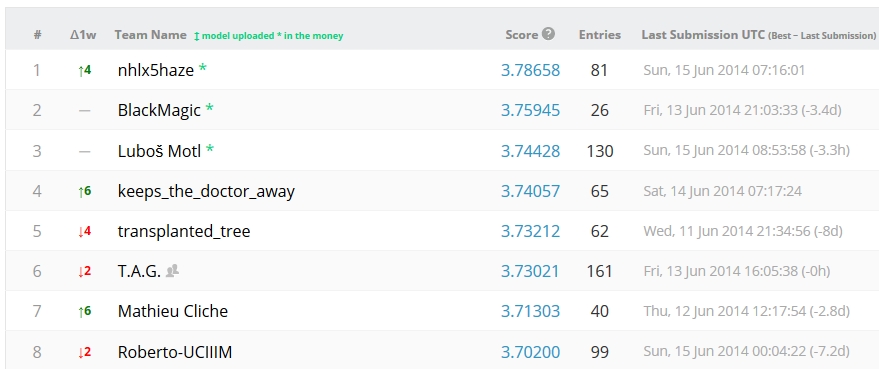
With still three months to go and 663 teams participating, the Higgs challenge has not even entered a hot phase yet, and still there is a lot to watch in the leaderboard at the kaggle site.
In the last few days, there has been a total revolution in the leading position, and a considerable increase in the best scores. And Lubos Motl is again third (and he would be first if there had been no movement in the other positions), implicitly answering some detractors who wrote comments in a previous post on the matter here. See the standings below.