Fake Banner
A Great Year For Experiment Design

While 2025 will arguably not be remembered as a very positive year for humankind, for many reasons...
Living At The Polar Circle

Since 2022, when I got invited for a keynote talk at a Deep Learning school, I have been visiting...

Conferences Good And Bad, In A Profit-Driven Society

Nowadays researchers and scholars of all ages and specialization find themselves struggling with...
USERN: 10 Years Of Non-Profit Action Supporting Science Education And Research

The 10th congress of the USERN organization was held on November 8-10 in Campinas, Brazil. Some...

User picture.
picture for Hank Campbellpicture for Patrick Lockerbypicture for Heidi Hendersonpicture for Bente Lilja Byepicture for Sascha Vongehrpicture for Johannes Koelman
Tommaso DorigoRSS Feed of this column.

Tommaso Dorigo is an experimental particle physicist, who works for the INFN at the University of Padova, and collaborates with the CMS and the SWGO experiments. He is the president of the Read More »

Blogroll
Tomorrow I will be packing up and leaving CERN to fly back home, after a quite eventful, productive, extenuating, exhilarating week. The reason for my coming to Geneva was the CMS week, an event that takes place four times a year, and where a good fraction of the members of our 2400-strong collaboration gather to listen to updates of the experiment, the detector, the analyses, and to discuss rules, appointments, organizational issues.
Ok, now it is public, so I can also broadcast it: LHC last night got the two proton beams to collide at 2.36 TeV total center of mass energy. You can see a few event displays here:

http://atlas.web.cern.ch/Atlas/public/EVTDISPLAY/events.html  (from ATLAS),

http://lhcb-public.web.cern.ch/lhcb-public/en/Collaboration/LHCbEvDis.html (from LHCB).

I am still waiting for some public info from CMS... Stay posted for more colorful event displays!
Well, as you know I cannot say anything about internal matters of the CMS experiment at the LHC, but I know that other sites will have information pretty soon on the matter. So my advice for tonight is to browse the web, and possibly the site of less discreet bloggers than myself. The CERN twitter feed might also be a good idea... All I can say is that LHC is working like a charm these days!
One of the cool things I have learned to do, through years of experience in data analysis at particle colliders, is to visualize the complex kinematics of a signal process in a multi-dimensional space, and imagine ways to separate it from backgrounds by selecting in the hyperspace the signal-rich region. I came across a very simple example of the above rather abstract statement yesterday, and I wish to share it with you.

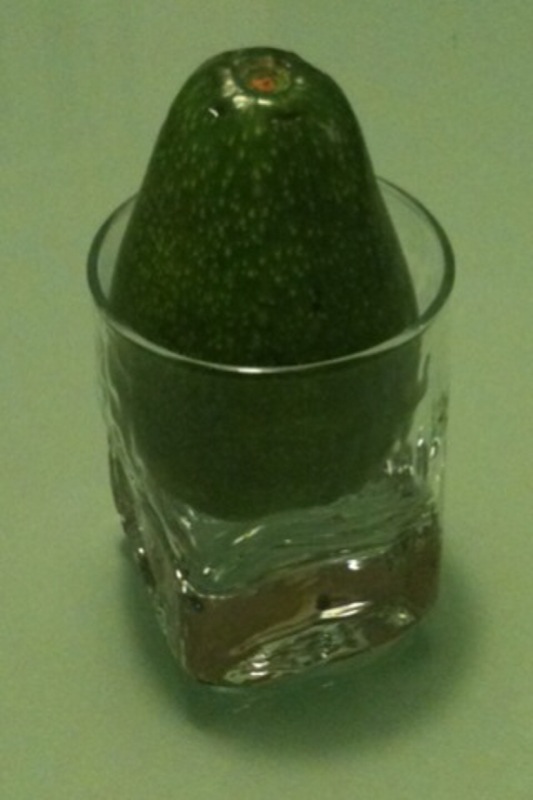
To help you visualize what I am going to discuss, here is the example: an avocado in a square tumbler. The avocado is top pair production, and the glass is Z plus b-antib production.

... Confused ? Let me explain.
The verdict is out: Amanda Knox and Raffaele Sollecito killed Meredith Kercher.

The murder of the young British student in Perugia two years ago was a highly disputed case, and the proof of guilt of the two young lovers -a US citizen studying in Perugia and her boyfriend- appears largely based on indicia, and not on the more solid ground one usually expects for a conviction in similar instances.
I do not know about you, but top quarks fascinate me. Since my early years as a student in particle physics I participated in the top search, and then the top discovery, with the CDF experiment at the Tevatron collider; and I then worked for many more years with top quark samples. And that particle is fascinating for many different reasons: its phenomenology, the richness of its decays, its mass close to the scale of electroweak symmetry breaking.

I feel honored by having had a chance to study the first few tens of top quark events that physicists have been able to produce, and yet I regret that during the last few years I have been unable to put my hands on the much larger datasets collected by the CDF experiment.