Fake Banner
A Great Year For Experiment Design

While 2025 will arguably not be remembered as a very positive year for humankind, for many reasons...

Living At The Polar Circle

Since 2022, when I got invited for a keynote talk at a Deep Learning school, I have been visiting...

Conferences Good And Bad, In A Profit-Driven Society

Nowadays researchers and scholars of all ages and specialization find themselves struggling with...
USERN: 10 Years Of Non-Profit Action Supporting Science Education And Research

The 10th congress of the USERN organization was held on November 8-10 in Campinas, Brazil. Some...

User picture.
picture for Hank Campbellpicture for Patrick Lockerbypicture for Heidi Hendersonpicture for Bente Lilja Byepicture for Sascha Vongehrpicture for Johannes Koelman
Tommaso DorigoRSS Feed of this column.

Tommaso Dorigo is an experimental particle physicist, who works for the INFN at the University of Padova, and collaborates with the CMS and the SWGO experiments. He is the president of the Read More »

Blogroll
Being a graduate student in particle physics is a tough, stressful job. I know it because I once was one, and I still remember the burden of giving exams, carrying on single-handedly a difficult analysis, and desperately struggling to learn the job of particle physicist, all the while trying to prove my worth to my colleagues. On the personal side, further trouble compounds the situation: one is usually fighting with tight money, stranded away from her family and boyfriend, and finds herself in the company of people whose similar priorities make the otherwise natural impulse of "having fun whenever possible" the last of their thoughts.

Particle Physics had a short fling with Numerology in its young years, but the two have never met again since then.

TD

It happens in the best families, so they say. Two experiments work 24/7 to produce an improved result on the Higgs search, and the result is disappointing, to say the least.

I am talking about the Tevatron, of course. For a little while longer, CDF and D0 will have the exclusive on Higgs boson searches. Last March, we all rejoyced when we saw that the Tevatron was starting to become sensitive to a high-mass Higgs, and indeed it excluded its existence in a range of masses between 160 and 170 GeV. We were waiting for more exclusions for the winter conferences of 2010, when more data would be used to produce improved results. Instead, no improvement, but actually, a retractatio. How is that possible ??

I recently discussed here the Tevatron results of searches for new Z bosons in electron-positron or dimuon samples collected by CDF and DZERO, pointing out that there seem to be a couple of intriguing upward fluctuations in the data. One of the dielectron fluctuations sits at a mass of 240 GeV, the other, also in the dielectron spectrum, is at about 720 GeV. Neither is compelling.
Today CNN features a short video with an interview to Professor Nielsen, the mastermind behind the whole "Higgs comes back from the future to prevent its own creation" crap.  I wrote about the matter a couple of times in the past, and will not reiterate here that I think his suggestions to pull out cards from a deck to decide whether to carry on basic research with the LHC is a unmitigated pile of you know what.
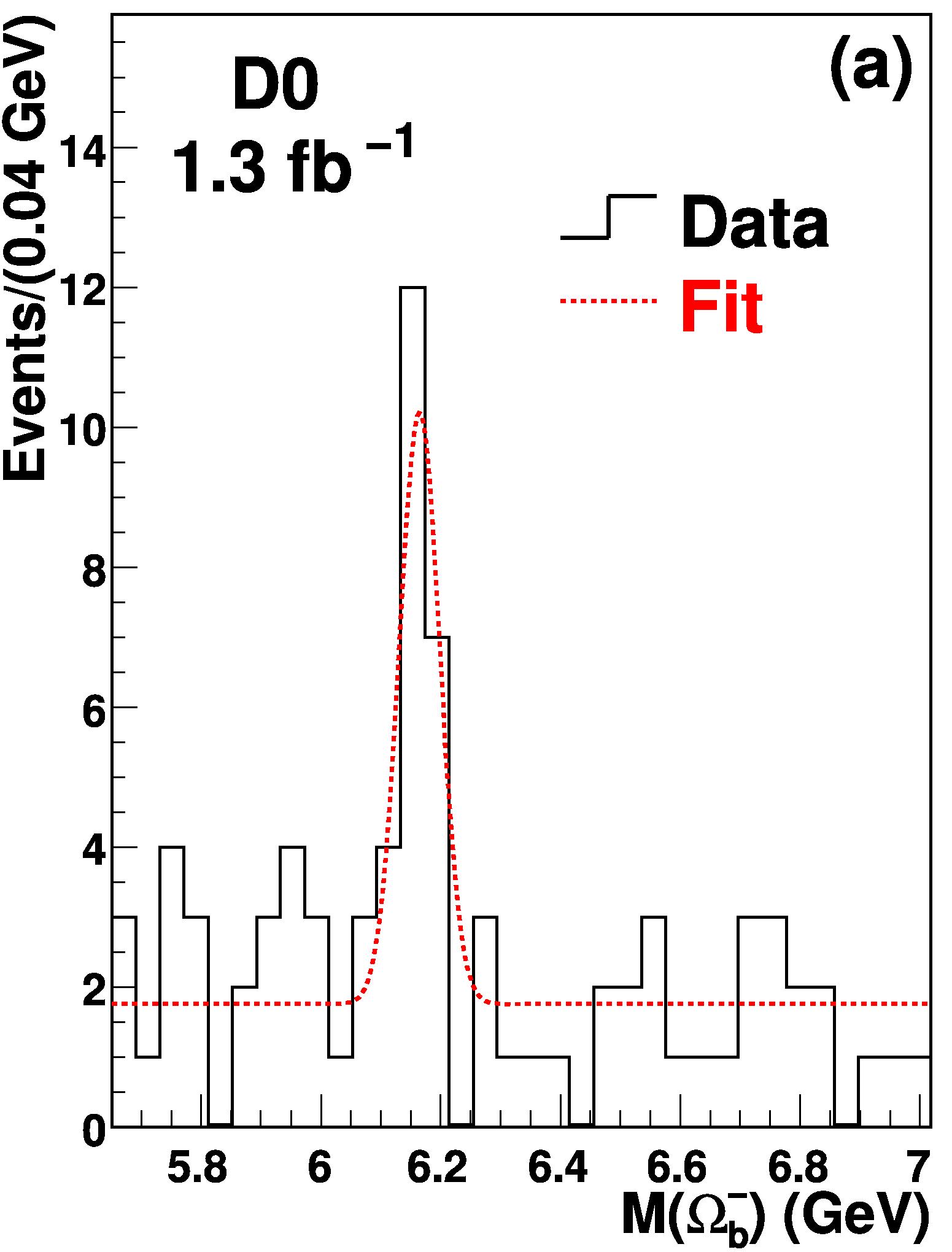
Last May the CDF collaboration published their observation of the  baryon, a particle made by a very exotic "bss" quark triplet. The CDF result came almost one year after a similar measurement was published by the competitor experiment, D0.