The Daytime Astronomer

antunes

antunes

Read more about the strange modern world of a day laborer in astronomy, plus extra space science-y goodness.
RSS Feed
Open Notebook Astronomy

Open Notebook Astronomy

Is the author of 'open notebook astronomy' an idiot?  Over at 365DOA, there is a full article on open notebook astronomy.  What is open notebook?  Making your data and your work visible, rather than only presenting the subset you find personally relevant.How does this help science?  Well, I could re-imagine the above article, but without openness.  Instead, I just present the parts that I think are relevant to my argument that the author of open notebook astronomy is, indeed, an idiot.

Aspergers Rule Processing

Aspergers Rule Processing

The issue at hand: a student with Asperger's Syndrome feels the teacher withholds recess breaks at a whim; the teacher feels that withholding recess is reinforcing the consequences of the student's actions.  From their personal viewpoints, each of them is correct.  Clearly, there is bad communication or signaling going on here.Note I use the shorthand 'Aspie' for 'someone with Asperger's syndrome', itself either a form of high-functioning autism, or a related pervasive developmental disorder (PDD), and the term 'neurotypical' to describe someone who does not have Asperger's.On Rules Processing

Zombies: The Safer Terrorists

Zombies: The Safer Terrorists

How can you test for disaster without freaking out all your co-workers?  Assume the best way to test for a disaster is to simulate it.  Now factor in that a typical co-worker, if they overhead that a chlorine tanker overturned in DC or that terrorists are storming the building, will likely freak out.  Is there a safe way to simulate an emergency?

Scientists Want More Children

Scientists Want More Children

Scientists want more children.  Seriously, that's not my headline, that's the conclusion reached by Ecklund and Lincoln back in August in the online PLos ONE journal.  Put simply, science as a career is not very kid-friendly, so older scientists feel regret over not having as many kids, and younger scientists make plans to leave science in favor of better work-life balance.

Glow-In-The-Dark Kittens (and Monkeys! And Ovaries!)

Glow-In-The-Dark Kittens (and Monkeys! And Ovaries!)

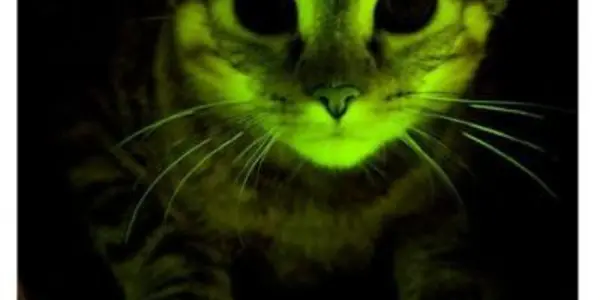
I don't want to sound alarmist, but glow-in-the-dark animals are real-- and it's not just cute kitty-cats.  As reported earlier here at Science 2.0, scientists did this and that to genetics to make AIDS-resistant cats.  Part of the process includes splicing in jellyfish DNA so the cats glow in the dark.Yes, not 'they glow because of the medical reason', they glow for the fun of it.  They glow because the scientists wanted to track the progress of the other stuff, the real medical stuff they were doing.

Being A Sexy Sexy Writer

Being A Sexy Sexy Writer

In Physics Today's 'We love you, you're perfect, now edit', three editors give advice to potential science writers.  Their advice includes the 3 holy rules:  1) know who you are writing for  2) meet your deadlines  3) be polite... and expands on it a bit.  Am I to steal another's writing instead?  No, so go read the piece.  That's what links are for.

Measure The Sun Yourself

Measure The Sun Yourself

Do you know what a creepmeter measures?  Measurement is the heart of science.  What distinguishes science from opinion or philosophy is measureables.  The root of science is facts that are determined by actual observation, compared, then extended into predictions.Any good measurement has three parts: the number value, the units you're using, and the error.  If I say I am 6 feet tall, that's a number (6) and a unit (feet), with a presumed error of 'within an inch or two'.  All three parts are crucial.

Let The Gifted Fly

Let The Gifted Fly

One fundamental myth of gifted education is "you can't put all the smart kids together, because the less-smart need the smarties around to challenge the others".  You can reword that as "it's okay to drag down the smarter kids for the sake of the group", but let's tackle the basic premise first.  Does the presence of smarter kids help the middle of the Bell Curve do better?

Worm Versus Meatball

Worm Versus Meatball

Antonio Carusone, describing himself as "a little obsessed with finding vintage design materials", has a look at NASA Graphic designs, circa 1970s.  Specifically, he hunted up this 1976 NASA Graphics Standards Manual.  Amidst the glories of clean modern design is the famous NASA 'worm' logo, which in 1992 was replaced by the somewhat controversial NASA 'meatball'.

The Pending Space Weather Catastrophe

The Pending Space Weather Catastrophe

Fact #1: There will be a solar event in the next five years that wipes out the electrical grid for the US.Fact #2: Solar and space weather prediction is about as accurate as hurricane predictions-- lots of maybes and false warnings, but great after-disaster analysis.Fact #3: It's hard to educate and convince at the same time, and the public doesn't know what space weather is, yet.Query: Are we doomed?In Solar Cosmic Katrina and Chicken Little, we find out that:

The Science Of Lady Gaga (and 10 Other Rejected Headlines)

The Science Of Lady Gaga (and 10 Other Rejected Headlines)

Life is hard when you're cutting edge.  Coming up with a good topic and title for a Science 2.0 article is not easy.  Today I tried to conceive of a unique and insightful piece about a little-talked about topic.  Specifically, the topic of the last space shuttle flight, which just occurred today.But what title could really capture this epic yet unreported event?  'The Day America Cried'?  Or maybe 'The Day America Shrugged', or perhaps 'The Day America Clicked on FB for, like, the 50th Time Today' might work better.  But perhaps that issue itself is too niche.  In the end, I abandonded that topic in favor of a new article.  But what to write about?