




Liberals and conservatives don’t just think differently, they also feel differently. This may even be a result, in part, of divergent neural responses.
I don't know much about the science behind this, but the NY Time's Nicholas Kristof points readers to an online survey set up by some psychologists to study morals and political beliefs:
This website is a collaboration among five social psychologists who study morality and politics. Our goal was to create a site that would be useful and interesting to users, particularly ethics classes and seminars, and that would also allow us to test a variety of theories about moral psychology. One of our main goals is to foster understanding across the political spectrum. Almost everyone cares about morality, and we want to understand --and to help others understand -- the many different ways that people care.
It's clearly true that there is a connection between moral psychology and one's political views. There are few political position that can be reached only by argument and empirical evidence; moral priorities and outlook come into play. In contrast to the way conclusions are reached in science (competent scientists from varying political, cultural, and religious backgrounds come to a consensus that whales descended from land mammals or that reverse transciption is critical for HIV replication), how you feel about justice, authority, loyalty, and God influences (and rightly so) what kinds of political conclusions you reach. Political consensus is not achieved by the same means as scientific consensus.
So go take the survey (a very brief and free registration is required) and feel free to post your results in the comments. Here are my results - apparently when making right/wrong decisions, I care a lot about fairness and potential harm, but I don't put much stock in authority or moral purity. (Actually, my authority score is surprisingly high, but there were some oddball questions in there that probably skewed the results, like whether I would disobey a commanding officers order's I disagreed with if I were in the military. I'm not big on authority, but unless we're talking about war crimes, you obey when you're in the military. Which is probably why I was never in the military...)
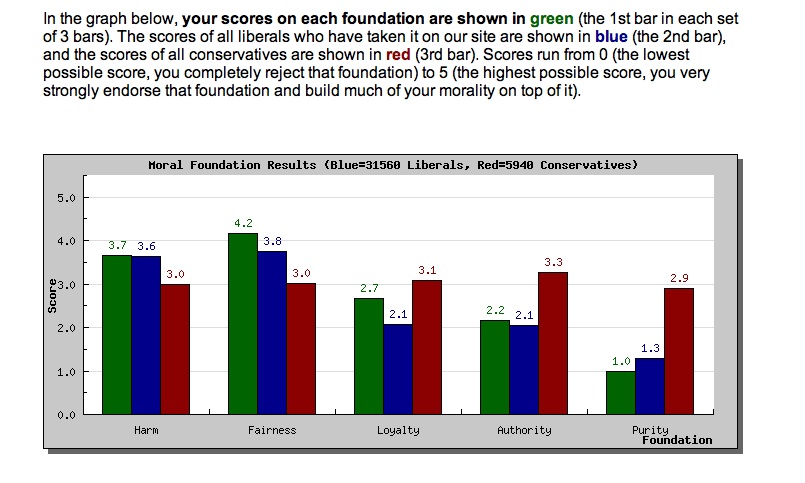
In any case, go have fun with the surveys.




Comments