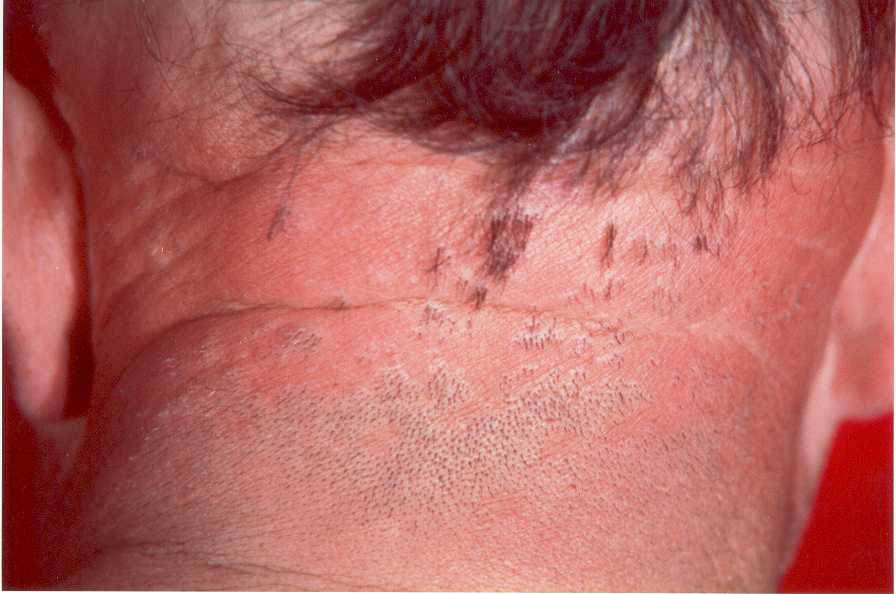




The first case of progressive scalp cicatricial alopecia and
follicular lichen planus (LP) on the trunk and extremities, was
described by Piccardi in 1914, to which he gave the name
"cheratosi spinulosa".

Graham-Little published a similar case in
the successive year of a 55 year old woman, referred by Lasseur of
Lausanne,Switzerland. LASSUEUR PICCARDI GRAHAM LITTLE Syndrome is a rare case where are associated "Cicatricial alopecia and lichen planus follicularis" come together small confluent patches of progressive scarring alopecia, appearance of the lichen planus follicularis with follicular keratosis and noncicatricial alopecia of the axilae and pubes.

LONDON, March 1 /PRNewswire/ -- The Disciplinary Committee of the Royal College of Veterinary Surgeons has this week decided to further postpone its decision on the sanction of a Lincolnshire veterinary surgeon who had appeared before the Committee a year ago, charged with serious professional misconduct.

How do scientists store nothing? It may sound like the beginning of a bad joke, but the answer is causing a stir in the realm of quantum physics after two research teams, including one from the University of Calgary, have independently proven it’s possible to store a special kind of vacuum in a puff of gas and then retrieve it a split second later.

In our everyday life, light is completely gone when we turn it off. In the world of quantum physics, which governs microscopic particles, even the light that is turned off exhibits some noise. This noise brings about uncertainty that can cause trouble when trying to make extremely precise measurements.

Kidney stones are very common – and painful – in men. About 3 in 20 men (1 in 20 women) in developed countries develop them at some stage. Mice, however, rarely suffer though the precise reasons are unknown. Jeffrey S. Clark and colleagues, writing in The Journal of Physiology, have come up with some answers.

Kidney stones are crystalline deposits of various chemicals that should normally be excreted in the urine, particularly oxalate. Common in food, it is usually disposed of by the gut into the faeces by exchanging it for chloride. If there is little chloride available, in a low-salt diet for example, oxalate may be retained by the intestine to eventually be excreted by the kidneys, where the stones may form.

Mice, unlike men, do not spontaneously develop kidney stones, making it difficult to set up an animal model of this common disease. Now, some reasons for this difference between mice and men may have emerged.

Do you like Thomas Pynchon, but are you stumped by the crazy turn-of-the-century science in his latest novel, Against The Day? You're not alone! I've put together a little guide for the perplexed, a three-part primer on special relativity, vector analysis and quaternions, and Riemann surfaces, just for Pynchon readers.
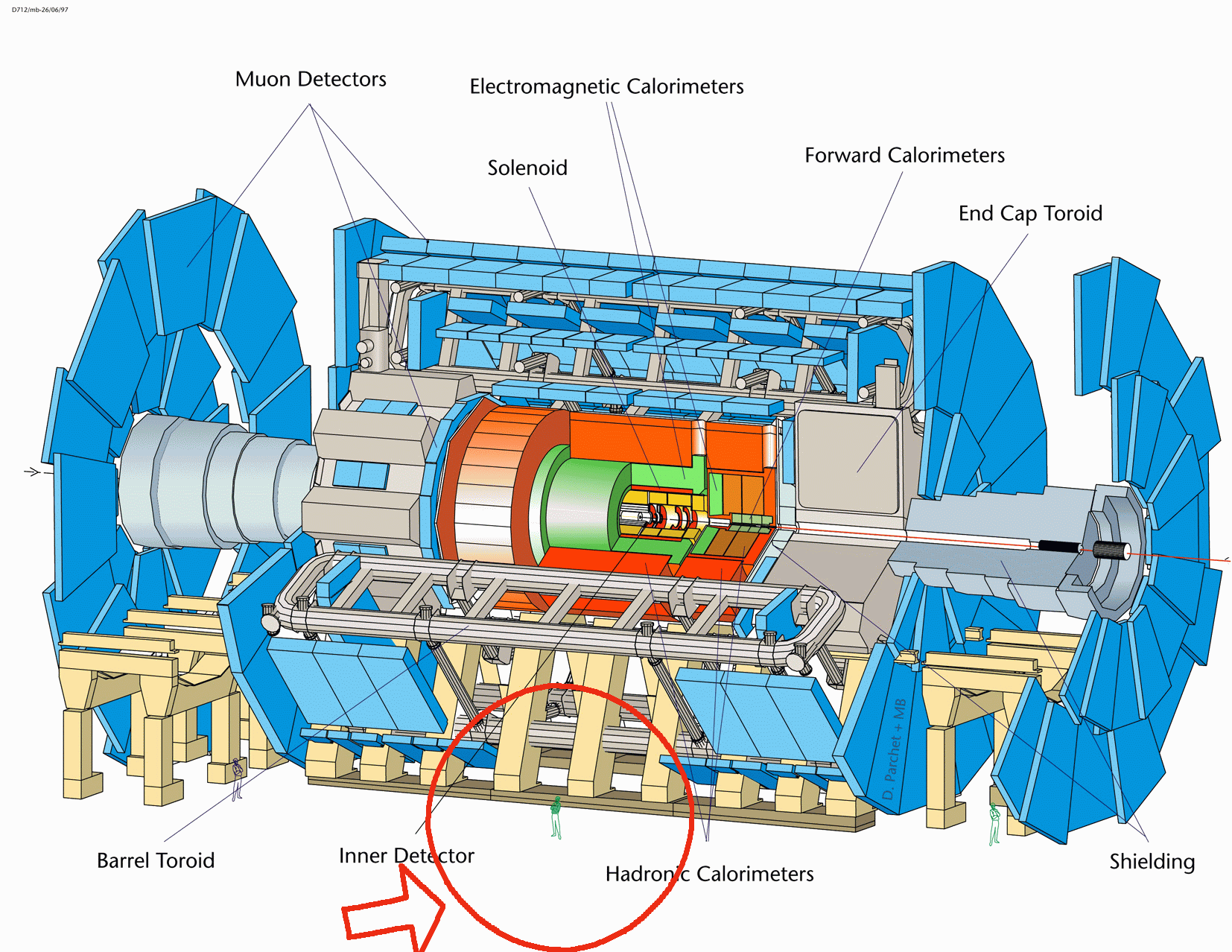


Today the ATLAS collaboration at CERN celebrates the lowering of its last large detector element. The ATLAS detector is the world’s largest general-purpose particle detector, measuring 46 metres long, 25 metres high and 25 metres wide; it weighs 7000 tonnes and consists of 100 million sensors that measure particles produced in proton-proton collisions in CERN’s Large Hadron Collider(LHC).

The first piece of ATLAS was installed in 2003 and since then many detector elements have journeyed down the 100 metre shaft into the ATLAS underground cavern. This last piece completes this gigantic puzzle.

“This is an exciting day for us,” said Marzio Nessi, ATLAS technical coordinator.

LONDON, February 29 /PRNewswire/ -- Europe's Largest XML Publishing and Component CMS (CCMS) Conference announces leading XML solutions provider JustSystems will be Gold Sponsor of X-Pubs 2008 and provide attendee reception and Sunday Content Workshop - June 22-24 London, UK

Naval warships are all-powerful vessels but they are also easy to spot.

Concerns about being detected have led the military to develop new stealth technologies that allow ships to be virtually invisible to the human eye, to dodge roaming radars, put heat-seeking missiles off the scent, disguise their own sound vibrations and even reduce the way they distort the Earth’s magnetic field, as senior lecture in remote sensing and sensors technology at Britannia Royal Navy College, Chris Lavers, explains in March’s Physics World.

Wars throughout the twentieth century prompted advances in stealth technologies. Some of the earliest but most significant strides towards invisibility involved covering ships with flamboyant cubist patterns – a technique known as “dazzle painting”.

Windmills and desalination installations are already commercially available. The windmills produce electricity from wind power, the electricity is stored and subsequently used to drive the high-pressure pump for the reverse osmosis installation.

It's not very efficient. The storage of electricity is expensive and energy is also lost during conversion. But Delft University of Technology (TU Delft) thinks the traditional windmill driving a pump directly can be more efficient and cheaper.

In the TU Delft installation, the high-pressure pump is driven directly by wind power. Water storage can be used to overcome calm periods. Plus, storing water is cheaper than storing electricity.

Museum archaeologists, conservation scientists, archivists and university researchers gathered at a one-day workshop at the Science and Technology Facilities Council (STFC) Daresbury Laboratory to discuss preservation of art and artefacts as well as immovable objects such as buildings and ships.

From how STFC is currently using its world leading light source facilities to help preserve the historic timbers of the Mary Rose, to why a bronze-age wooden shovel has survived so perfectly for over 4000 years in unfavourable soil conditions - delegates took part in discussions with STFC scientists involved to discover how cutting edge techniques can take heritage research into new and productive directions.