






GOTHENBURG, Sweden, February 21 /PRNewswire/ -- With two successful international product launches, Swedish biotech firm Cellectricon is entering a new expansion phase. The share issue will strengthen Cellectricon's financial capacity prior to a number of significant product launches in 2008-2009. These products have been developed in close collaboration with leading global pharmaceutical companies to meet the industry's increasing demand for fully automated, highly efficient systems for pre-clinical pharmaceutical development.

CHARENTON-LE-PONT, France, February 21 /PRNewswire/ --

- New Acquisitions in Canada and Puerto Rico

Essilor is pursuing its external growth strategy with three new acquisitions.

The Company is stepping up its development in Eastern Europe by setting up operations in Bulgaria. Its new subsidiary Essilor Bulgaria Eood has acquired Optymal Ood, which currently distributes Essilor lenses and instruments in Bulgaria and has sales of nearly EUR1 million. The acquisition will enable the Company to enhance its competitive position in the fast growing corrective lens market, especially the progressive lens segment.

PHILADELPHIA and LONDON, February 21 /PRNewswire/ --

- Report Examines Recent Developments at Major Patenting Authorities Worldwide

Thomson Scientific, part of The Thomson Corporation (NYSE: TOC; TSX: TOC) and leading provider of information solutions to the worldwide research and business communities, has published its 2008 Patent Focus Report. Authored by Joff Wild, editor of Intellectual Asset Management magazine, and published in Thomson Scientific's KnowledgeLink(SM) eNewsletter, this report explores recent activities at each of the world's major patenting authorities (USA, Europe, Japan, China and India). The report is available free at scientific.thomson.com/newsletter.

PHILADELPHIA and LONDON, February 21 /PRNewswire/ --

- New content expands English-language coverage of Asian patent data via Derwent World Patents Index and provides essential resources for prior art research

Researchers at Dana-Farber Cancer Institute have found a previously unknown molecular pathway in mice that spurs the growth of new blood vessels when body parts are jeopardized by poor circulation.

At present, their observation adds to the understanding of blood vessel formation. In the future, though, the researchers suggest it is possible that the pathway could be manipulated as a means of treating heart and blood vessel diseases and cancer.

Bruce Spiegelman, PhD, and his colleagues at Dana-Farber discovered that PGC-1alpha – a key metabolic regulatory molecule – senses a dangerously low level of oxygen and nutrients when circulation is cut off and then triggers the formation of new blood vessels to re-supply the oxygen-starved area – a process known as angiogenesis.

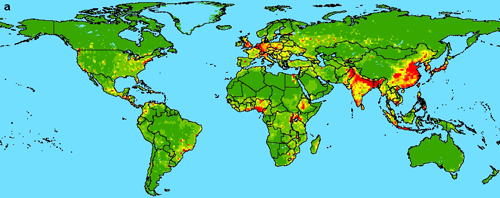
Deadly emerging diseases have risen steeply across the world and an international research team has provided the first scientific evidence mapping the outbreaks’ main sources.

They say:

New diseases originating from wild animals in poor nations are the greatest threat to humans and;

Expansion of humans into shrinking pockets of biodiversity and resulting contacts with wildlife are the reason.

Meanwhile, richer nations are nursing other outbreaks, including multidrug-resistant pathogen strains, through overuse of antibiotics, centralized food processing and other technologies.


Zoonotic pathogens passed from wildlife to people, from lowest occurrence (green) to highest (red).

University of Michigan scientists and their colleagues at the National Institute on Aging have produced the largest and most detailed worldwide study of human genetic variation, a treasure trove offering new insights into early migrations out of Africa and across the globe.

Like astronomers who build ever-larger telescopes to peer deeper into space, population geneticists like Noah Rosenberg are using the latest genetic tools to probe DNA molecules in unprecedented detail, uncovering new clues to humanity's origins.

The latest study characterizes more than 500,000 DNA markers in the human genome and examines variations across 29 populations on five continents.


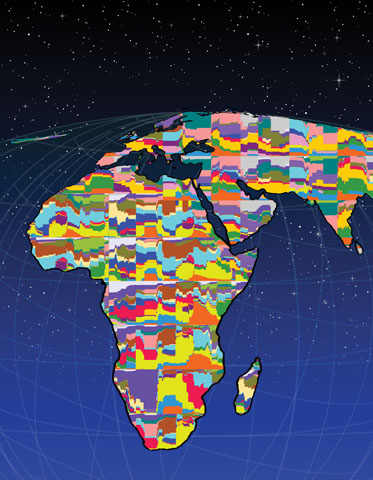
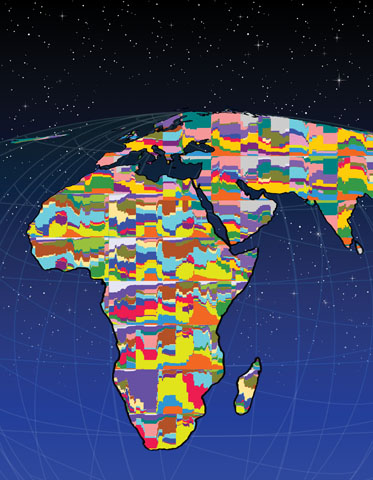
A schematic of worldwide human genetic vari

A team of researchers has discovered the remains in Madagascar of what may be the largest frog ever to exist.

The 16-inch, 10-pound ancient frog, scientifically named Beelzebufo, or devil frog, links a group of frogs that lived 65 to 70 million years ago with frogs living today in South America.

Discovery of the voracious predatory fossil frog is significant in that it may provide direct evidence of a one-time land connection between Madagascar, the largest island off Africa's southeast coast, and South America.


Beelzebufo. This ain't your daddy's giant devil frog. Credit: SUNY-Stony Brook

A straight line may be the shortest distance between two points, but it isn’t necessarily the fastest or easiest path to follow.

That’s particularly true when terrain is not level, and now researchers have developed a mathematical model showing that a zigzag course provides the most efficient way for humans to go up or down steep slopes.

Human migration from Africa to Europe more than 30,000 years ago is still visible in the genes of Europeans today - and because the numbers were small, the harmful variations were magnified as time passed.

A study in the Feb. 21 issue of Nature compared more than 10,000 sequenced genes from 15 African-Americans and 20 European-Americans. The results suggest that European populations have proportionately more harmful variations, though it is unclear what effects these variations actually may have on the overall health of Europeans.

Computer simulations suggest that the first Europeans comprised small and less diverse populations. That would have allowed mildly harmful genetic variations within those populations to become more frequent over time, the researchers report.

