




“The practice of having Ph.D. graduates employed by the university that trained them, commonly called ‘academic inbreeding’ has long been suspected to be damaging to scholarly practices and achievement ” says a 2010 report in the journal Management Science.
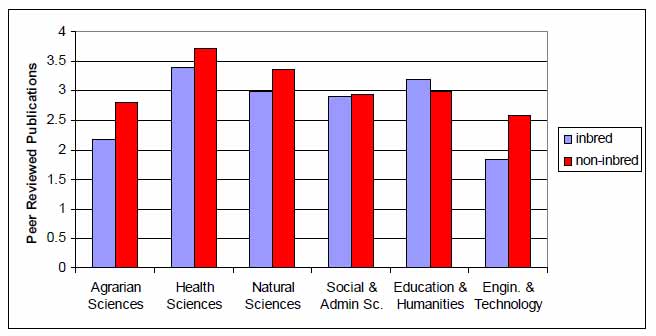
Until recently, precise details regarding the levels of possible damage had not been formally quantified. Progress was made, however, by a joint Portuguese / US research team which examined the academic inbreeding (AI) and scientific productivity (SP) of 414 academics across 14 higher education institutions in Mexico between 1999 and 2002.
Their paper ‘Navel Gazing: Academic Inbreeding and Scientific Productivity’ (Management Science, Vol. 56, No. 3, March 2010, pp. 414-429.) The investigators registered the peer-review output from university departments specialising in Agrarian Sciences, Health Sciences, Natural Sciences, Social&Admin Sciences, Education&Humanities, and Engineering&Technology – and cross-referred it to the level of endemic AI (as defined above in paragraph one).
The results almost completely demonstrated that in all faculties examined, non-inbred output was higher. (* see note [1] below)
“… an excessive dependence from inbred talent can easily lead to academic fossilization and knowledge atrophy.”
say the researchers, and, quantifying the damage in percentage terms -
“Our estimates suggest that academically inbred faculty generate on average 15% less peer reviewed publications than their non-inbred counterparts.”
The paper can be read in full here
* [1] Except, for as yet unexplained reasons, in Education&Humanities. Future research may clarify this apparent anomaly.





Comments