Banner
    5 Greatest Palaeontology Fakes Of All Time #5: The Linxia Cheetah
    By Oliver Knevitt | January 9th 2011 11:00 PM | 15 comments | Print | E-mail | Track Comments
    About Oliver

    In a nutshell: I like fossils. But even more than than that, I like arguments about fossils. Which is why my current occupation as a PhD researcher...

    View Oliver's Profile

    In a piece by Richard Stone in this week’s Science, it was pointed out that in Chinese Museums, it is likely that up to 80% of the marine reptiles on display have been altered or artificially combined to some degree. This seems like a shocking figure, but it is more understandable when it is considered that few of these museums have palaeontologists as staff, and that many of these fossils are unearthed by Chinese farmers that dress their finds up so that a museum is more likely to buy them. Of late there has been a boom, both in the numbers of museums, but also in the acquisition funds set aside for accessioning fossils; this, coupled with prizes for the best specimens, means that finding (or fabricating) a complete fossil can prove to be quite lucrative. This forgery can range from the odd added-in bone here and there, to the whole scale chimeric sticking together of many specimens.

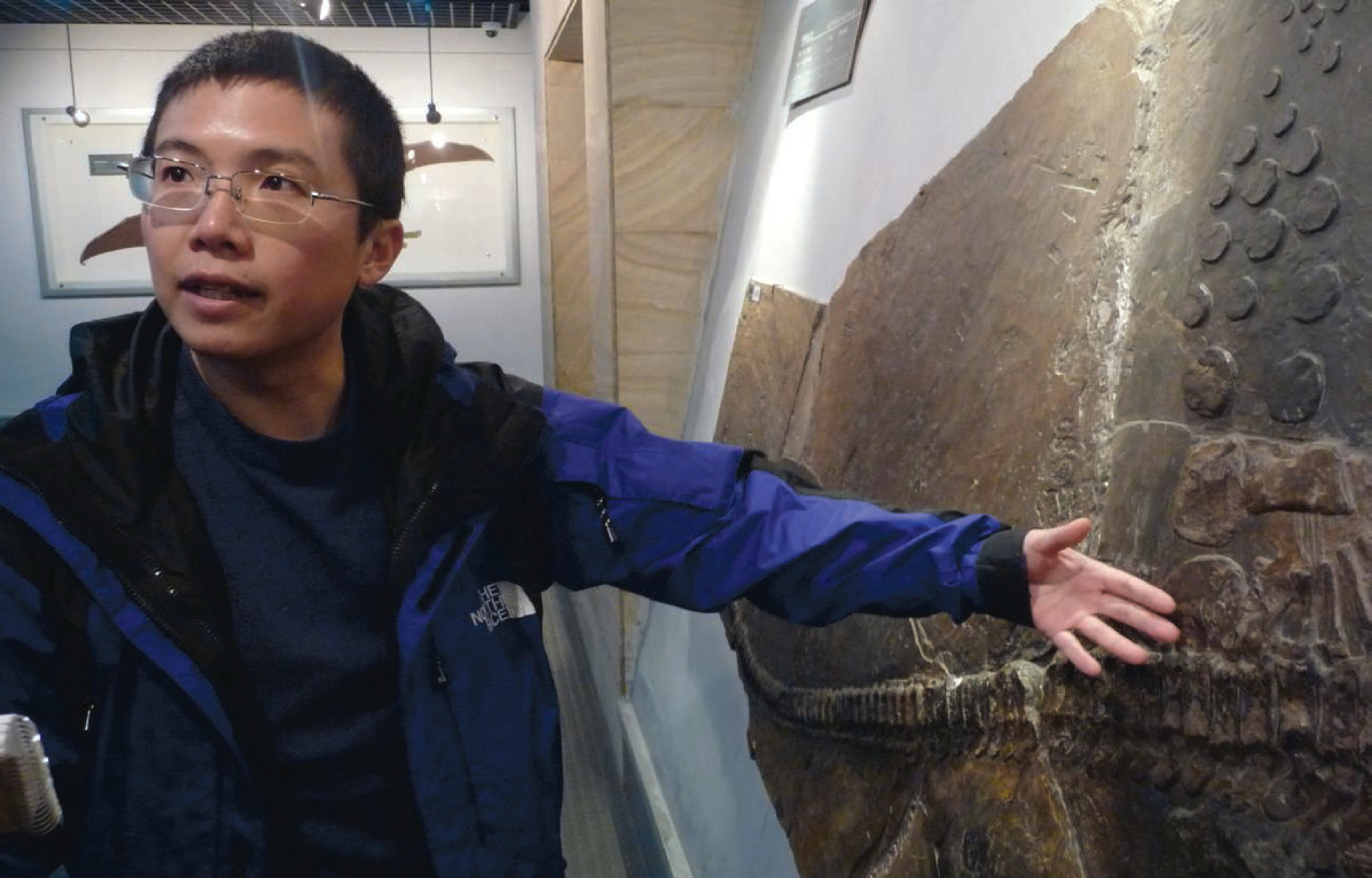
    In many cases, these fakes are blatantly obvious. The centerpiece of the Geological Museum of China’s Prehistoric Life exhibit (seen below) is of a striking Triassic ichthyosaur. But when you take a closer look, something is amiss. In the upper part of the specimen, the shoulder girdle and lower jaw can clearly be seen, representing the ventral (belly) side of an organism, whereas lower down, the dorsal (back) surface of the vertebrae are seen; clearly this is several specimens botched together. Chinese museums are riddled with examples such as these, which is a real pain for any researcher in that they have to spend many days separating the real fossil "wheat" from the faked "chaff" -- not to mention the untold damage that has been done to the now palaeontologically defunct specimens.
     Richard Stone
    Li Chun with a faked icthyosaur in the Geological Museum of China. You can even see from here that the lower part of the specimen is upside down. Image Credit: Richard Stone

    The commercial fossil market is awash with fakes; in fact it can be rather difficult to buy real fossils. Forgers in China have faked pretty much any fossil you like; examples include birds, fish, mammals, dinosaurs, dinosaur eggs, icthyosaurs, and other reptiles - they have a particular penchant for mimicking the sauropterygian Keichosaurus. Although the bulk of faked fossils come from China, this problem is not limited to China. Many of those famous Morrocan trilobites are faked, as are Pleistocene mammal skulls from around the world. Indeed, for anybody that thinks they have ever bought any fossilized amber: unless it came from the Dominican republic it is almost certainly fake. (PaleoDirect have a great emporium of faked fossils at their website.)

    Most of these fossils are prepared well enough to fool your average fossil dealer or even museum worker, but can easily be earmarked by a trained palaeontologist. However, occasionally – just occasionally – a hoax fossil slips through the net, and ends up in the scientific literature. These fossils tend to whip up a maelstrom of debate and can incite fierce opinion on both sides, ending up with red faces for many of those involved when they are later revealed to be hoaxes. Thankfully it doesn’t happen very often, but over the next few weeks I'm going to pick up on some of the greats.

    5. Acinonyx kurteni - the Linxia Cheetah
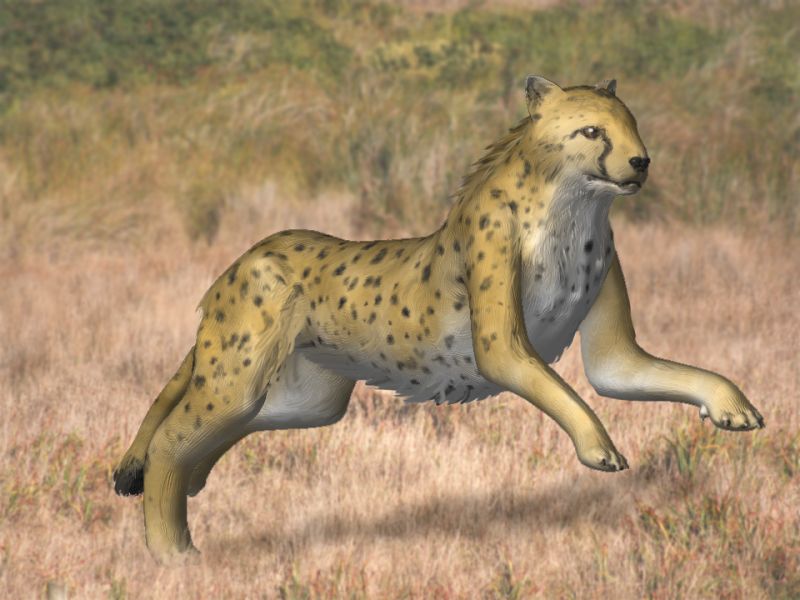
     Per Christiansen and Ji H. MazákA reconstruction of A. kurteni. From Wikipedia (Open Access).

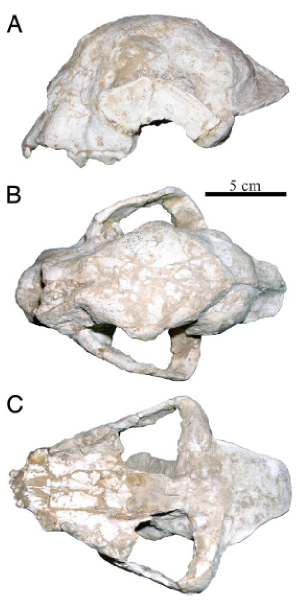
    Acinonyx kurteni was named for a skull found in Late Pliocene deposits and, at 2.5-2 Ma, this makes it one of the oldest cheetahs ever found. First described by
    Per Christiansen and Ji H. Mazák early in 2009 in the prestigious journal PNAS, it was excitedly described as the most primitive cheetah ever found, having a unique combination of both primitive and derived traits. The authors went as far to state that this specimen disproves that cheetahs originated in the New World, favouring an Old World origin based on the interpretation of this fossil.

    Alas, it was too good to be true. As soon as
    Deng Tao, a paleontologist at the Institute of Vertebrate Paleontology and Paleoanthropology in China saw the paper, he knew it was fake. Just from from the published pictures, he said that he could see that parts of the skull have been concocted from plaster, (I can't see this myself, but I'll take his word for it). But for Deng, what really gave the game away was a subtle aspect of the morphology; as he explains, “The parietal area is glued by some bone pieces to imitate the skull of a modern cheetah, but the forger did not make the parietal crests".

    As yet, PNAS have refused to retract the paper and the authors still stand by their interpretation. They have refused requests to view the skull and have not answered as to where the fossil was sourced from. This is downright dodgy to me, and so I'm inclined to agree with Deng, who has collected from Linxia for over a decade and knows the suspicious characters that prowl the area, and whose opinion is corroborated by
    Qiu Zhanxiang, a world expert on mammalian skulls.

    This fossil makes my list because when it was published it made quite a storm, being published as it was in PNAS, and very quickly was covered in many newspapers. In these modern times, an idea can be cemented in the public consciousness very quickly, regardless of whether it is subsequently retracted or not. Even if this paper had been retracted a month or so later I doubt that it would have been noticed; we can compare this with some of the examples later on in this series. Deng has now decided not to pursue the matter in any case, as he has not been allowed to see the skull itself that lead to the ruckus.

    In a way, though, retraction is not tackling the root cause of what lead to this paper being published. There needs to be an extensive training program for fossil preparators, and extensive guidance for those going into the field to collect. Only by nipping this problem in the bud can we prevent a legion of duplicitous dealers ruining China's
    globally important paleontological legacy, and allow us to treat fossils sourced from China with the confidence and awe that they deserve.

    Next week:
    The 5 Greatest Palaeontology Fakes of All Time #4: Irritator

    ------
    Citations and links


        Stone, R. “Altering the Past: China's Faked Fossils Problem.” Science 330, no. 6012 (2010): 1740.
        Christiansen, P., and J. H Mazák. “A primitive Late Pliocene cheetah, and evolution of the cheetah lineage.” Proceedings of the National Academy of Sciences 106, no. 2 (2009): 512.

    The Cheetah story was also picked up by many news outlets,
        The Guardian http://www.guardian.co.uk/science/2008/dec/29/fossil-cheetah-skull-evolution
        National Geographic http://news.nationalgeographic.com/news/2008/12/081229-cheetah-skull.html
        Live Science http://www.livescience.com/animals/081230-cheetah-skull.html

    Also, see PaleoDirect's fake fossil page at http://www.paleodirect.com/fakefossils1.htm for an incredible collection of fakes and how to tell the difference.



    Comments

    One has to wonder why fossils would be so lucrative for Chinese farmers? If we look closely at the types of fossils that return a premium, it is the fossils that fall into the catagory of "missing link", such as the infamous "Archeorapter" that just less than a decade ago made front page headlines in National Geographic who reportedly paid 250,000 dollars for the fossil. It was exposed as a fake and a later retraction was published on page 47 (not the front page). Perhaps it is the vanishingly small evidence (one could even argue non-existant) of actual missing links. If there were real evidence for evolution, then there wouldn't be a bunch of fakes selling for lots of money.

    Hank
    Of course there would.    The assertion that random fossilization happened at every stage of evolution in a convenient location that has already been found is shockingly ignorant about science, biology, paleontology and grade-school chemistry.   

    Sometimes people fake things.   They did not do it to debunk your young earth creationist agenda, they did it for money.
    Want more no-nonsense, independent science? Buy Science Left Behind
    Oliver Knevitt
    I agree with Hank. We don't even need a fossil record to know that all life evolved; looking at the morphological relationships between animals is enough. Vice versa, if there were no living animals, the gradual change of forms represented universally in the fossil record is enough. But, as it happens, we have both, and they both compliment each other magnificently. The thing with these fake vertebrate fossils is that, compared to the amount of vertebrate fossils found, day in day out by specialists out in the field, they barely register. It's only in China, where there is a unique combination of: a massive impetus on museums to source fossils; a huge, easy to extract wealth of fossils; a lack of protection on the fossil beds; the willingness of poorly staffed museums to buy fossils from dodgy dealers, and the vast sums involved in buying them. Anywhere else, no-one would bother. And don't get me started on the fallacy of "missing links".
    "We don't even need a fossil record to know that all life evolved; looking at the morphological relationships between animals is enough" - wow, thats a real scientific approch. Its enough for you because you see similarities??? Its amazing how fast our requirements for proving a scientific fact has weakend when it comes to evolutionary proof. When no real evidence is provided, we just claim whatever we want as proof. Without real facts, evidence and profs. It is just what it should be called " The theory of evolution" NOT the fact of evolution.

    Oliver Knevitt
    Do you really think we're so stupid to just look at similarities and assume they evolved? No, of course we don't. What I mean by this is that we all show modifications from ancestral bauplans.

    And evolution is both a theory AND a fact. Keep on your toes, we've explained this over and over again for years.

    Again, this is meant to be a site for open minded scientists, so you'll get my standard creationist schtick:

    No scientist wants to engage in exchanges with creationists because they go absolutely nowhere; creationists do not listen and simple rattle off more and more woefully misunderstood anecdotes, as your post has demonstrated. Evolution happened, so for god's sake get over it. The greatest tragedy, is that you have massively misunderstood your faith if you think that this non-issue is important to you. Read a book on theology first, then pick up a biology textbook.

    I am happy to point out large scale misunderstandings with the theory of evolution and of the fossil record as a whole, but I have much better things to do than answer misguided rants.
    One has to wonder why fossils would be so lucrative for Chinese farmers?

    Because they look pretty on people's living-room walls? And maybe whole skeletons with every bone in the position it had in life look prettier than jumbled, incomplete piles of bones? And maybe unique skeletons (unique because they're pieced together from incomplete skeletons of two or more species) fetch higher prices than the fossils everyone already has?

    You didn't think this through, didn't you?

    Concerning transitional forms, we're swimming in them. Try to learn about the origins of limbed vertebrates, birds, whales, or many other examples.

    I can't help feeling that people latch unto "evolution" as the main sticking point for the claims of Christianity because they think it is the biggest problem to creationism. It's nothing of the sort. I'm taking this off thread a bit, so apologies, but "evolution" (natural selection) only ever acts on genetic code that is i.e. there must be a gene for natural selection to act on in the first place. Natural selection happens, but mapping it back to the beginning of time as a means of explaining how we got here doesn't in my opinion work. Where did the genes for natural selection to act on come from? As far as I can tell, there are still no examples of ribozymes (RNA enzymes) which can completely replicate itself, or even a significant portion of itself. An issue which Dawkin's (a self-proclaimed expert in most things) suddenly becomes unqualified to speak on.

    For me the biggest hurdle for evolutionists is the link in with big bang theory. This only works if there was extremely large amounts of matter around before the bang event - the most important issue, is where did that come from and why. Lets not get into bosons here either, the standard model just does not work. Even if it did, the matter/anti-matter paradigm would cancel so much material out of any big bang that to be left with any over at the end you would need a universe many many times larger than ours to crunch itself. Where did that universe come from? I find ironically that evolutionists frequently display much more faith in their life paradigm than do Christians, or those of other creationist faiths, which, whether you agree with it or not, have an explanation - a supernatural creator. Without a creator, where and how did it all start - there is no answer to this, only opinions.

    Oliver Knevitt
    Jimbo, I'm sorry, but you're not making any hint of sense. Why on earth are you bringing up the Big Bang and molecular evolution onto a thread concerning the illegal fossil trade anyway?

    No scientist wants to engage in exchanges with creationists because they go absolutely nowhere; creationists do not listen and simple rattle off more and more woefully misunderstood anecdotes, as your post has demonstrated. Moreover, its a complete non-issue. No creationist seems to have any problems with atomic theory, or relativity, but these are supported by less evidence than is evolution. Evolution happened, so for god's sake get over it. The greatest tragedy, is that you have massively misunderstood your faith if you think that this non-issue is important to you. Read a book on theology first, then pick up a biology textbook.

    I am happy to point out large scale misunderstandings with the theory of evolution and of the fossil record as a whole, but I have much better things to do than answer misguided rants.

    BTW any other creationist posts will get the above 2 paragraphs posted as a reply, so before you post, ask yourself whether its really worth it. I am genuinely bored of reading them.
    David Yerle
    "If there were real evidence for evolution, then there wouldn't be a bunch of fakes selling for lots of money."
    What???
    Evolution has been observed, live, in the lab. Evolution has been forced on foxes to create a race of "dog-like" foxes. "Missing links" are not needed to prove evolution. It is a fact, seen everyday, not only in the lab but all around us. Antibiotic resistant bacteria are an example of evolution: they didn't start like that, the resistant ones were selected by our antibiotics. Mutated flu viruses every year are also an example. We have created geneticall modified tomatoes. Peppers are artificially evolved evolved chilies. Pretty much every vegetable you can buy in a supermarket has nothing to do with how it was before agriculture: artificial selection is responsible for their size.
    Just look at the variety of dog races. How do you think they came to be? Did Noah have a chihuahua?
    We need no more evidence for evolution! It's a fact, for God's sake!
    David Yerle
    It's worth noting that many of the magnificent fossils of marine reptile from the British Lias have been "improved" by preparators to add to their commercial value, a practice which has been going on for as long as they have been collected. I've had the opportunity to examine closely a number of specimens sold the the Natural History Museum by Thomas Hawkins in the early part of the 19th century, and all show some sign of tampering, from straightening out of necks and tails to the skilful modelling of missing elements in plaster. Many ichthyosaur "specimens" are composites of more than one individual, in some cases individuals from different taxa.

    These "improvements" were not carried out by palaeontologists, and were not aimed at proving any scientific theory. They are a purely commercial excercise designed to enhance the commercial value of the finds, often to the detriment of science. When you discover that the holotype of a species is partly constructed from plaster, you need to go through a rigorous exercise in unpicking the tangled thread of description and referred specimens. It's an academic nightmare.

    Hank wrote: The assertion that random fossilization happened at every stage of evolution in a convenient location that has already been found is shockingly ignorant about science, biology, paleontology and grade-school chemistry.
    I didn't assert anything. Unfortunately for evolutioinists, the locations of fossilization are very inconvenient, and are causing the story of evolution to change several times a year. Examples include skull 1370, penguin feather fossils, detailed squid fossils in the pre-Cambrian fossil layer (which are identical to todays squids, i.e. no sign of evolution for about 500,000,000 years), just to name a few. Random fossilization sounds a lot like a global catastrophic event don't you think? Chemistry debunks the idea of millions of years of evolution also. You might research Dr. Mary Schweitzers discovery of viable collagen and DNA in a 80 mya Hadrosaur fossil. Chemistry in the lab clearly shows that even in a frozen state DNA cannot possibly survive 100,000 years let alone 80 million. There are many more examples to cite also. Of course I suppose that exceeds grade school chemistry. I agree also that sometimes people fake things. Sometimes people buy faked things too. The people making these purchases are often times experts that should know better, but apparently excitement gets the best of them. You only have to think back to the very recent front page headlines of National Geographic, depicting the "Archeoraptor". That was reportedly purchased for 250,000 dollars by National Geographic expert Paleontologists who were very excited at the find. It fit perfectly into the spot they expected to find such a "missing link" since "everyone knows" that birds evolved from Therapod dinosaurs. Why would experts get so excited about a missing link if we already have so much evidence? The fact is there are no "water tight" missing links when there should be millions out of the billions of fossils we now have cataloged. There are only a handful of "missing link" catagory fossils and those are all very subjective.
    Oliver: Morphological relationships between animals is hardly enough to prove evolution occurs. Octopi have similar eyes to us humans, but nobody has ever claimed we are directly related that I know of. Gradual change is not an indicator either. What we now know about this "gradual change" you speak of is that it is always a loss of information, and never a gain, i.e. mutation and natural selection. I am sure you have seen at some point in your life, a copy image that has been copied so many times that the image is no longer legible. That is what is happening to all of life on this planet, a slow motion extinction. Consider the giant salamanders of China, and how they can no longer survive without human intervention because these creatures can no longer regulate their internal temperature. For evolution to be true, there "HAS" to be a gain of information somewhere...think about it..from single cells to thinking human..you have to add info there. No information adding mechanism in the genome has been observed by humans to date. Evolution "ameoba to man" is just a story until a mechanism is shown to exist.
    David: It may look good on someones' wall to have a fossil hanging there, but these aren't art collectors buying them. These are professional Paleontologists who know what they are looking at, but are desperate for a "real" missing link. I have thought this through very thoroughly. You should review all of the fakes and see how long it took experts to discover they were fakes, when it was obvious. It took Pildown man 50 years to be discovered. The "best" evidence we are told by prominent evolutionists is whale evolution (one of the areas you mentioned). If you look closely you will see that no proof of relationship has been shown at all. Pakacetus was placed in the "whale catagory because one of the bones in it's jaw resembles one of the bones in a whales ear. The original find of Pakacetus just a few pieces of skull fragments and a few forelimb. It was originally depicted as an aquatic animal complete with full color pictures of a swimming fish looking animal. Later other Pakacetus fossils where discovered that refuted the "known fact" that Pakacetus was aquatic, and the new story was told that Pakacetus was a land dwelling animal that was the precursor to whales. (Even though the fossil layers dramatically overlap, it is only based on 1 similar looking bone, there is not enough time "evolutionarily speaking"for all the radical developments to take place for a land dwelling animal to change into a full time aquatic animal, with deep diving capabilities, a radically altered heat radiating/conserving mechanism, fully functional sonar, and complete rearrangment of breathing apparatus)
    If missing links were real, there would be far less of a market for the faked ones.

    Hank wrote: "Sometimes people fake things. They did not do it to debunk your young earth creationist agenda, they did it for money."
    You are correct, they did not do it to debunk the young earth creationist agenda ( I never claimed I was a young earth creationist, you assumed that) they did do it for money. That is because missing link fossils are not required for the young earth model, it explains the data without the need of missing links, so there is no money in it. However there certainly is a very good market in the materialistic/atheistic agenda of evolution, and a lot of money to be made if one can produce a missing link since they are so rare. So rare as to be virtually non-existant.
    Oliver: I would like to hear your thoughts on the fallacy of missing links, I am reasonable and willing to listen.

    David wrote: "Concerning transitional forms, we're swimming in them. Try to learn about the origins of limbed vertebrates, birds, whales, or many other examples.
    I already covered one part of whale evolution that demonstrates the subjective nature of evolution stories, and demonstrates that repeatable, demonstrable, and testable science cannot be employed. The evidence has to be historically analyzed and interpreted. The way we do this is by using todays known values, conditions, rates, etc. to relate how things could get into the ground the way they are positioned. The best way to discover historical conditions is to have an actual observer who recorded the events (which by the way is what young earth creationists claim). Evolutionists claim all sorts of things about birds, whales, limbed vertabrates, etc. without any real evidence that it happened. That is why full color pictures were created of an aquatic animal complete with a fluke for swimming (Pakacetus) even though no fluke was ever found in any Pakacetus fossil. That is just plain false, but the pictures are there if you would care to review them. Bird evolution is another problem for evolutionists. The story is that birds evolved from Therapod dinosaurs. Recently some students at Oregon State University discovered something that had been overlooked for quite some time. The way birds lungs are attached would not be possible in Therapod dinosaurs, they would suffocate. Another problem is that there is no good missing link between birds and Therapods ( a point I have made more than once), since the vaunted Archteroptyx shows up in fossil layers millions of years AFTER birds do, it can hardly be birds ancestors. Now, cladists pretty much insist (because of homology) that Archteroptyx must be the ancestor, so choose to ignore stadard dating techniques, and believe it anyway. So which is it? As far as limbed vertabrates..that covers a lot of ground. I am not aware of any transitional forms, maybe you could enlighten me on a transitional form that actually shows a transitional feature between two types?
    Thank you

    Oliver Knevitt
    I haven't bothered to answer most of your points, because because they all either untrue, misrepresented, misunderstood, or just plain ignorant, and so I got a bit bored. But as for this:
    Oliver: I would like to hear your thoughts on the fallacy of missing links, I am reasonable and willing to listen.
    http://www.science20.com/between_death_and_data/missing_link_fallacy-75791

    And this time, I would like to hear your thoughts too, if you wouldn't mind.

    Oliver
    It is easy to claim my points are untrue, misrepresented, misunderstood, or just plain ignorant, however it is quite another to actually demonstrate it. Instead of resorting to Ad Hominem attacks, why not address what you think is wrong logically and prove what you say? Ad Hominem attacks are a demonstration of logical fallacy, and show you have no real argument.

    Oliver Knevitt
    Look, I don't want to get bogged down in pointless exchanges. Feel free to comment on the validity of my arguments against missing links in the other article, but I'm not going to sit here and knock down straw men.