
Banner
    The Jacuzzification Of Evolution
    By Mark Changizi | November 23rd 2009 03:59 PM | 24 comments | Print | E-mail | Track Comments
    About Mark

    Mark Changizi is Director of Human Cognition at 2AI, and the author of The Vision Revolution (Benbella 2009) and Harnessed: How...

    View Mark's Profile
    “Come on into the hot tub,” I told my three year old boy. But he wouldn’t budge. No way was he joining his older sister in there. “It’s warm, and it feels nice!” I urged, “There’s nothing to be afraid of.” But it was only when I turned off the jets that I could eventually coax him in.

    “Why would my boy be so afraid of a hot tub?” I wondered. But as I reflected upon my panty-waist boy, I decided that perhaps I wasn’t being fair to him. In fact, in hindsight, I think he was behaving rationally. Hot tubs are frightening. They violently churn and bubble, as if they are actually boiling. I have spent so much time in hot tubs over the years that I now hardly notice the foam, the burning temperature, the Pseudomonas bacteria and the skin-ripping, high-pressure jets.

    We get used to things, and not just to jacuzzis. My jacuzzification also happens for intellectual matters (a topic of an earlier piece, The Value of Being Aloof: Or, How Not to Get Absorbed in Someone Else’s Abdomen). One generation’s jacuzzi is another generation’s maelstrom. 

    In particular, we get used to evolution. We scientists, especially. We’re so accustomed to evolution that when we find skeptics of evolution, we think of them as poor, blind, close-minded saps who can’t see the most obvious truths.
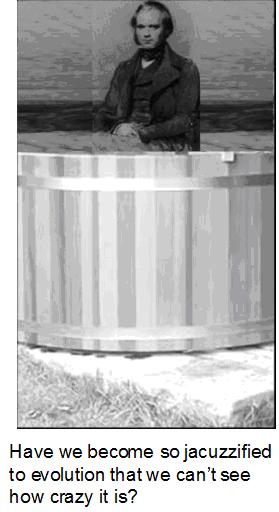
    Darwin's jacuzzi

    But how obvious is evolution, really? And how close-minded are those who don’t yet accept evolution?

    Let’s start with the obviousness of evolution. First and foremost…evolution ain’t obvious! Evolution is perhaps the craziest true theory ever!   "Let me get this straight: Add a teaspoon of heritable variation, a ton of eating one another, and epochs of time…get yourself a superzoo of fantastically engineered creatures. Yeah, that’s not crazy!”

    The only reason most of us scientists don’t find evolution crazy is that we’re jacuzzified to a wrinkley pulp. And this level of comfort with the bizarre theory of evolution can be counterproductive when trying to explain evolution to the uninitiated. You won’t convince my three-year-old to get into the hot tub by suggesting that there is no bubbling or churning – he can see the bubbling and churning with his own eyes. (BTW, no intent to analogize evolution skeptics with three-year-olds! Just a useful analogy that popped up.) If you’re so jacuzzified that you fail to see the churning, you will be incapable of addressing the real worry: that the churning might hurt.

    Similarly, if you’re so used to evolution that you fail to see how weird it is, you’ll be in a poor position to explain why it isn’t as crazy as it at first sounds. Better to say, “Yes, evolution is crazy, but there’s overwhelming evidence that it is, indeed, the mechanism underlying the emergence of life in all its glory.” (And you should also admit that, although we have mountains of evidence that evolution is the mechanism, we are very far from understanding how exactly it does it, just as we’re sure the brain underlies our thoughts but do not comprehend how the brain works. This was the topic of an earlier ScientificBlogging.com piece titled Is Evolution Fast Enough?’ How I Responded.

    The fact that evolution wins the prize for “non-obviousishness” should already begin to change one’s view about the supposed close-mindedness of evolution’s skeptics. Evolution is extraordinary, and extraordinary theories take extraordinary evidence. Extraordinary evidence indeed exists, but you can’t communicate the evidence in a simple one-liner. (Much less in a one-liner addressing the other as a “close-minded sap”.)

    Religious folk surely have their hang-ups (whereas I am utterly hang-up-less), but religious doctrine has come a long way over the centuries. Few still believe the Earth is at the center of the universe, for example, something that was once perhaps just as central to the religious world view as creation. But the evidence for the Earth not being at the center is overwhelming. And more important than being overwhelming, the idea that the Earth is not at the center of the universe is not nearly as crazy as evolution. 

    Religion can, then, be convinced of scientific discoveries it is initially opposed to. And, it is reasonable to expect that the more intrinsically implausible a theory sounds, the longer it will take for religion to become convinced. Evolution is the king of the implausible, and perhaps that’s why it is one of the last major scientific truths not having infiltrated all the corners of religion. 

    But evolution won’t infiltrate religion if we scientists can’t address the skeptic’s worries. And we won’t be able to address the worries if we’re so overcooked in evolution that we are incapable of seeing just how preposterous it seems.

    Comments

    Gerhard Adam
    Actually I would have to disagree somewhat since evolution seems so obvious to virtually everything we do.

    While I can agree that the mechanisms for evolution seem so unusual, that appears to be more a function of how one translates biochemistry into walking around grass and meat eaters.  But the majority of people have no problem in seeing how computers (or their operating systems) have evolved.  They can clearly see how each new version builds on the old and yet when it comes to evolution they want to introduce probabilities as if each has to be built from scratch each time.

    Similarly it doesn't take much imagination to extrapolate from using a rock to pound something to the hammer.

    The evidence for evolution (not just biological) in the world around us is not just overwhelming but it is intuitively obvious.  What is startling is that something so blatantly obvious wasn't considered earlier as being applicable to biological systems.

    Even for those that would seize on my comments as being indicative of intelligent design, it should be clear that no designer is creating anything without building on that which preceded it.  One could even extend that argument to inanimate forms like the Grand Canyon (whether one wants to call it evolution or simply change).  In short it would be truly difficult to find almost anything in our world that doesn't evolve over time.
    Mark Changizi

    "Gerhard Adam, could you please step out of the hot tub. Very little skin left." The idea that *blind* processes can, with enough time and strife, create superb machines like sea cucumbers and people is, frankly, impossible to wrap my mind around. I believe it, just as I believe the brain underlies my thinking. But just as I can't wrap my head around the fact that its atoms somehow instantiate *me*, I can't grasp how blind evolution can create all these brilliant examples of life.

    You say, "In short it would be truly difficult to find almost anything in our world that doesn't evolve over time." Sure, but these other things don't become "life".
    Gerhard Adam
    :)
    Perhaps the problem isn't evolution as much as it is life?  After all, you wouldn't be shocked at a blind process like iron rusting.  Why should evolution be more mysterious than the idea that hydrogen and oxygen can blindly form a compound like water?

    If we take as a given that chemical processes give rise to life, then the concept of evolution becomes more self-evident.  It's the transition between chemical processes and life that seems impossible. 

    In my view what makes evolution so plausible is that it isn't constrained by moral choices.  In biological systems, death is simply one possible outcome and consequently it becomes easier to see how biology literally functions on the principle of "that which doesn't kill you makes you stronger".

    I agree that life is quite mysterious and becomes even more so when we consider origins.  However, evolution of existing systems doesn't strike me as that mysterious.

    BTW ... could you pass me a drink while I'm sitting in the jacuzzi?
    Mark Changizi

    "However, evolution of existing systems doesn't strike me as that mysterious."

    It isn't that "evolution of existing systems" is crazy. What's crazy is the idea that, with enough of that blind stuff, it can actually lead to an astoundingly complex "machine".  When I say "evolution" is crazy, I mean that the idea that natural selection (and sexual selection) can explain all the biological richness on Earth is crazy.  (...but overwhelmingly demonstrated to be true!)
    adaptivecomplexity
    After all, you wouldn't be shocked at a blind process like iron rusting.


    Even the effects of non-living processes over time can be hard to wrap your mind around. Standing at the edge of the Grand Canyon an thinking that this was produced first, by millions of years of accumulation of sea bed sediment, followed by millions of years of erosion, is a mind-blowing experience.  And in this case you can literally see the sediment layers in the rock - you have some direct visual evidence of the process.

    The issue is that we, in our limited experience have no direct experience, or intuitive conception of deep time, and what's possible over such long stretches of time.

    Mark, your post reminds of a quote by Feynman, who was trying to make a related point about how non-intuitive quantum mechanics is:

    Things on a very small scale behave like nothing that you have any direct experience about. They do not behave like waves, they do not behave like particles, they do not behave like clouds, or billiard balls, or weights on springs, or like anything that you have ever seen... Because atomic behavior is so unlike ordinary experience, it is very difficult to get used to, and it appears peculiar and mysterious to everyone - both to the novice and to the experienced physicist... So we have to learn about them in a sort of abstract or imaginative fashion and not by connection with our direct experience.


    Maybe evolution isn't quote so abstract, but in many ways, it's inaccessibility is comparable.
    Mike
    Mark Changizi
    I agree that there is a shear-amount-of-time difficulty for our minds, but to me that is not the problem. For the Grand Canyon, I can see how more and more erosion, with self-organizing drainage networks, leads to deeper and deeper and wider and wider etc., etc., etc.

    But imagine that I told you that, after all that erosion, the result wasn't the Grand Canyon, but a modern football stadium, with seats, bathrooms, flat field, fake grass, box seats -- the works.  That is, imagine after more and more blind activity, one gets a highly engineered complex structure that *does* amazing stuff.
    Gerhard Adam
    I guess, in part, my point is that part of the mystery is how the question is asked.  I would suggest that it would be equally mysterious if we tried to postulate something like the internet based solely on our knowledge of 1's and 0's. 

    The only real difference is that in the latter case we know all the details and steps we took, and yet if we were to consider something like this back in the 1950's is would be nothing short of miraculous.  I understand your point about biology being self-starting processes and so there is no direct corollary to engineered solutions.  As a result, it seems that the question isn't really about complexity or even organization, but rather it's one of how such self-starting processes can give rise to such structures.

    Don't get me wrong, I fully appreciate just how mysterious it all is and I can agree with your sentiment about it.  It just seemed that the mystery was pushed back a bit farther in the discussion for me, because once I accept that self-organization occurs, then evolution isn't hard to envision.
    adaptivecomplexity
    I suppose there is the matter of scale, or the extent of the change. When you look at a human hand, whale flipper, bat wing, etc. it's easier to wrap your mind around the evolutionary process, because these are essentially variations on a theme.
    But I agree with you - compared with non-biological processes, biological evolution, which produces complex, functional structures is in a different league altogether.
    Mike
    "Religion can, then, be convinced of scientific discoveries it is initially opposed to. And, it is reasonable to expect that the more intrinsically implausible a theory sounds, the longer it will take for religion to become convinced. Evolution is the king of the implausible, and perhaps that’s why it is one of the last major scientific truths not having infiltrated all the corners of religion."

    I would not hold my breath. The cosmic mis-alignment that religion promoted was not as integral to religion's core tenets as anti-evolution is. Realigning the earth's place in the cosmos still allowed man to remain central. Accepting Darwin and evolution would move man out of his center-of-the-universe role in a way that accepting modern cosmology never did.

    Religion has realized this and it is why its promoters have taken a very strong God-OR-Darwin position. Belief in God, by definition, constitutes a rejection of evolution. And acceptance of evolution means a rejection of God (Making you -god forbid- an athiest.).

    Further, most anti-evolutionists do not have the vocabulary or grounding in science to even engage in a conversation about Darwin's theory. Nor are they interested in obtaining the necessary knowledge base. As such, I doubt that there will be any movement of religion towards accepting the science behind evolution.

    I doubt the current Judeo-Christian power structure will ever accept evolution, and Darwin will continue to be the most vilified man in history.

    Mark Changizi

    More optimistic than you, but I take your points.

    On religion "promoters have taken a very strong God-OR-Darwin position", I have seen many scientists do exactly this. Many of my colleagues have a the-first-step-to-understanding-Darwin-is-rejecting-your-sucky-religion approach to teaching evolution. Not helpful, in my (atheist, Darwinian) opinion.

    Thanks,  -Mark
    Nice conversation everyone. And to Mark, a challenging column that makes us think. One fact obvious to Darwin, and to anyone else who cared to consider it, was that breeding (artificial selection) could produce remarkable differences in domestic mammals and flowering plants in surprisingly brief time frames. To a thoughtful individual like Darwin, it might not have been too great an intellectual leap to the basic idea that a natural version of breeding could occur in wild populations of flora and fauna, ultimately leading to the origin of species. Now that we know about genes, mutations and chromosomes, we have a mechanism by which such changes can occur, and why species are for the most part unable to interbreed. Creationists, by the evidence of their eyes, are forced to accept the fact that variations occur in populations. Where they seem to draw the line is that variations can evolve into species. It would be an interesting, perhaps even fundamental experiment, for someone to undertake a breeding program with fruit flies that had the goal of demonstrating true speciation.

    Hfarmer
    Interesting.  The thing to do in a situation like the one you describe would be to first turn off the jets, in the jacuzzi, and even turn off the heat.  Let the three year old get used to it.  Then turn on the heat, then turn on the jets.  Get him accustomed to it.

    The same can be done with evolution.  I have been able to discuss evolution with people by starting from the common ground of belief in God.  Many religious people simply belief that evolution is anti God.  That evolution, and non-Christian faith were sent by Satan to take people away from Jesus.  If you however talk about religion first you may establish some common ground.

    Then from there analogize evolution, as I do in my mind to a artist creating a sculpture from a shapeless blob of clay.  Say to them the clay does not magically become a statue, we shape it with our hands, we create the work of art.  Say we create the work of art not in a blink of an eye but over time.

    From there analogize us to the lump of clay.  Say God created us and everything not with hands but with forces of nature.  Working in ways that we don't fully understand, over time periods we can barely grasp ( I mean we can say 1000 MYA but just what does it really mean to a creature that only lives a century?) we were shaped and molded into what we are.

    From there I can launch into a discussion of random mutations, and natural selection as signs of the power of God.  God not working through mystery God does not want us to understand, Instead God working through processes we can observe, describe, and try to understand rationally.

    If all else fails point out to them the macro-evolution of the Polar bear back into a Grizzly type bear which could be happening.  The best proof of evolution would be watching a species come into being before our eyes on a relatively short time scale. (A few generations of recorded human history perhaps?) 

    One more thing...  The term "panty waste" is homophobic, and transphobic.  I find it personally offensive.      
    Science advances as much by mistakes as by plans.
    Mark Changizi

    Good advice / ideas, Hontas. 

    (On "panty waste", I think it is "waist", not "waste". And as far as I know, it means one is acting like a baby, babies being the ones who wear pants that fasten or button to their shirts at the waist. Of course, at three he pretty much IS a baby, so I should cut him some slack.)

    Mark
    Hfarmer
    I see your definition is more proper.  I have never heard it used that way.  Just so you know. In my life, and many others. it always meant what it did in the urban dictionary.  
    Sissy male
    That guy is such a panty waist, he's afraid of everything.


    I'm not going to tell you what you can and cannot say. However you ought to know that to much of your audience the above is the only known definition. I have seen the one you give just as I googled for it just now.

    Let me put it this way. Such terms are like the word "Gook". There was a time when using it was acceptable. It was used by US soldiers to refer to whomsoever they were fighting at the time. From Hati to S.E. Asia. Then for some reason by the mid-late 70's it became unacceptable. While the clean meaning was retained. It now essentially has one active meaning and is not used in polite conversation.

    I accept what you have said. Please, try to be more sensitive in the future. :-)
    Science advances as much by mistakes as by plans.
    Aitch
    Hontas I'm sorry but it seems as though it is you who were being insensitive, by misreading/spelling the words Mark used and adding a dimension unintended by the Author. This is known conventionally as a projection, and despite you saying you accept what he said, it seems to show the very immaturity alluded to in both its original and conventional use - perhaps that underlies why you felt upset? Just my perception Aitch
    Hfarmer
    Spoken like someone who's never been called a sissy, or at least not as often as I have been.  Trust me it hurts.  Mostly because it's followed by a punch (or two or ten or worse).  
    Science advances as much by mistakes as by plans.
    Aitch
    You misjudge yet again, Hontas I know being called a cissy, as well as knowing being afraid. [Though I wouldn't like to compete with you as to quantum] I also learned the cowardice that masks many of the cissycallers who have not faced fear for themselves, and like to bully others for aggrandizement, so they can fool others of their fearlessness Pain is at the core of it, and so the cycle of projection completes itself Maybe the 'Don't tase me bro' is prophetic....? and serves as a warning.....? Guys who use tasers aren't known for their wisdom, IMO Aitch
    Hfarmer
    Actually it's from a funny video from a few years back.  Remember this  incident  ( _http://www.youtube.com/watch?v=6bVa6jn4rpE  )

    A university of Florida student was just asking a question of John Kerry.  He asked him about Skull and Bones.  A secret society that Kerry and Bush are known to have belonged to.  He was then tackeled and tased after running around a bit.   He said to one African american officer... "Don't tase me bro... don't tase me!".  Then he got tased.  His fate was sealed as soon as he said bro. 
    Science advances as much by mistakes as by plans.
    Aitch
    Messing with the Illuminati in a public forum, on camera is the best way to get tased, - though I wouldn't regard it as funny Each to his own Aitch
    rholley
    Hello again Hontas.  Nice to see you back on the blog.

    How are things going at DePaul?

    Sorry no time to comment on wider issues at present.  Nor energy either:

          Nad oes ynof nerth na bywyd
          Fel yn gorwedd yn y bedd.

    (There is no strength in me, nor life
    like one lying in the grave.)

    You can see why they prefer to sing the English version at Rugby matches.  It's much milder at this point in the hymn Cwm Rhondda, where it goes:

           I am weak, but thou art mighty;
           Hold me with thy powerful hand.
    Robert H. Olley Quondam Physics Department University of Reading England
    Hfarmer
    Oh things are going pretty good there.  I am in the final stages of drafting my thesis and hopefully with the latest draft I am something like done.  (It's with another student for proofreading, then if they say it's ok I'll turn it over to the professors. 
    Science advances as much by mistakes as by plans.
    Aitch
    Mark Interesting perspective on an old problem, however even putting all the Scientists/Evolutionists/Creationists/Religionists/Moralists//Skeptics in the Jaccuzzi together won't stop the different opinions about who we are and how we came to be here Perhaps a Steam, Sauna, or Russian Bath with Eucalyptus branch flails would help?? [Oops, sorry, got my tongue stuck in my cheek....] Aitch
    Gerhard Adam
    After re-reading this article and many of the comments it still seems to me that the wrong question is being considered.  Evolution is merely the idea that things change, however it is the ability for selection to operate that determines what changes get propagated into the next "round".

    The example of the Grand canyon simply illustrates change, but since there aren't thousands of Grand Canyons that can be selected for, we can never arrive at the creation of a football stadium.  In the case of the inanimate objects, changes occur but no selection does.

    In the case of biological systems, the act of reproduction is what provides the selection mechanism, so that when changes occur, (because of competition), some changes are better than others, and consequently we have a filtering mechanism that leads to the next generation.  As a result, we would expect to see a gradual "improvement" in survivability determined by the environment and the competitors.

    Increased complexity is not an issue because not every change results in more complex implementations.  It is merely that the filter of selection ensures that only those traits that are beneficial will result in transmission to future generations.

    More importantly, not every system is selectable, so for natural selection to work we must have a system already in place that provides that mechanism.  The issue of origin of life doesn't qualify, since it is only after life occurs (or some selectable form of processes) that evolution and natural selection can occur, which in turn can result in quite rapid changes.

    In other words, it is only by the process whereby some forms persist while others don't, that we arrive at this point.  This is the same criteria that I was referring to before with the internet or computers or any other example.  It isn't simply that these things change, but rather that consumers provide the selective force that determines which ones "survive".  As a result, we see a gradual progression of forms that build on previous iterations. 

    In fact, this is (in my view) a significant argument against Intelligent Design, since to claim that the design is already "perfect", then even micro-evolution shouldn't occur, since it would suggest that improvements are necessary for the survival of an organism (so clearly the design is not optimal).  If every organism were already optimally designed, then there is nothing to select and we wouldn't expect to ever see any changes.

    Artificial selection (as in breeding dogs) also illustrates this point, except that in this case the breeder is doing the "selecting" thereby producing more and varied breeds of dogs.  This requires that breeding capitalizes on intrinsic changes in the animal.  Without change, no amount of selection can produce a different breed.

    DUH. it's taken me about 50 years to grasp the basics and i'm a university graduate
