
Autism Awareness
    The Power Of The Brain Through The Window Of Savants
    By Mark Changizi | December 14th 2009 12:00 AM | 10 comments | Print | E-mail | Track Comments
    About Mark

    Mark Changizi is Director of Human Cognition at 2AI, and the author of The Vision Revolution (Benbella 2009) and Harnessed: How...

    View Mark's Profile
    Daniel Tammet is an autistic savant and author of the recent book Embracing the Wide Sky: A Tour Across the Horizons of the Mind (Free Press). You may have heard of him. For example, most people first became aware of the existence of Iceland upon hearing that Tammet learned Icelandic in a week.

    This is also the fellow that rattled off the first 22,514 digits of pi in five hours, enough for even the most exacting civil engineer, and far more accurate than the 19th century Texas town that passed an ordinance that pi would be approximated as 4. If ever there were a real human with superpowers, then Tammet fits the bill. Although stricken with adversity, his brain nevertheless is in certain respects blessed with something extra, smarter, almost magical.
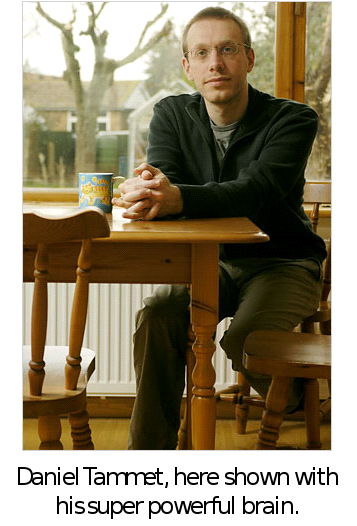


    But I don’t believe that the moral of extraordinary people like Tammet is that they are extraordinary. No doubt they ARE extraordinary – doing *anything* 22,514 times is amazing, especially when a transcendental number is involved. The moral of Daniel Tammet is not that he’s extraordinary, but that it follows that we must ALL be extraordinary. In fact, it follows that we must all have powers even greater than the ones in the savant repertoire.

    You might be responding, “Extraordinary powers! Me? No, you must be mistaken.” And that does seem like a reasonable response, because if we really had mind-boggling powers, wouldn’t we be the first to know? The answer is, “No.” Your own powers are perhaps the most difficult for you to notice. Your capabilities were selected over evolutionary time to work effortlessly as intended, but there was no selection pressure to brag to your consciousness about how exceptionally cool your hardware is.

    You have employed your natural capabilities your whole life, and you have seen them in action in everyone you know; that leads to a “nothing to see here, folks, please go home” mentality about your own capabilities. The only time you are likely to notice your capabilities is when something goes wrong with them. But that still falls quite short of appreciating just how powerful the mechanisms are when they are up and running.

    And this is where Daniel Tammet’s brain, and that of other savants, becomes useful . (I knew there was a reason for your brain, Daniel!) His brain allows us to begin to appreciate the true extent of our own non-savant capabilities. The savant brain is just like our brain, but with a twist. And because giving a (metaphorical) twist to neural tissue can only hinder its workings, the powers of savants are an underestimate to the power we have inside us.

    Why? Consider what cannot be underlying the talents of savants. It is NOT the case that their brain possesses mechanisms, or algorithms, fundamentally different from those found in our brains. That’s the impression one might get by watching television shows or movies about savants: their brains are endowed with some altogether fancy qualitatively new design enabling them to implement their power. But savants are savants because of a disorder; their brains do not end up as they “should” be.

    Their brains have undergone a “twist”. And when mistakes happen in the construction of any machine – biological or otherwise – the chances of getting efficiently designed and altogether new functionality is essential zero. Evolution gets fancy new functionality by virtue of countless generations of tiny changes. Evolution does not design new gadgets in one go.

    What must, then, be going on is that one of the fancy gadgets that is inside all of us is being directed, in savants, in a manner in which it wasn’t selected for. For example, Tammet describes his internal experience of what it’s like to determine the digits of pi as something like visualizing a complex landscape. His brain ended up with a “twist” that gave him the ability to harness the computational power of his visual system for calculating the digits of pi, something his visual system was not designed to do. (As an aside, see my own attempt to harness our visual system for computation)

    The beauty of savant cases is that once the power of the brain is redirected in an utterly unusual direction, then we who observe these savant powers in action have a much better ability to judge the true extent of their power. Whereas we are nearly incapable of gauging how superbly capable the mechanisms are when directed as evolution intended, we see clear-as-day the brawny power of our mechanisms when twisted to point in a strange direction.

    When we see Daniel Tammet reaching the 22,500th digit of pi, and we’re reeling with wonder, we should pause and realize that what Tammet has done is provide a lens through which you can see the superpower hidden inside your own brain.

    In fact, because Tammet’s pi-calculating machinery wasn’t designed for that, the machinery is probably nowhere near as sophisticated as a pi-calculating biological machine would be were pi-calculation to have been selected for.

    The machinery Tammet harnesses for pi-calculation – machinery you have as well, but without the “twist” you can’t harness it as he does – is much more well designed for what it is supposed to do (something having to do with seeing) than for pi-calculating, so the power of Tammet’s superpower pales in comparison to what’s going inside of all of us (including Tammet when he uses his visual system as “intended”).

    Daniel, thanks for illustrating to the world the amazing power of our brains! And thanks for being a good sport!


    Comments

    Alan Snyder started using magnetic fields to impede activation of certain cerebral regions and hey presto people began to draw better etc etc. I have doubts about the size of these effects but the research does raise some fascinating questions about cerebral functions. The website: Centre for the Mind, can provide more info. Bit too jazzy for me but there are peer reviewed publications from this group.

    http://www.centreforthemind.com/

    http://www.wisconsinmedicalsociety.org/savant_syndrome/savant_articles/e...

    Mark Changizi

    Nice; and new to me. Thanks. -Mark
    adaptivecomplexity
    I appreciate the point that our brains have amazing computational power, and that autism-causing mutations are unlikely to have created some new complex function in the brain.   Of course what I want (and I think what a lot of us want), when I read about savants like Daniel, is to figure out how to tap into that power to develop the ability to rapidly memorize long piano pieces, speed read with near-perfect recall, quickly perform 3-figure multiplication in my head, etc.
    Do cognitive scientists have any idea how the power to calculate 20,000 digits of pi is unleashed in a case like Daniel's? Has the brain in this case co-opted an area normally dedicated to some other task?
    Mike
    Mark Changizi

    Well, *that* will require that you come out to my three-week ten-grand training course in Florida.

    Seriously, no. 

    There are, however, a few people working on how the brain can get harnessed to do stuff it "shouldn't" be doing. The link I gave in the text above is one case where I've tried to do it 

    But usually it is culture that's trying to do the harnessing. My research has argued that we can read only because writing has shaped itself to look "like nature". I talk about it in detail in Chapter 4 of my current book, The Vision Revolution. But, generally, here are some relevant links:
    http://www.scientificblogging.com/mark_changizi/topography_language
    http://changizi.wordpress.com/2009/10/13/excerpt-from-chapter-4-of-the-v...
    http://www.telegraph.co.uk/technology/3345612/Alphabets-are-as-simple-as...
    http://www.journals.uchicago.edu/doi/pdf/10.1086/502806 [the paper itself]
    See also Stanislas Dehaene's new book, Reading in the Brain

    More generally, I'm working on new research (in my upcoming book Harnessed) on how cultural evolution has shaped the sounds of speech and music to be "just right" for our brains, which were not (so I argue) selected for processing them.

    You may think that that is still lame compared to doing 22,000 digits of pi. But that's just because it can be difficult to appreciate the powers we have...in reading, speech-processing and music-processing. To turn an ape brain not designed for these things into a human brain that can do them...that's amazing. This is language and music we're talking about!
    adaptivecomplexity
    You may think that that is still lame compared to doing 22,000 digits of pi
    No - I was joking a bit. I am impressed with the powers we have. But if you held your training course in Florida, I probably would come. Especially if it was held in January. I didn't realize that your book dealt with reading and the brain - I've been reading Proust and the Squid, and I've salivated over Dehaene's book in the book store. I'm going to have to put your book on my list too! Thanks for the links.
    Mike
    My research has argued that we can read only because writing has shaped itself to look "like nature".

    Yeah, I read something touching on this issue a few months ago. Some anthropologist, possibly de Waal. The argument was that even the sounds we make were initially derived from the association of the sound and\or lip formation with the meaning(emotional and\or declarative) of the sound.

    Out on a limb and dangling precariously ....

    I have often wondered if the abilities of savants represent the type of information management that occurs in our brains all the time but is masked by those huge frontal lobes which appear to play a very important role in socialisation. Damasio has argued that while most are carrying on about Left - Right issues it can also be argued that there is a type of competition between the posterior and anterior regions of the cerebral cortex. The frontal lobes, which have afferents to many regions of the cerebral cortex, are recruiting these regions for purposes that these regions were not originally adapted towards. In savants this "recruitment" is somewhat diminished, "freeing" these posterior sensory regions to perform marvelous feats. This may explain why some animals can display remarkable powers of perception and navigation in spite of their small brains.

    Conversely it can be argued that over time the frontal lobes, originally evolved to address socialisation issues, are now recruited for complex problem solving and creativity. Hence "nerdism", people so preoccupied with complex conceptual issues, particularly if this preoccupation began in childhood, do demonstrate a lack of socialisation. Not that I'm suggesting anyone here belongs to the nerdism demographic! Oh why not! We only have so many cerebral resources and if some devote more of those resources to conceptual matters rather than socialisation issues more power to them!

    Mark Changizi

    On frontal lobes, sounds very plausible.

    On nerdism, generally, one would expect such zero-sum-games to go on, which is why the general intelligence factor, or g, is so perplexing. ...that for most animals, when smarter in respect X, they're smarter in most seemingly-quite-unrelated (although probably not unrelated) respects A, B, C, D, etc.

    -Mark
    Hey Mark,

    I enjoy the topics you put up. You are an adventurous soul and in these matters that is a critical requirement. Your topics touch on something I read just an hour or so ago:

    .... Francois Jack distinguished between two categories of scientific investigation: day science and night science. Day science is rational, logical, and pragmatic, carried forward by precisely designed experiments. .... Night science, on the other hand, "is a sort of workshop of the possible, where are elaborated what will become the building materials of science. Where hypotheses take the form of vague presentiments, or hazy sensations."

    Kandel, In Search of Memory. p. 240.

    Thanks for stimulating my thinking about these issues Mark. Typically I prefer neuroimmunology and avoid these topics because they make my brain hurt.

    Now its early morning here in Aus so I must continue reading before sleeping.

    Thanks again,

    John.

    Rich Shull
    Savants seem impressive but in the total scheme of things all they are doing is reading their picutre thoughts.  As an Autisitc guy learning a different kind of human thought process a few steps below you operate from,  I can assure you it is natural autism. Savants are a natrual "stoping off" point on the way up the thought scale(in a journey that has never been in a text book yet) Autism is sublevel different kind of human thought process that takes place during the lack of eye contact. While we don't have eye contact we have internal thoughts (picture thoughts) that we do. These internal thoughts range from MR/DD thing to savants to even normal thought as you know it once its all figured out.

    These thoughts are the building blocks of the mind and have never been in a book before. When Rain Man the movie Character was reading the phone book in the Movie of the same name he was literally doing just that ,reading the phone book  from his photo memory. Evolution for most people glossed over that ability and of course added a few social things to our minds but it did that by watering down quite a few things that would have made us 'smart'. Few of us have a photo memory today.  These deep reading the phone book and figuring PI things seem to be (have been) natural human thought.

    If all the autism picutre thoughts even those we use that BUILD on the work of Temple Grandin were known and  figured into psychology ; psychology would be solved, the mind would  not be a puzzle any more but a scary shallow 'swichboard'.   If this autism ever passes peer review and the "new News" it contains is ever implemented colleges could offer courses in being a savant. Savants are just a few steps below 'normal', If our deep internal picurue thoughts are discovered .  Savants are just reaching down into the depths of the mind and taping the intenral codes we all use but don't know we use. Once psychology figures this out kindergarten will start out in the picutre thought sublevel thought range and the 123's and the abc's will work much better. 123 and the abc's are believe it or not already short cutted normal thoughts.   

    The reason Savants are so impressive is, if you will, they are holding a mirror to man's intenral thoughts. All of mankind could do things like that and we probably did before 'Evolution' made us social.   I know my regular autism thoughts are very intense and tooo-ooo complicated to be communicated so I have had to learn to water them down.  One or two thoughts of my Turing Motor engne could yield a 1000 engineering dawings. If I talk about those in terms of my deep thoughts NO One will understand it. I have to water them down socialize them with picutre thoughts then talk about them watered down. I see a 'dumb' autisitc kid or an MR/DD student I see as a smart savant type (really) that just needs to learn his -her internal thought codes (picutre thoughts ) and they will recover nicely. Who ever dreamed the mr/dd student is really smart and could bloom nearly instantly with the aid of their intenral thoughts being taught to them? Of Course this is all new news to psychology, and the psychology experts have never done a mile in our shoes and still see autism as a defect and they way they go about it- it really is.  Bring this autism full circle like we have, and some experts will be red faced and humaninty will grow from the experience.      rich Shull
