Banner
By Mark Changizi | April 29th 2010 01:52 PM | 15 comments | Print | E-mail | Track Comments
About Mark

Mark Changizi is assistant professor in the Department of Cognitive Science at Rensselaer Polytechnic Institute, with expertise in theoretical neurobiology...

View Mark's Profile
Note: RPI put out a press release today (4/29/2010) on my work today so I am reposting this with today's date also.

If you ever have a mysterious skin rash and show your doctor, he or she may very well take a marker and encircle it, and then ask you to come back in a week. What’s the marker for? That’s obvious. If the rash is expanding, it may grow by only, say, 5% in a week, far too little to notice. But with the marker pen tightly encircling the original extent of the rash, any growth in the rash will become perceptually obvious because it will have grown beyond the boundary of the marker pen. 

As obvious as this is for rashes, this basic principle is not currently followed for the much more acutely important skin color changes that occur in various medical conditions. Despite skin pallor having had a long history within medicine diagnosis, the medical community is currently handicapped in its ability to visually sense clinically relevant skin color modulations. For skin color, medicine is markerless. If a doctor sees a patient, and then sees the patient again later, the doctor will have little or no idea whether the skin has shifted. Quantitatively small color shifts can have tremendous medical implications: it can, for example, mean the difference between having healthy oxygen saturation and life-threateningly low oxygen saturation. 

But we can do better. Our eyes have evolved, so I have argued in my research, to be near optimally sensitive to skin color changes due to underlying physiological changes in the blood. The skin color changes that mattered over evolution were socio-sexual signals, and socio-sexual signals tend to have strong spectral gradients our oximeter eyeballs are great at detecting. In fact, our eyes depend on these gradients to see skin colors. For example, our perception of blue-green veins depends crucially on its contrast with the surrounding skin. Blue-green veins if viewed all by themselves (i.e., through an aperture) do not appear blue-green at all. Veins are just slightly spectrally shifted toward blue-green compared to the skin’s baseline color, but when seen with the baseline color in the spatial surround, one sees the veins as genuinely blue-green. 

Clinical color changes, on the other hand, are not selected to be seen – they are just side effects of being sick – and can often lead to much more spatially uniform shifts in color. And that’s the problem. If a patient’s skin color shifts a small amount for many clinical reasons (like central cyanosis), then when the doctor or nurse comes back, the color shift will often be imperceptible.
 
We can, however, fix this with a little marker pen. Rather than encircling the baseline extent of the rash, we need a marker pen to record the baseline color of the patient’s skin. And one place to begin marking up is the beloved hospital gown (although the same point will apply to any other colors visually proximal to the patient, such as the walls or sheets). The problem with hospital gowns is not just the drafty bum, but that gown colors are not designed to harness the oximetric, blood-diagnosing powers of our eyes.

The figure below shows four sample hospital gown colors, and on each of these colors I have placed the same five patches of skin. The central patch, let us presume, is your baseline skin color. The patches around the central patch are slightly color-shifted from the baseline, namely (from top, clockwise) bluer, redder, yellower and greener. Even with the baseline pitch there in the image, the color shifts are not perceptually salient. All the patches look qualitatively like the baseline patch’s color. And in real life the nurse or doctor would see the central patch, and then come back later and see just one of the shifted colors – determining if the color has changed would be nearly impossible. 
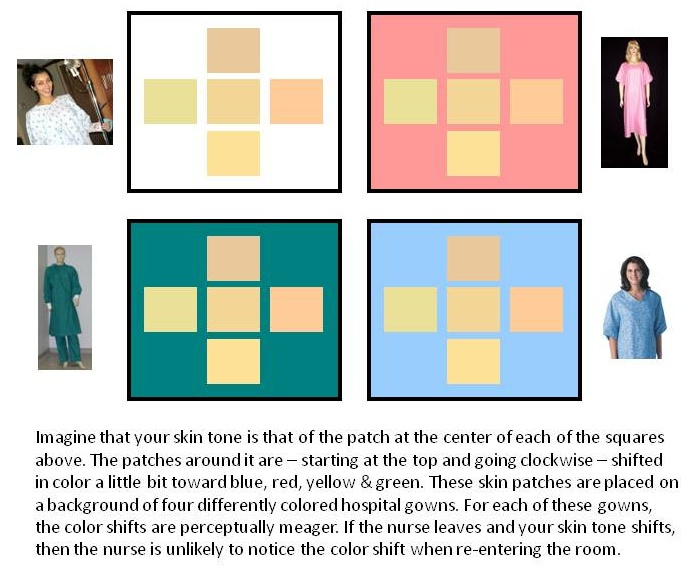
mark changizi nude colored gown color changes


But now consider what happens if I lay those same five colored skin patches adjacent to a gown that has a color matching the baseline skin color in the center. In the figure below the four color-shifted patches look utterly and qualitatively distinct. They don’t look just a wee bit bluer, redder, yellower and greener than baseline. Rather, they now look distinctly blue, red, yellow and green. Again, these are the exact same four patches as were in each of the “gowns” in the previous figure. 
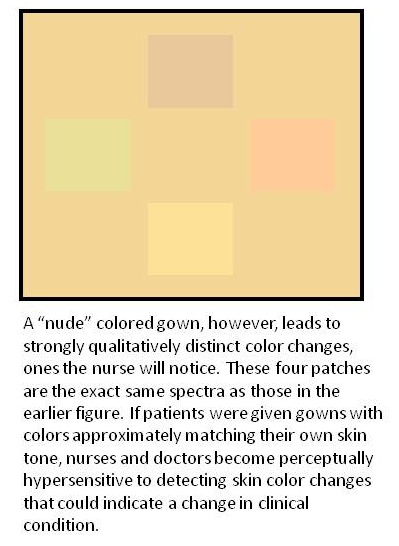
mark changizi nude colored gown color changes


Here, then, is the simple prescriptive advice for hospitals: buy skin tone colored gowns, with colors relevant for the population you serve, and have patients wear a gown that best matches their baseline skin color. The tighter the color match, the more hypersensitive the eyes of the nurses and doctors are at sensing tiny spectral shifts away from baseline. I also suggest “skin color adhesive tabs” in a recent publication, which you can read here: http://www.changizi.com/colorclinical.pdf

Are these ideas relevant, you might ask, given that hospitals these days have cheap access to oximeters? Here is what co-author Kevin Rio and I write about this at the end of the article I just mentioned above:
One may wonder if these two techniques for harnessing color vision for oximetry are relevant in modern medicine, given the availability of pulse oximetry. [T]he clinical disciplines most utilizing pulse oximetry are also the disciplines that most often refer to the patient’s clinical skin color in diagnosis: thus, the actual practice of medicine appears to value our human color capabilities, despite the presence of pulse oximetry. There are several potential explanations for this: (a) color perception provides redundant detection of oxygen saturation (e.g., if the oximeter becomes unattached), (b) observation of skin color modulations may lead to a faster behavioral response by the clinician (the “look” of sickness may be more psychologically engaging than numbers or beeps from an oximeter), and (c) our color perception is capable of sensing the spatial gradients in skin color across the body, and the nature of those gradients can impart information to a clinician. Furthermore, there are circumstances where pulse oximetry is not used today, but where the “color oximetry” techniques above would be of great value: (i) in certain parts of the hospital (e.g., in transit, or the emergency department waiting room), (ii) in third world hospitals, where it is still not part of standard care, (iii) in the field (e.g., for athletes or soldiers, and (iv) in the home (e.g., for SIDS detection). 

Haiti comes to mind.

Comments

Looks pretty white-people centric, from the illustrative material you’ve used. My wife and her family side is all black, as is my mum’s side of the family, and there’s a far wider range of different colours of black skin even within the same families. You’d end up running out of appropriate gowns fairly quickly on some days, only leaving inappropriate shades.

Mark Changizi
Ian,

The same point applies to any and all skin. Illustrative material is, well, illustrative. And I'd guess there's similar baseline variability for all ethnicities.  Whether a gown color palette of 20 or 200 is practical will depend on how cheap they are to make, and so on.  But the closer the match, the better for the eye. 

Mark

Not sure which culture or country you are writing from, but outside of the TV show "House", there is no doctor in America that has the time or effort to notice skin color. Here, they barely read their own charts. If you don't tell the nurses about a problem, the MD hasn't got a clue. "Next, Please!"

Mark Changizi

Steve,

:) True. My wife's a doctor.  These days it applies more to nurses, clinicians, etc.  But it is nevertheless the case that, to this day, medicine is filled with references to the patient's acute skin tone, especially in places where oximetry is crucial.  And there is a long history of color-blind doctors fussing about their inability to see signs the color-normals easily see (e.g., see Supp Table 1 on page 15 of http://www.changizi.com/colorface.pdf ).

Mark


logicman
A good idea, Mark, but I forsee two problems. 

Firstly, there is the psychological problem of self-image.  Consider the similar anorexia problem of body-size self-image.  Admittedly this is anecdotal evidence, but it was reported to me by a professional photographer in Pakistan that portraits have to be airbrushed to lighten the apparent skin tone.  It seems that customers will not accept pictures which accurately portray the sitter's skin tone.  Such portraits draw remarks such as: "I'm not that dark!"

Secondly, given the huge range of interpersonal and international skin tones, hospitals would have a logistics problem in stocking a sufficient range and quantity of gowns.

May I suggest a plausible alternative?  The bumpatch.  A small patch is selected to match the patient's gluteal epidermis.  It has 4 cut-outs in it, so it functions in the way you describe: as a cognitive comparison boundary.

This should not impact overmuch on a busy doctor's time, and may speed things up:

Next!
Bend over!
Next!
Bend over!
Next!


Mark Changizi

Funny. On the logistics, hospitals are complicated places that spend inordinate amounts of money on endless packaging, gizmos and shmizmos. The question is not, to me, whether this is too complicated, but whether the clinical advantage outweighs the cost.  And while the better the color match, the more sensitive the eyes are, a rough match is still much better for the eyes than the white, blue, green or red colors currently used. Even having only three skin tones available that roughly covers the range of the population may go a long way to harnessing our oximetric eyes. And having walls and sheets picked that are roughly in the average skin tone of the population will be much better than having it spectrally far from every one's skin color.

In addition to gowns, I do suggest in this paper here -- http://www.changizi.com/colorclinical.pdf -- another technique, this one placing several colored tabs on the skin. When the patient's skin shifts, what the clinician perceives is not that the skin has changed color, but that the tab has changed color, namely in the opposite direction to the color shift. So, e.g., an initially skin-color-matching tab is placed on the skin, and suppose the patient's skin cyanoses and so shifts a little toward blue. What the clinician will perceive is that the little tab is now yellow, signaling to the clinician that the skin has shifted in the blue direction, and the perceived saturation of yellowness indicates the amount of the spectral shift.

-Mark

Part of the problem might be that we generally haven’t required the development or expansion of a vocabulary with which to be precise about colour to that degree. I mean, we’re ridiculously blunt about describing colours we even know aren’t accurately portrayed. I’m not white, I’m a sort of pinky beige colour, but categorically I’d be described as “white” in the news media, whereas my wife is a nice brown at the lighter end of the scale, but her daughters differ from that in either direction quite significantly, but they’re all categorised as “black”. White is the colour of paper, but even white paper can vary a lot. Black is the colour of my Nikon, but it‘s remarkably difficult to shoot a black object properly without it having to show some reflected light. But not even Stevie Wonder and Paul McCartney are absolutely black or white people. I think the problem is that we simply don’t have the vocabulary for all the different shades of skin that we are faced with day after day every day. It’s like a negative snowclone, I suppose. And if we don’t have the vocabulary, we probably don’t have the category in our minds in which to be able to refine in detail what it is - whatever category we have is too wide, too blunt to be useful.

Mark Changizi

Ian,  Indeed. I have argued that this color-naming difficulty for one's own skin color (or whatever skin color one sees most) is expected if our color perception adapts so as to be optimally sensitive to the color modulations near that baseline. (That's one of the fun parts of the first chapter of The Vision Revolution, actually!)   -Mark

Interesting!

A small adhesive strip like a temperature key on a weather map would work and be cost effective. It could also be used with other information, such as adhesives stickers that tell the temperature of the object they are applied to.

Mark Changizi

Right! See the latter part of this paper: http://www.changizi.com/colorclinical.pdf -Mark

Graphic artists have been measuring color for many years. For example, there are sophisticated tools for making sure that the color printed on a piece of paper matches the color displayed on a monitor which in turn matches the color picked up by a scan of a photograph. I guess I don't see why these colorimetric tools can't be used to measure color, or even print a color swatch calibrated to match a patient's color to document what it was when measured.

Mark Changizi

Skin is tricky, in particular the color modulations due to hemoglobin.  ...they're not picked up by normal cameras, because normal cameras have sensitivities uniformly distributed across the spectrum, and to be sensitive to modulations in oxygenation requires a specific design for the cones (namely, like ours).  But one can use color adhesive tabs from a palette, something I discuss at the end of the paper I cite above.  -Mark

jtwitten
Our eyes have evolved, so I have argued in my research, to be near
optimally sensitive to skin color changes due to underlying
physiological changes in the blood.

Bearing in mind that I do not have time to read through your entire research oeuvre to answer this question, assuming optimality, why have the eyes evolved for this sensitivity as opposed to skin tone changes in response to blood physiology being evolved to match eye sensitivity?

Mark Changizi
Nice question. Hemoglobin concentration and oxygenation modulations in the skin have the same spectral modulations for all primates (color and color blind), and most (or all) mammals.  That is, our skin spectra has the same spectral modulatory capabilities it always had, well before we had color vision.

Add a comment

The content of this field is kept private and will not be shown publicly.
  • Allowed HTML tags: <sup> <sub> <a> <em> <strong> <center> <cite><TH><ul> <ol> <li> <dl> <dt> <dd> <img> <br> <p> <blockquote> <strike> <object> <param> <embed> <del> <pre> <b> <i> <table> <tbody> <div> <tr> <td> <h1> <h2> <h3> <h4> <h5> <h6> <hr> <iframe>
  • Lines and paragraphs break automatically.
  • Web page addresses and e-mail addresses turn into links automatically.
CAPTCHA
If you register, you will never be bothered to prove you are human again. And you get a real editor toolbar to use instead of this HTML thing that wards off spam bots.