

Ibn al-Haytham can be called the father of modern optics. His 11th-century Book of Optics, which was published 1000 years ago, is considered by some to be in the same league as Newton's Principia regarding its influence in physics, yet very little is known about the writer.
Science 2.0 fave Jennifer Ouellette of Cocktail Party Physics tackles the topic in Physics World, with one of those semi-historical accounts of al-Haytham's life when he was banished from society and deprived of books and came up with his revolutionary theories about the form and passage of light.
Ouellette creates some meat for the skeletal plot of the medieval Muslim polymath's life, from the awe and intimidation felt when he was summoned by the Caliph to use his engineering prowess to overcome the annual flooding of the Nile, to his fear of punishment when he realized he had failed in his task.
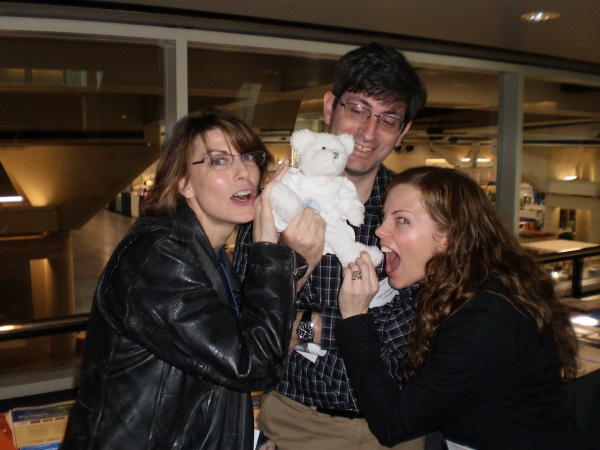
Jennifer Ouellette with another mad genius, our own mascot Bloggy, at the AAAS meeting, along with Carl Zimmer and Kirsten "Dr. Kiki" Sanford.
Al-Haytham was only able to escape a death sentence from the notoriously brutal Caliph by pretending he had gone mad. The Caliph instead incarcerated Al-Haytham, imprisoning him under house arrest to a cell. Confined and alone, it was here that Al-Haytham carried out the work that was to make him famous.
In 11th-century Egypt, Aristotle's ancient thought that visible objects and our own eyes emit rays of light to enable our vision still held. Ouellette imagines al-Haytham lying alone in his darkened room questioning why the objects in the room are not emitting light and asking 'Is it possible that the ancients were mistaken?'
The question providing the crux, al-Haytham was spurred into experimental action with the candles and copper in his bare room to conclude that there is no mysterious "form" that all objects emit; rather there are sources of primary light that are reflected by other objects.
As Ouellette writes, "This is a work of fiction – a fanciful re-imagining of a 10-year period in the life of Ibn al-Haytham, considered by many historians to be the father of modern optics. Living at the height of the golden age of Arabic science, al-Haytham developed an early version of the scientific method 200 years before scholars in Western Europe."
Released from prison after the Caliph's death, Al-Haytham (AD 965-1040) went on to make contributions to astronomy, mathematics, engineering and medicine, as well as physics. But it his seven-volume Book of Optics, which he wrote while imprisoned, that remain his most famous contributions to science, covering visual perception, psychology and physical optics.

Science 2.0 fave Jennifer Ouellette of Cocktail Party Physics tackles the topic in Physics World, with one of those semi-historical accounts of al-Haytham's life when he was banished from society and deprived of books and came up with his revolutionary theories about the form and passage of light.
Ouellette creates some meat for the skeletal plot of the medieval Muslim polymath's life, from the awe and intimidation felt when he was summoned by the Caliph to use his engineering prowess to overcome the annual flooding of the Nile, to his fear of punishment when he realized he had failed in his task.
Jennifer Ouellette with another mad genius, our own mascot Bloggy, at the AAAS meeting, along with Carl Zimmer and Kirsten "Dr. Kiki" Sanford.
Al-Haytham was only able to escape a death sentence from the notoriously brutal Caliph by pretending he had gone mad. The Caliph instead incarcerated Al-Haytham, imprisoning him under house arrest to a cell. Confined and alone, it was here that Al-Haytham carried out the work that was to make him famous.
In 11th-century Egypt, Aristotle's ancient thought that visible objects and our own eyes emit rays of light to enable our vision still held. Ouellette imagines al-Haytham lying alone in his darkened room questioning why the objects in the room are not emitting light and asking 'Is it possible that the ancients were mistaken?'
The question providing the crux, al-Haytham was spurred into experimental action with the candles and copper in his bare room to conclude that there is no mysterious "form" that all objects emit; rather there are sources of primary light that are reflected by other objects.
As Ouellette writes, "This is a work of fiction – a fanciful re-imagining of a 10-year period in the life of Ibn al-Haytham, considered by many historians to be the father of modern optics. Living at the height of the golden age of Arabic science, al-Haytham developed an early version of the scientific method 200 years before scholars in Western Europe."
Released from prison after the Caliph's death, Al-Haytham (AD 965-1040) went on to make contributions to astronomy, mathematics, engineering and medicine, as well as physics. But it his seven-volume Book of Optics, which he wrote while imprisoned, that remain his most famous contributions to science, covering visual perception, psychology and physical optics.



So we’ll let you off this time, since whether one speaks of him as coming from Iraq or Egypt is a bit like asking whether Handel was a German or English composer. The biography goes on to say:
Certainly, it is most fortunate for science that Al-Haytham (965 – 1040) lived when he did. The world he grew up in was about to receive some massive blows.
The first of these was the sacking of Baghdad (the great home of mathematics in his day) by the Seljuk Turkish invader Toğrül Bey in 1055. He was quite moderate for his time, and half the people survived, including the great mathematician and poet Omar Khayyam.
The First Crusade followed 40 years later, but none of these reached Baghdad, whose next invader was Hulagu (grandson of Jenghis) Khan in 1258. This time almost total massacre was the day. However, one mathematician who did survive was the Persian Nasir al-Din al-Tusi. It seems that Hulagu allowed him to live, hoping that he would be able to foretell the future. As I have written elsewhere, Al-Tusi is most likely one of the sources used by Copernicus.
One wonders, after this, why anyone would ever bother returning to Baghdad. A century and a half later (1401) the population was again wiped out by Timur (a descendant of Jenghis Khan again!), whom English readers might know from Marlowe’s play Tamburlaine the Great. One might have thought that this was curtains for mathematics, but Timur’s grandson Ulugh Beg (1393 – 1449) preferred mathematics to massacre, and was not only a good mathematician in his own right, but supported the even greater mathematician al-Kashi (1390 – 1450).
Alas, Ulugh Beg’s son reverted to family type, and arranged the murder of his own father in order to seize the throne. Thereafter, it was curtains for mathematics in that part of the world.
Even in European history, it is remarkable how much great mathematics and science was produced in times of great turmoil. However, it seems there is only so much that a given culture can take before giving up on knowledge.
[1] “Carrying dates to Basra” is the Arabic equivalent of “carrying Coals to Newcastle”.