




Heck and his colleagues examined 22 interstellar grains from the Murchison meteorite for their analysis. Dying sun-like stars flung the Murchison grains into space more than 4.5 billion years ago, before the birth of the solar system. Scientists know the grains formed outside the solar system because of their exotic composition.
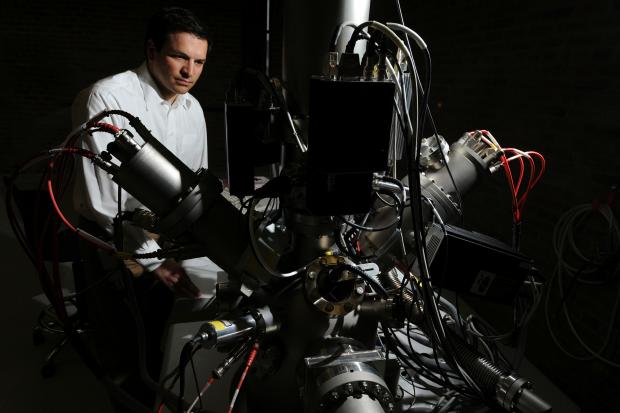
Philipp Heck with the Chicago Center for Cosmochemistry's time-of-flight mass spectrometer, which can reveal the chemical composition of minute experimental samples. Heck and his associates used magnetic sector mass spectrometers in their latest study on interstellar dust grains. Photo: Dan Dry
“The concentration of neon, produced during cosmic-ray irradiation, allows us to determine the time a grain has spent in interstellar space,” Heck said. His team determined that 17 of the grains spent somewhere between three million and 200 million years in interstellar space, far less than the theoretical estimates of approximately 500 million years. Only three grains met interstellar duration expectations (two grains yielded no reliable age).
“The knowledge of this lifetime is essential for an improved understanding of interstellar processes, and to better contain the timing of formation processes of the solar system,” Heck said. A period of intense star formation that preceded the sun’s birth may have produced large quantities of dust, thus accounting for the timing discrepancy, according to the research team.
Citation: “Interstellar Residence Times of Presolar Dust Grains from the Murchison Carbonaceous Meteorite,” Astrophysical Journal, June 20, 2009, Vol. 698, Issue 12, pages 1155-1164



Comments