




Even in deserts the air contains water and the research scientists have found a way of obtaining drinking water from air humidity using a system is based completely on renewable energy, making it autonomous.
Even in places with no lakes, rivers or groundwater, considerable quantities of water are stored in the air. In the Negev desert in Israel, for example, annual average relative air humidity is 64 percent – in every cubic meter of air there are 11.5 milliliters of water.
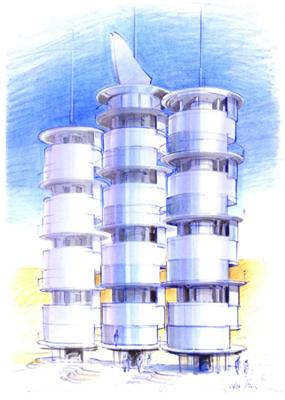
Plants producing large quantities of drinking water from moisture in the air could look like this. © Logos Innovationen. Photo credit: Fraunhofer-Gesellschaft
“The process we have developed is based exclusively on renewable energy sources such as thermal solar collectors and photovoltaic cells, which makes this method completely energy-autonomous. It will therefore function in regions where there is no electrical infrastructure,” says Siegfried Egner, head of department at the IGB.
The principle of the process is as follows: hygroscopic brine – saline solution which absorbs moisture – runs down a tower-shaped unit and absorbs water from the air. It is then sucked into a tank a few meters off the ground in which a vacuum prevails. Energy from solar collectors heats up the brine, which is diluted by the water it has absorbed. Because of the vacuum, the boiling point of the liquid is lower than it would be under normal atmospheric pressure. This effect is known from the mountains: as the atmospheric pressure there is lower than in the valley, water boils at temperatures distinctly below 100 degrees Celsius.
The evaporated, non-saline water is condensed and runs down through a completely filled tube in a controlled manner. The gravity of this water column continuously produces the vacuum and so a vacuum pump is not needed. The reconcentrated brine runs down the tower surface again to absorb moisture from the air.
“The concept is suitable for various sizes of installation. Single-person units and plants supplying water to entire hotels are conceivable,” says Egner.
Prototypes have been built for both system components – air moisture absorption and vacuum evaporation – and the research scientists have already tested their interplay on a laboratory scale. In a further step the researchers intend to develop a demonstration facility.


Comments