

Banner
    Posteromedial Cortex: Divide Between Narcissists And Psychopaths Narrow
    By News Staff | October 2nd 2010 01:05 PM | 5 comments | Print | E-mail | Track Comments
    Like many of history's greatest minds, narcissists spend a great deal of time deep in thought - but for narcissists it is thought about themselves.

    Neuroscientists recently found a correlation between high scores on the Machiavellian Egocentricity subscale - a measure of narcissism - and activity during rest in the posteromedial cortex, a brain region that previous studies have associated with thoughts about the self.  The study also found a correlation between poor decision-making and brain activity during rest in the medial prefrontal cortex. Impulsive action without regard for consequences is another aspect of psychopathic behavior.

     Narcissists thinking about themselves all of the time is more than a stereotype. Since narcissism is one component of the psychopathic mind, differences between the brain patterns of normal people and narcissists may help psychiatrists to understand and treat dangerous individuals.
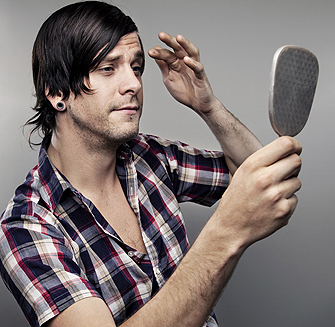


    Just a graphic, no actual narcissism was clinically established in this guy.  Credit: USC.

    “Perhaps the fact that psychopathy [like personality traits in general] tends to be stable across life might be due to neural mechanisms,” said Tong Sheng, the study’s lead author.

    The researchers analyzed brain regions active during rest because they are believed to support a baseline state of thought that includes reflection about the self.   Other studies have linked the posteromedial cortex and medial prefrontal cortex to self-reflective thought.

    Activity in the resting state falls off when a person starts a task or reacts to a stimulus, supporting the hypothesis that resting state activity has to do with unstructured recall and reflection.

    The study involved 19 healthy volunteers who had their brains scanned by functional magnetic resonance imaging at rest and while performing a task.   Outside the scanner, the subjects took psychological tests to measure narcissism and decision-making.

    The researchers wanted to answer a simple question; if these regions are actually important for self-processing, are people who are more narcissistic going to activate these regions even more?

    The answer appears to be yes.    The researchers also found a correlation between poor scores on the decision-making test and activity in the medial prefrontal cortex. 

    The researchers measured the intensity of activity in the resting state by comparing it to activity in the same regions during performance of a task.   Subjects who scored high in narcissism showed a greater drop in activity in the posteromedial cortex when asked to perform a task. 

    More impulsive subjects showed a similar drop in the medial prefrontal cortex. This makes sense, they explained, since that region seems to be involved in decisions. Subjects who struggle to control their impulses would be expected to show neural deficits in decision-making.   They say the study is the first to show a correlation between narcissism and activity in the posteromedial cortex.

    The study was funded by the Eunice Kennedy Shriver National Institute of Child Health&Human Development, a USC James H. Zumberge Individual Award, the USC Brain and Creativity Institute and the USC Dornsife Cognitive Neuroimaging Center.


    Citation: Sheng T, Gheytanchi A, Aziz-Zadeh L (2010) 'Default Network Deactivations Are Correlated with Psychopathic Personality Traits', PLoS ONE 5(9): e12611. doi:10.1371/journal.pone.0012611


    Comments

    I don't think it's very scientific to come to such conclusions and publish them for public review when the study included only 19 subjects.

    Hank
    It may sound low but statistically that's pretty efficient.   With that number you will only have one outlier (absolutely bonkers result) giving you a margin of error of +/- 19%. 

    That may sound high but it actually isn't, since the thing they are testing, activity in  the posteromedial cortex, is quite specific - it isn't like a political opinion poll where even +/- 5% can be wildly inaccurate (people losing in polls win all of the time).

    It's not only unnecessary because the research is so specific, it's darn expensive to overshoot accuracy.    To get down to +/- 10%, they would need 71 users so they would have to test 76 to account for the 5 likely outliers.    And, like I say, given what they are testing, activity during rest and comparing it to people who score on a personality test a certain way, would be no more accurate.


    Want more no-nonsense, independent science? Buy Science Left Behind
    rholley
    I’m worried.  I’ve often thought wouldn’t it be good to have my brain analysed in order to find out why I behave the way I do.

    Now I ask: is that an indicator of narcissism?
    Robert H. Olley Quondam Physics Department University of Reading England
    Hank
    I hope not or it afflicts me also; I prefer to consider analyzing my brain a cautionary tale for future generations.
    Want more no-nonsense, independent science? Buy Science Left Behind
    I must say that I am not surprised at the results of this small study. Psychologists have been suggesting for years that narcissism can be observed on a continuum ranging from mild (low self-esteem which is compensated for by an external appearance of excessive self-confidence, over-concern for self and poor empathic skills) through to fairly severe (narcissistic personality disorder, characterised by a complete lack of empathy, carefully concealed delusions of fantastic grandiosity and fantasies of unlimited achievement) all the way to very severe ("malignant" narcissism, an as-yet tentative diagnostic concept, which shares traits with psychopathy such as predatory behaviour).
    However, although psychopaths display narcissistic traits, there is a clear diagnostic distinction between a malignant narcissist and a psychopath which is easily explained: a psychopath has no internal emotional life whereas even the most extreme narcissists clearly does.
    Using Facebook as a research tool for narcissism holds a certain irony, in that it is hypothesised that it is a good representation of, and possibly contributing factor to, the modern obsession with the outer form of a person (who and what they appear to be) rather than the inner form of a person (who and what they really are). One quite useful, if simplistic, way of recognising narcissistic traits is by an obsession with the former to the detriment of a balanced consideration of the other.
    For readers who are interested, I have written more on the possible causes of the modern trend towards narcissistic traits and some possible responses to it here Narcissism and Society
