Banner
The Scorched Cherry Twig And Other Christmas Miracles Get A Science Look

Bleeding hosts and stigmatizations are the best-known medieval miracles but less known ones, like ...

$0.50 Pantoprazole For Stomach Bleeding In ICU Patients Could Save Families Thousands Of Dollars

The inexpensive medication pantoprazole prevents potentially serious stomach bleeding in critically...
Metformin Diabetes Drug Used Off-Label Also Reduces Irregular Heartbeats

Adults with atrial fibrillation (AFib) who are not diabetic but are overweight and took the diabetes...

Your Predator: Badlands Future - Optical Camouflage, Now Made By Bacteria

In the various 'Predator' films, the alien hunter can see across various spectra while enabling...

User picture.
News StaffRSS Feed of this column.

News Releases From All Over The World, Right To You... Read More »

Blogroll

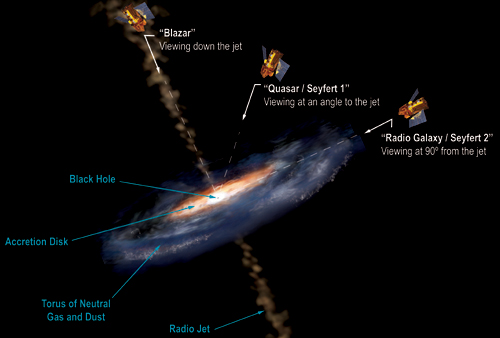
You’d think that astronomers would have found all the different classes of active galaxy nuclieu (AGN ) - after all, AGN such as quasars, blazars, and Seyfert galaxies are among the most luminous objects in our Universe, pouring out the energy of billions of stars from a region no larger than our solar system.

But a team has discovered that a relatively common class of AGN has escaped detection until now.

Scientists here have developed new dye-sensitized solar cells (DSSCs) that get their pink color from a mixture of red dye and white metal oxide powder in materials that capture light.

Currently, the best of these new pink materials convert light to electricity with only half the efficiency of commercially-available silicon-based solar cells -- but they do so at only one quarter of the cost, said Yiying Wu, assistant professor of chemistry at Ohio State.

And Wu is hoping for even better.

"We believe that one day, DSSC efficiency can reach levels comparable to any solar cell," he said. "The major advantage of DSSCs is that the cost is low. That is why DSSCs are so interesting to us, and so important."

Limiting and labeling trans fats in food is not enough, according to Walter Willett, an epidemiologist and nutrition professor at the Harvard School of Public Health, who argues to food manufacturers that they should be banned altogether.

Willett was among dozens of speakers on the opening day of the Institute of Food Technologists Annual Meeting & Food Expo here, the world’s largest annual food science forum and exposition.

While some trans fats occur naturally in foods, most are the result of cooking or baking with hydrogenated oils. Those oils provide creamy textures that are enjoyable to eat and affect positively the shelf life and stability of many foods like baked goods.

Researchers at Johns Hopkins have found a way to overcome a major stumbling block to developing successful insulin-cell transplants for people with type I diabetes.

Traditional transplant of the cells, accompanied by necessary immune-suppressing drugs, has had highly variable results, from well- to poorly tolerated. Part of the problem, the Hopkins researchers say, is an inability to track the cells—so-called pancreatic beta cells—once they’re inside the body.

Now a new technique encapsulates the insulin-producing cells in magnetic capsules, using an FDA-approved iron compound with an off-label use, which can be tracked by magnetic resonance imaging (MRI).

In order for the best baseball team to win, the National League would have to extend its season to 256 games say a pair of physicists at the Los Alamos national Laboratory in New Mexico.

Because of randomness, there's always a chance a bad team can win so mathematically a certain outcome for the best team requires a number of games equal to roughly the cube of the number of teams. In the National League, with its 16 teams, that means 4096 regular season games or 256 per season, almost 100 more than the 162 games they play now.

Scientists at the U.S. Department of Energy's Argonne National Laboratory have identified a new technique for cleansing contaminated water and potentially purifying hydrogen for use in fuel cells, thanks to the discovery of a innovative type of porous material.

Argonne materials scientists Peter Chupas and Mercouri Kanatzidis, along with colleagues at Northwestern and Michigan State universities, created and characterized porous semiconducting aerogels at Argonne's Advanced Photon Source (APS). The researchers then submerged a fraction of a gram of the aerogel in a solution of mercury-contaminated water and found that the gel removed more than 99.99 percent of the heavy metal.