




The Order of the Hermits of St Augustine was founded in 1256 but by 1274 were on the way out because they were founded after 1215 and lacked continuous existence since late antiquity. For 25 years, until their order was re-confirmed, Augustinian friars worked to prove their legitimacy, by going to remote areas that prominent clerics wouldn't. For example, many know of England's Saint George, the famous dragon slayer, but far less famous is Guglielmo of Malavalle who was venerated by the Augustinians for killing a dragon with a humble wooden staff shaped like a pitchfork.
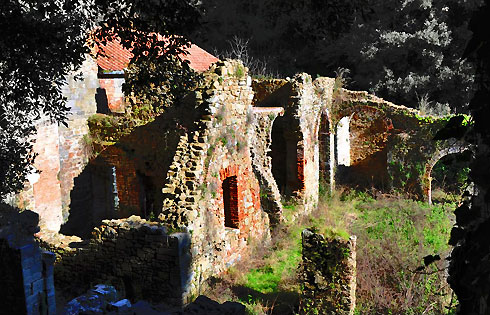
The older section of the hermitage at Malavalle. Link: Augnet
Then, as now, nature is always finding new ways to destroy plant and animal life, and the toxic breath of dragons was to blame. They emerged from swamps, which have rightfully been associated to disease, and the tale goes that Guglielmo was inspired to was determined to rid the area of them. So he settled in Malavalle, ‘the bad valley’, in Tuscany’s swampy Maremma region, home of toxic air and terrible storms, where not even hunters dared to enter.
It worked. He slayed the dragon 'with a pitchfork', it is said, though it may have been his agricultural science that was divinely inspired. The weather improved, crops yielded good harvests, and livestock multiplied.
He made a true life-or-death difference. Yet most have never heard of it. That is where Dr. Ilko helped. She analyzed frescoes, manuscripts, hagiographies and letters, and discovered some had been misdated and wrongly attributed. Or outright ignored. Perhaps because rural life didn't get much respect in the predecessor to Italy.
A Florentine friar in the 1320s wrote stories down and it's now housed in Florence’s Biblioteca Medicea Laurenziana. For example, one recounts how Giovanni of Florence built the Augustinian hermitage of Santa Lucia in Larniano and healed the the broken leg of an ox with touch. Another story describes Jacopo of Rosia commanding a low-yield apple tree to produce better fruit each year, as well as him multiplying cabbages.
“The Franciscans and Dominicans, in particular, are credited for Italy’s rapid urban renewal from the 1200s onwards," notes Dr. Ilko. "Not many people realize that the Augustinians drew most of their power from the countryside. Their miracles were very green-fingered, agricultural."
That mat be why they got less respect. Rome, Florence and Siena got all the Renaissance attention. Yet being rural may have kept the order alive. Direct contact with nature gave the friars legitimacy and belief they had spiritual powers to help with natural resources including timber, crops and wild animals - their miracles convinced the Church to renew them. They took over a spot the Franciscans had rejected as too inhospitable, with an ancient walnut tree stuffed with demons that had guarded the supposed burial site of the Emperor Nero, and founded the convent of Santa Maria del Popolo, framed by trees and gardens on one side.
Perhaps with Leo XIV becoming the first Augustinian and first American Pope, the ruins of Augustinian hermitages will be better cared for and have access improved so that that more people can visit them.






Comments