Banner
The Scorched Cherry Twig And Other Christmas Miracles Get A Science Look

Bleeding hosts and stigmatizations are the best-known medieval miracles but less known ones, like ...
$0.50 Pantoprazole For Stomach Bleeding In ICU Patients Could Save Families Thousands Of Dollars

The inexpensive medication pantoprazole prevents potentially serious stomach bleeding in critically...

Metformin Diabetes Drug Used Off-Label Also Reduces Irregular Heartbeats

Adults with atrial fibrillation (AFib) who are not diabetic but are overweight and took the diabetes...

Your Predator: Badlands Future - Optical Camouflage, Now Made By Bacteria

In the various 'Predator' films, the alien hunter can see across various spectra while enabling...

User picture.
News StaffRSS Feed of this column.

News Releases From All Over The World, Right To You... Read More »

Blogroll

If objects from space kindled life on Earth, how did it happen?

The terrestrial or extra-terrestrial case for important ingredients that led to the building blocks of life is a hot debate. A new paper says that  adenosine triphosphate, similar to what is now found in all living cells and vital for generating the energy that makes something alive, could have been created when meteorites containing phosphorus minerals landed in hot, acidic pools of liquids around volcanoes, which were likely to have been common across the early Earth.

Building on work done by Dominic ffytche et al in 2000, which delineates more than a dozen types of hallucinations, particularly in relation to people with Charles Bonnet syndrome (a condition that causes patients with visual loss to have complex visual hallucinations), a new paper in Brain outlines  case studies of hallucinations of musical notation, and commented on the neural basis of such hallucinations.

While ffytche believes that hallucinations of musical notation are rarer than some other types of visual hallucination, Professor Oliver Sacks M.D. details eight examples of people who have reported experiencing hallucinations of musical notation, including:

Bodily fluids contain lots of information about the health of people, that is why medical doctors routinely have blood and urine analyzed.

But bodily fluids can do more than mark infectious diseases or cancer and organ failure, researchers at ETH Zurich and at the University Hospital Zurich have shown they can take advantage of modern high-resolution analytical methods to provide real-time information on the chemical composition of exhaled breath.

Yes, your breath has an identifiable individual chemical pattern. Call it a a 'breathprint'? 

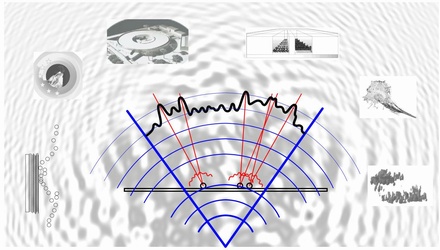
The first published results from the Alpha Magnetic Spectrometer (AMS) physics experiment on the International Space Station were announced today and though the result is the most precise measurement to date of the ratio of positrons to electrons in cosmic rays, we still have not caught our first glimpse into dark matter.

The AMS experiment, constructed at universities around the world and assembled at the European Organization for Nuclear Research (CERN), is the world's most precise detector of cosmic rays.  It was installed on the Space Station May 19th, 2011 after having been brought into orbit on the last flight of NASA's space shuttle Endeavour. To date it has measured over 30 billion cosmic ray events.   

Amyloids
are the quintessential bad boys of neurobiology.
These clumps of misfolded proteins found in the brains of people with Alzheimer's disease and other neurodegenerative disorders muck up the seamless workings of the neurons responsible for memory and movement, and researchers around the world have devoted themselves to devising ways of blocking their production or accumulation in humans.

Understanding how amyloids form requires an understanding of the biology of proteins, which are essentially strings of smaller components called amino acids attached end to end. Once they're made, these protein strings twist and fold into specific three-dimensional shapes that fit together like keys and locks to do the work of the cell.

PubMed Central is costing biomedical journal sites readership and that effect is increasing over time.

The bulk of modern biomedical studies are controlled by the government, which means taxpayer-funding, so it makes sense that the results would be available to the public, but Phillip M. Davis writing in The FASEB Journal says that PubMed draws readership away from the scientific journal even when journals themselves are providing free access to the articles.