Banner
The Scorched Cherry Twig And Other Christmas Miracles Get A Science Look

Bleeding hosts and stigmatizations are the best-known medieval miracles but less known ones, like ...

$0.50 Pantoprazole For Stomach Bleeding In ICU Patients Could Save Families Thousands Of Dollars

The inexpensive medication pantoprazole prevents potentially serious stomach bleeding in critically...

Metformin Diabetes Drug Used Off-Label Also Reduces Irregular Heartbeats

Adults with atrial fibrillation (AFib) who are not diabetic but are overweight and took the diabetes...

Your Predator: Badlands Future - Optical Camouflage, Now Made By Bacteria

In the various 'Predator' films, the alien hunter can see across various spectra while enabling...

User picture.
News StaffRSS Feed of this column.

News Releases From All Over The World, Right To You... Read More »

Blogroll

A lifelong diet rich in omega-3 fatty acids can inhibit growth of breast cancer tumors by 30 percent, according to new research published in the Journal of Nutritional Biochemistry, which they say is the first to provide unequivocal evidence that omega-3s reduce cancer risk.

Breast cancer remains the most common form of cancer in women worldwide and is the second leading cause of female cancer deaths. Advocates have long believed diet may significantly help in preventing cancer but epidemiological and experimental studies to back up such claims have been lacking, and human studies have been inconsistent.

Gravity works, it is a dominant force in physics, but at the very large and very small scales it holds a lot of mysteries left to be solved.  Foe example, when it comes to stars in young star clusters the dynamics in these crowded environments cannot be simply explained by the pull of gravity.

After analyzing Hubble Space Telescope images of star cluster NGC 1818 in the Large Magellanic Cloud, a satellite galaxy of the Milky Way, researchers at the Kavli Institute for Astronomy and Astrophysics (KIAA) at Peking University in Beijing found more binary star systems toward the periphery of cluster than in the center, the opposite of what they expected. The distribution of binaries is thought to result from complex interactions among stars within young clusters.

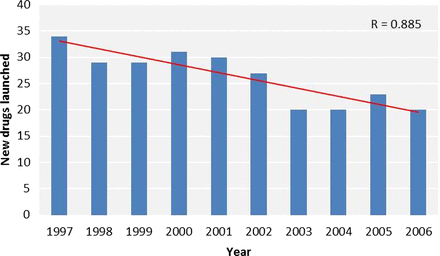
In the UK, pharmaceutical innovation seems to be dying. The supply of new medicines has conspicuously dwindled in recent decades but that is not due to innovation issues, it is because regulations have caused the costs of drug development to soar, along with the time it takes to bring a new drug to market: from 3 years in 1960 to 12 in 2000. 

The UK is historically the second largest source of new drug development, generating more than 10% of all new medicines around the globe. The US has historically been the runaway leader though output looks bleak in America as well, for similar reasons.

The hypothesis that tomato fruits from organic farming and greater stressing conditions associated with organic farming leads to more nutritional compounds, such as phenolics and vitamin C, recently got tested.

The Sun's eruptive events can change even more radically than the weather in Kentucky. Some eruptive events come just with a solar flare, while some provide additional ejection of solar material, a coronal mass ejection (CME). Some even involve complex moving structures in association with changes in magnetic field lines that loop up into the sun's atmosphere, the corona.

On July 19th, 2012, an eruption occurred on the sun that produced all three. A moderately powerful solar flare exploded on the sun's lower right limb, sending out light and radiation. Next came a CME, which shot off to the right out into space. And then, the sun treated viewers to one of its dazzling magnetic displays – a phenomenon known as coronal rain.

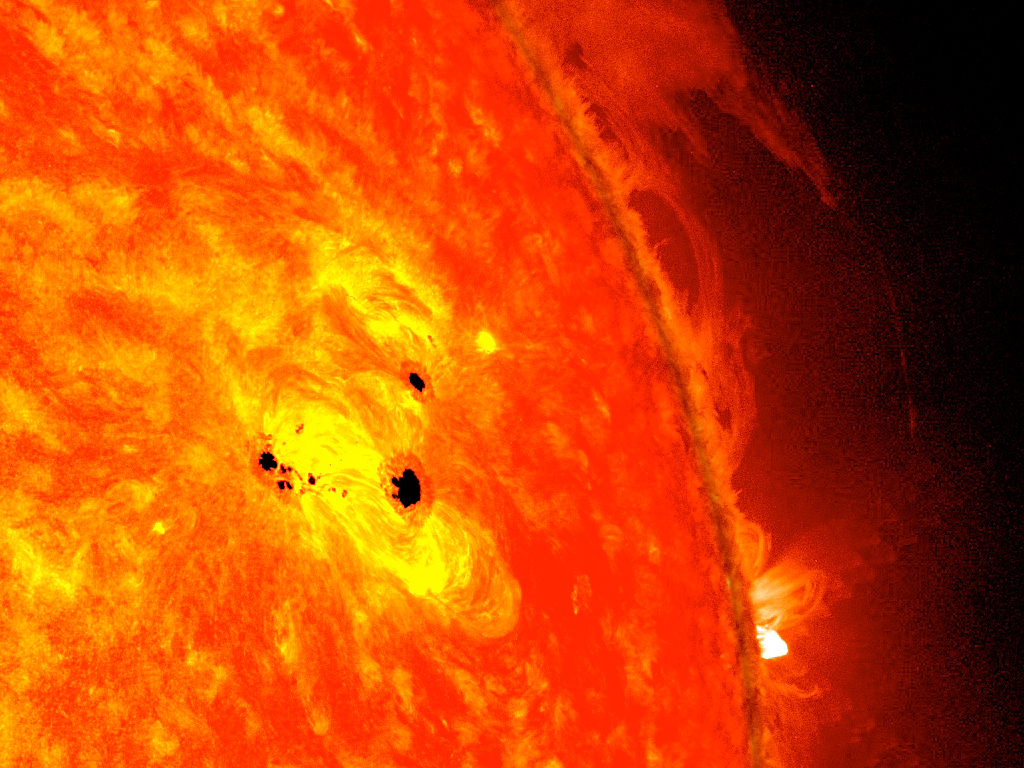
Sunspots on the surface of the Sun happen when magnetic fields rearrange and realign, forming dark spots Over the course of the last 48 hours, scientists watched a giant sunspot form - it has grown to over six Earth diameters across but its full extent is hard to judge since the spot lies on a sphere, not a flat disk.

The spot quickly evolved into what's called a delta region, in which the lighter areas around the sunspot, the penumbra, exhibit magnetic fields that point in the opposite direction of those fields in the center, dark area. This is a fairly unstable configuration that scientists know can lead to eruptions of radiation on the sun called solar flares.