Banner
Social Media Is A Faster Source For Unemployment Data Than Government

Government unemployment data today are what Nielsen TV ratings were decades ago - a flawed metric...

Gestational Diabetes Up 36% In The Last Decade - But Black Women Are Healthiest

Gestational diabetes, a form of glucose intolerance during pregnancy, occurs primarily in women...

Object-Based Processing: Numbers Confuse How We Perceive Spaces

Researchers recently studied the relationship between numerical information in our vision, and...

Males Are Genetically Wired To Beg Females For Food

Bees have the reputation of being incredibly organized and spending their days making sure our...

User picture.
News StaffRSS Feed of this column.

News Releases From All Over The World, Right To You... Read More »

Blogroll

Acid rain and ozone depletion may seem like modern problems but it has been connected to the Permian extinction 250 million years ago, a mass die-off so severe in Earth's history that even Mother Jones hasn't used it as a corollary of modern climate issues.

Contemporaneous volcanic eruptions in Siberia and the atmospheric effects of those eruptions long ago would have caused the devastation rather than leaving an outside light on. New results from a team including show that the atmospheric effects of these eruptions could have been devastating. Their work is published in Geology.

Researchers from the University of Granada have grown artificial skin from the adult stem cells of an umbilical cord. The paper inl Stem Cells Translational Medicine shows the ability of Wharton jelly mesenschymal stem cells to turn to oral-mucosa or skin-regeneration epithelia.

To grow the artificial skin the researchers also used a biomaterial made of fibrin and agarose, designed and developed by the University of Granada research team. The work has been carried out in the laboratories of the Faculty of Medicine, alongside the Experimental Unit of the Granada "Virgen de las Nieves" University Hospital Complex.

Would you drink wine flavored with mint, honey and a dash of psychotropic resins? Ancient Canaanites did more than 3,000 years ago.

Archaeologists have unearthed what may be the oldest, and largest,ancient wine cellar in the Near East, containing forty jars, each of which held up to fifty liters of strong, sweet wine flavored with mint, honey and a dash of psychotropic resins.  The cellar was discovered in the ruined palace of a sprawling Canaanite city in northern Israel, called Tel Kabri, far from many of Israel's modern-day wineries, and dates to about 1,700 B.C. 

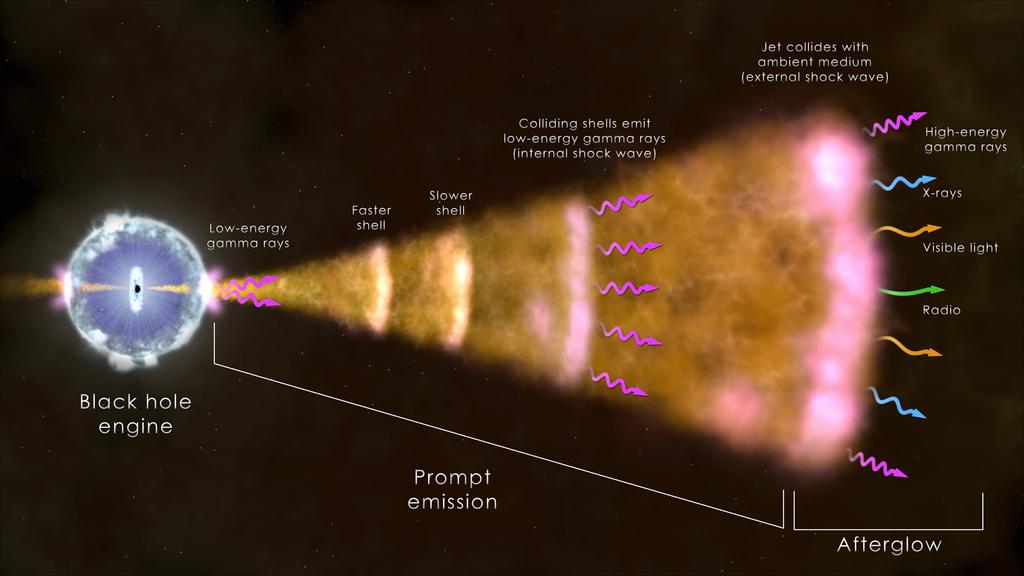
Recently, a gamma-ray burst occurred with an optical flash that peaked at magnitude 7 on the astronomical brightness scale, easily visible through binoculars. It is the second-brightest flash ever seen from a gamma-ray burst. 

On April 27th, a blast of light from a dying star in a distant galaxy became the focus of astronomers around the world. The gamma-ray burst was designated GRB 130427A and a trio of NASA satellites, working in concert with ground-based robotic telescopes, captured never-before-seen details that challenge current theoretical understandings of how gamma-ray bursts work.

NASA's Swift Gamma-ray Burst Mission detected the burst almost simultaneously with the GBM and quickly relayed its position to ground-based observatories.

Astronomers from around the world have used data from satellites and observatories to explain the brightest Gamma-ray Burst (GRB) ever recorded.

An unusually bright GRB, now deemed GRB 130427A, was observed on April 27th 2013 by the Swift satellite and was then found this be a result of an extremely powerful stellar explosion. This explosion produced a jet of matter moving close to the speed of light, which was formed when a massive star collapsed to make a black hole at its centre. As a result, a blast wave caused the rest of the star to expand outwards, producing a glowing shell of debris observed as an extremely bright supernova. 

Los Alamos' RAPTOR
(RAPid Telescopes for Optical Response)
telescopes in New Mexico and Hawaii received a very bright cosmic birth announcement for a black hole on April 27th. 

The RAPTOR (RAPid Telescopes for Optical Response) system is a network of small robotic observatories that scan the skies for optical anomalies such as flashes emanating from a star in its death throes as it collapses and becomes a black hole - an object so dense that not even light can escape its gravity field. 

This birth announcement arrived from the constellation Leo in the form of an exceptionally bright flash of visible light that accompanied a powerful burst of cosmic gamma-ray emissions.