Banner
The Scorched Cherry Twig And Other Christmas Miracles Get A Science Look

Bleeding hosts and stigmatizations are the best-known medieval miracles but less known ones, like ...

$0.50 Pantoprazole For Stomach Bleeding In ICU Patients Could Save Families Thousands Of Dollars

The inexpensive medication pantoprazole prevents potentially serious stomach bleeding in critically...
Metformin Diabetes Drug Used Off-Label Also Reduces Irregular Heartbeats

Adults with atrial fibrillation (AFib) who are not diabetic but are overweight and took the diabetes...

Your Predator: Badlands Future - Optical Camouflage, Now Made By Bacteria

In the various 'Predator' films, the alien hunter can see across various spectra while enabling...

User picture.
News StaffRSS Feed of this column.

News Releases From All Over The World, Right To You... Read More »

Blogroll

The annual melting of sea ice in the Arctic is approaching its yearly "minimum," the time when the floating ice cap covers less of the Arctic Ocean than at any other period during the year, and there is some good news -   this year's summer low is not going to be too bad. 

The concerning news is that this year's melt rates are in line with the sustained decline of the Arctic ice cover observed by NASA and other satellites over the last several decades.

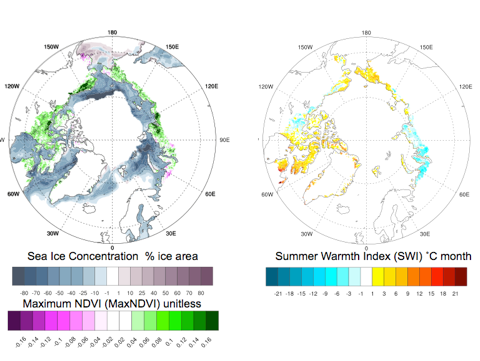
A recent review of research on the response of plants, marine life and animals to declining sea ice in the Arctic found that sea ice decline and warming trends are changing the vegetation in nearby arctic coastal areas.

A $12 million program wants to revolutionize current farming methods by giving crops the ability to thrive without using costly, polluting artificial fertilizers.

Four teams are using synthetic biology to create new components for plants: a global search for a mysterious lost bacterium with significant unique functions; work to engineer beneficial relationships between plants and microbes; and an effort to mimic strategies employed by blue-green algae.

The U.S. National Science Foundation (NSF) and U.K.'s Biotechnology and Biological Sciences Research Council (BBSRC) made the awards following an 'Ideas Lab' that focused on new approaches for dealing with the challenges of nitrogen in the growing global food demand.  

Since man discovered agriculture, farmers have used ingenious ways to pump more nitrogen into crop fields; farmers have planted legumes and plowed the entire crop under, strewn night soil or manure on the fields, shipped in bat dung from islands in the Pacific or saltpeter from Chilean mines and plowed in glistening granules of synthetic fertilizer made in chemical plants. 

A new Washington University in St. Louis project seeks to miniaturize, automate and relocate the chemical apparatus for nitrogen fixation within the plant so nitrogen is available when and where it is needed — and only then and there.

Astronomers have assembled images from more than 13 years of superheated gas - 5,000 light-years long - as it is ejected from a supermassive black hole.

Even in such a cosmically short time frame, it gives us a better understanding of how black holes shape galaxy evolution.

A study shows for the first time that chromosomes rearrangements (such as inversions or translocations) can provide advantages to the cells that harbor them, depending on the environment they are exposed.