Banner
The Scorched Cherry Twig And Other Christmas Miracles Get A Science Look

Bleeding hosts and stigmatizations are the best-known medieval miracles but less known ones, like ...
$0.50 Pantoprazole For Stomach Bleeding In ICU Patients Could Save Families Thousands Of Dollars

The inexpensive medication pantoprazole prevents potentially serious stomach bleeding in critically...
Metformin Diabetes Drug Used Off-Label Also Reduces Irregular Heartbeats

Adults with atrial fibrillation (AFib) who are not diabetic but are overweight and took the diabetes...

Your Predator: Badlands Future - Optical Camouflage, Now Made By Bacteria

In the various 'Predator' films, the alien hunter can see across various spectra while enabling...

User picture.
News StaffRSS Feed of this column.

News Releases From All Over The World, Right To You... Read More »

Blogroll
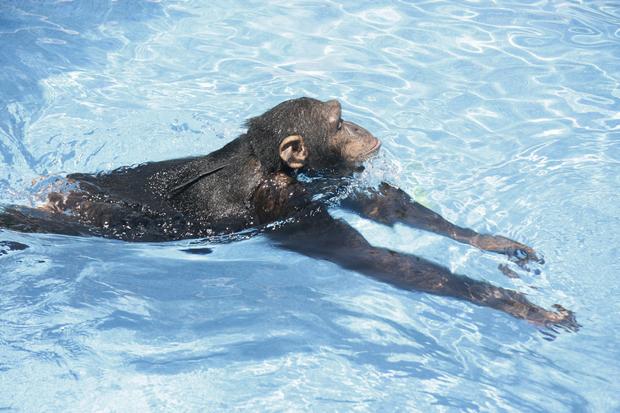
Zoos have used water moats to confine chimpanzees, gorillas or orangutans. When apes ventured into deep water, they often drowned, which indicated that apes could not learn to swim and so prefer to stay on dry land.

But it turns out that they can.

Two researchers have video-based observation of swimming and diving apes. Instead of the usual dog-paddle stroke used by most terrestrial mammals, these animals use a kind of breaststroke. This swimming strokes peculiar to humans (and apes) might be the result of an earlier adaptation to an arboreal life.

Light traveling in a vacuum is the ultimate speed demon, moving at about 700 million miles per hour.

Matter cannot exceed the speed of light - unless, perhaps, there is a speed bump in light's path. Researchers from  France's Université de Nice-Sophia Antipolis and China's Xiamen University have embedded dye molecules in a liquid crystal matrix to throttle the group velocity of light back to less than one billionth of its top speed. The team says the ability to slow light in this manner may one day lead to new technologies in remote sensing and measurement science. 

Though women work in corporations and serve at higher levels of organizations more than at any time in world history, sociologists note that they still lag behind men in one high-profile way; fraud.

Obviously cultural critics can argue that women are being left behind in opportunities to commit fraud because they do not have equal numbers at the highest levels, but that is a self-correcting problem over time. Regardless of the gender landscape, the sociologists who examined a database of recent corporate frauds found that women typically were not part of the conspiracy. When women did play a role, it was rarely a significant one.

Toxicologist Edward Calabrese of the University of Massachusetts Amherst has dropped cultural bombs on both the U.S. National Academy of Sciences and two scientists who provided crucial information for Atomic Age carcinogen risk assessment.

Regarding the linear no threshold (LNT) dose-response approach to ionizing radiation exposure in the 1950s, Calabrese says there was deliberate suppression of evidence to prevent the regulatory panel from considering an alternative, threshold model - the LNT model was later generalized to chemical carcinogen risk ssessment.

An international analysis of conservation biologists finds that they work late at night and over weekends - just like much of the salaried corporate world and science writers. 

Thanks to athletes like Ryan Braun and Lance Armstrong, doping has gotten a bad rap, but if solar power is ever going to be viable, doping will be essential.

Flexible thin film solar cells require fewer materials and can be manufactured in large quantities by roll-to-roll processing. One such technology relies on cadmium telluride (CdTe), which is a distant second to silicon-based solar cells but cheap in terms of production costs. Because they are grown on rigid glass plates, these superstrate cells have, however a big drawback: they require a transparent supporting material that lets sunlight pass through to reach the light-harvesting CdTe layer, thus limiting the choice of carriers to transparent materials.