Banner
The Scorched Cherry Twig And Other Christmas Miracles Get A Science Look

Bleeding hosts and stigmatizations are the best-known medieval miracles but less known ones, like ...

$0.50 Pantoprazole For Stomach Bleeding In ICU Patients Could Save Families Thousands Of Dollars

The inexpensive medication pantoprazole prevents potentially serious stomach bleeding in critically...

Metformin Diabetes Drug Used Off-Label Also Reduces Irregular Heartbeats

Adults with atrial fibrillation (AFib) who are not diabetic but are overweight and took the diabetes...

Your Predator: Badlands Future - Optical Camouflage, Now Made By Bacteria

In the various 'Predator' films, the alien hunter can see across various spectra while enabling...

User picture.
News StaffRSS Feed of this column.

News Releases From All Over The World, Right To You... Read More »

Blogroll

New evidence is helping to solve the mystery surrounding a collapse of the Antarctic ice sheet 23 million years ago.

The surface of the East Antarctic ice sheet is so cold that models can only simulate its collapse by applying a significant climatic warming. Yet numerous lines of evidence suggest that 23 million years ago the Antarctic ice sheet decayed in size as changes in Earth's orbit around the Sun drove more subtle changes in Earth's seasons.

Scientists from Cardiff University's School of Earth and Ocean Sciences analyzed fossil "foraminifera". These microscopic animals live in the ocean - on death their shells collect on the seafloor making a geological record of the past.

NASA's Solar Dynamics Observatory and the Reuven Ramaty High Energy Solar Spectroscopic Imager have provided the most comprehensive movie ever of a mysterious process at the heart of all explosions on the sun: magnetic reconnection.

Magnetic reconnection happens when magnetic field lines come together, break apart and then exchange partners, snapping into new positions and releasing a jolt of magnetic energy. This process lies at the heart of giant explosions on the sun, such as solar flares and coronal mass ejections, which can fling radiation and particles across the solar system.

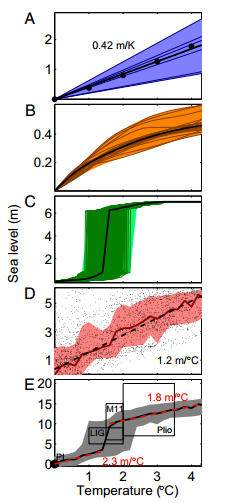
If warming projections exceed estimates and rise by 1 degree Celsius, a new computer model finds that sea levels will rise about seven feet - over the next several thousand years.

But that would be duplicated for every degree of additional warmth as well.

The paper in the Proceedings of the National Academy of Sciences combined analyses of four major contributors to potential sea level rise into a collective estimate, and compared it with evidence of past sea-level responses to global temperature changes.

Music decreases children's perceived sense of pain, say the authors of an article in JAMA Pediatrics.  

The team conducted a clinical research trial of 42 children between the ages of 3 and 11 who came to the pediatric emergency department at the Stollery Children's Hospital and needed IVs. Some of the children listened to music while getting an IV, while others did not. Researchers measured the children's distress, perceived pain levels and heart rates, as well as satisfaction levels of parents, and satisfaction levels of health-care providers who administered the IVs. The analysis took place between January 2009 and March 2010.

Learned fear is a good thing. It keeps us from making risky, stupid decisions or falling over and over again into the same trap. 

New research found that a missing brain protein may be the culprit in cases of severe over-worry, where the fear perseveres even when there's nothing of which to be afraid. The researchers examined mice without the enzymes monoamine oxidase A and B (MAO A/B), which sit next to each other in our genetic code as well as on that of mice. Prior research has found an association between deficiencies of these enzymes in humans and developmental disabilities along the autism spectrum such as clinical perseverance – the inability to change or modulate actions along with social context.

A new moon, designated S/2004 N 1, has been discovered orbiting the distant blue-green planet Neptune, the 14th known to be circling the giant planet.

S/2004 N 1 is estimated to be no more than 12 miles across, making it the smallest known moon in the Neptunian system. It is so small and dim that it is roughly 100 million times fainter than the faintest star that can be seen with the naked eye. It even escaped detection by NASA's Voyager 2 spacecraft, which flew past Neptune in 1989 and surveyed the planet's system of moons and rings.