A 10 year project to observe and analyze regular data about ocean circulation and how it impacts on Britain’s climate has provided new insight into Atlantic Meridional Overturning Circulation (AMOC), a major system of currents in the North Atlantic.
10 years is too short a time to be meaningful but it is an important milestone. Since 2004, the project team has been monitoring the AMOC at 26.5N degrees, near where it carries its maximum heat, using instruments moored at 30 locations across the Atlantic between the Canary Islands and the Bahamas - so-called fixed arrays. The arrays’ instruments measure the temperature, salinity and pressure of the ocean, from which the AMOC’s strength and structure can be calculated.
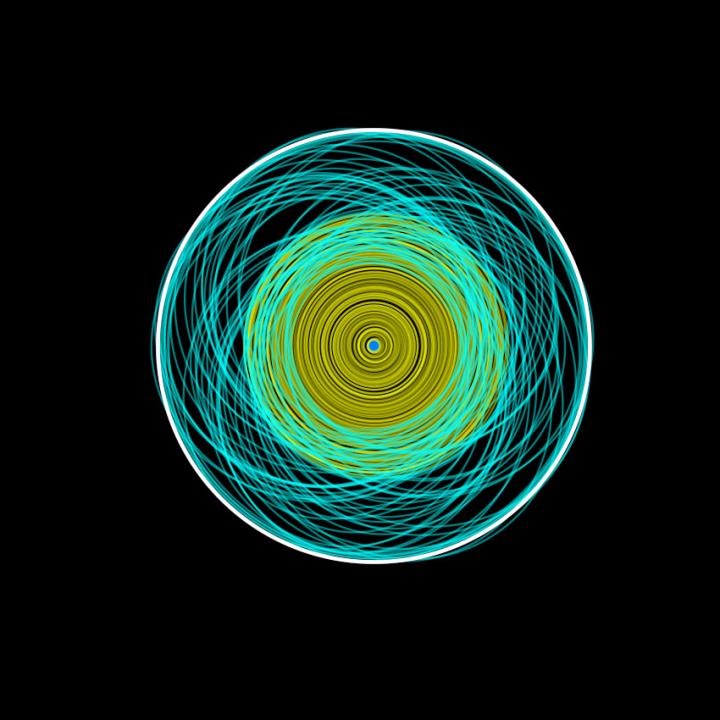
We may have Jupiter to thank for our unusual solar system.
Before the inner planets we now call Mercury, Venus, Earth, and Mars formed, a great inward-and-then-outward journey that Jupiter made early in the solar system's history may have torn apart a number of super-Earths - planets larger than Earth but smaller than Neptune - and caused their giant remnants to fall into the sun billions of years ago.
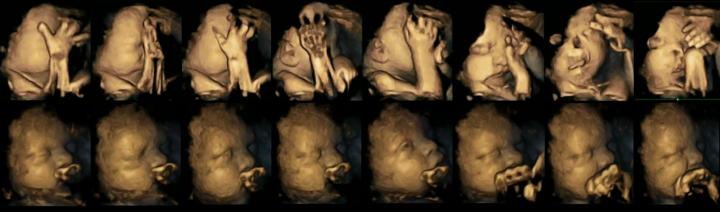
High-definition scans lead a team of researchers to conclude that the harmful effects of smoking during pregnancy may be reflected in the facial movements of mothers' unborn babies.
In the small pilot study, the scholars observed 4-d ultrasound scans and found that fetuses whose mothers were smokers showed a significantly higher rate of mouth movements than the normal declining rate of movements expected in a fetus during pregnancy. The researchers suggested that the reason for this might be that the fetal central nervous system, which controls movements in general and facial movements in particular did not develop at the same rate and in the same manner as in fetuses of mothers who did not smoke during pregnancy.
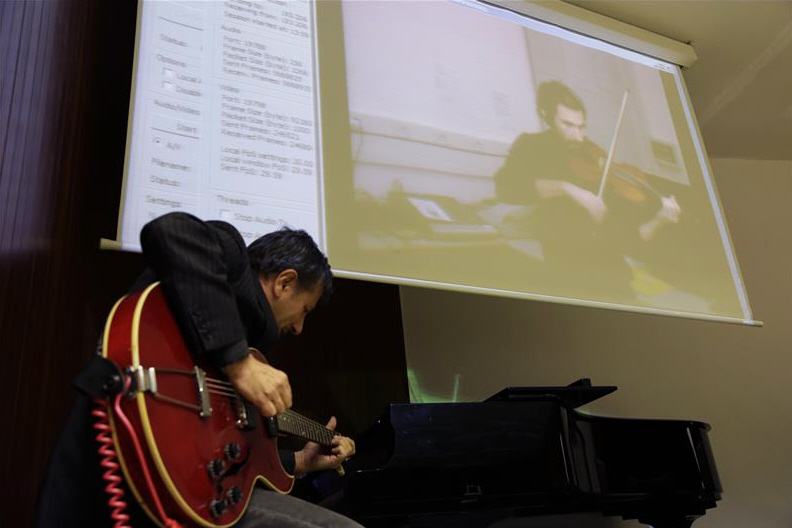
Latency is so ingrained into modern communication we almost forget about it but in live or recorded events, like performances or rehearsals over a long distance, it is crippling.
When recording a soundtrack over a pre-recorded base, the latency is perceptible to the human ear if a delay of 15-20 milliseconds occurs - the track seems displaced from the rest, giving the sense of being poorly played. To resolve displacement over long distances, elements such as sound capture, sound coding and decoding servers, intermediate network elements, lines of communication and the software used all must be factored in.
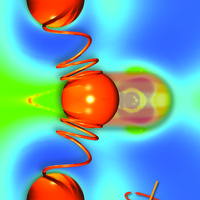
Researchers have discovered proof that acoustic phonons, the elemental particles that transmit both heat and sound, have magnetic properties.
In a new paper, the authors describe how a magnetic field roughly the size of a medical MRI reduced the amount of heat flowing through a semiconductor by 12 percent. But because the phonons reacted to the magnetic field, the particles must be sensitive to magnetism.
Patients with carpal tunnel syndrome are more than twice as likely to have migraine headaches, according to data derived from nearly 26,000 Americans responding to a national health survey. Among other questions, participants were asked whether they had had carpal tunnel syndrome during the past year or "severe headache or migraine" during the past three months.
Patients with carpal tunnel syndrome have symptoms such as hand numbness and weakness, resulting from pressure on the median nerve in the wrist.
The association also runs in the other direction, with migraine patients having higher odds of carpal tunnel syndrome, say Dr. Huay-Zong Law and colleagues of University of Texas Southwestern Medical Center at Dallas.


 Why Antarctic Sea Ice Stopped Growing In 2015
 Wealth Correlated To Loneliness
 Ousiometrics Analysis Says All Human Language Is Biased
  Wavelengths Of Light Are Why CO2 Cools The Upper Atmosphere But Warms Earth