Banner
Why Antarctic Sea Ice Stopped Growing In 2015

Though numerical models and popular films like An Inconvenient Truth projected Arctic ice...

Wealth Correlated To Loneliness

You may have read that Asian cultures respect the elderly more than Europe but Asian senior citizens...

Ousiometrics Analysis Says All Human Language Is Biased

A new tool drawing on billions of uses of more than 20,000 words and diverse real-world texts claims...

Wavelengths Of Light Are Why CO2 Cools The Upper Atmosphere But Warms Earth

There are concerns about projected warming on the Earth’s surface and in the lower atmosphere...

User picture.
News StaffRSS Feed of this column.

News Releases From All Over The World, Right To You... Read More »

Blogroll

Talk to long-time anglers with a favorite spot and they will often tell stories of one fish they could never get. In mythical overtones, they will speak of its ability to avoid capture, attributing an almost supernatural intelligence (for a fish). Such stories were once so common that 'fish story' became its own brand of tall tale.

A new study mapped individual heritable traits of fish to environmental conditions and concluded that some fish really are going to be harder to catch.

The work by the University of Eastern Finland and the Finnish Game and Fisheries Research Institute
in the Paltamo Unit of the Finnish Game and Fisheries Research Institute

In the past, it was common practice to get rid of anything that was used - and unused - in operating rooms, but with rising health care costs due to government insurance and growing realization that many countries have few supplies at all, recovery of unused operating room materials has gotten new life.

Johns Hopkins University School of Medicine reported during the 2014 Clinical Congress of the American College of Surgeons that recovery of unused medical supplies from operating rooms for donation to surgical centers in developing countries can potentially alleviate a significant global burden of surgical diseases. 

Damage assessments from environmental hazards are always a challenge because of the competing constituencies pulling on science and the fuzzy nature of estimates. After the 2010 Deepwater Horizon spill in the Gulf of Mexico, the Obama administration was editing science reports to reflect its goals, environmentalists were raising money claiming earth was ruined and using wild guesses for damage, and BP lobbyists were mitigating penalties behind the scenes by claiming it wasn't so bad.

What about possibly 2 million barrels of oil that are still down there? Are they a hazard? Where did they go?

In the United States, Democrats have long insisted that women should vote for Democrats, because abortion was the most important issue.

Abortion is not really an issue any more. It was allowed by states prior to the Roe v. Wade Supreme Court decision and has been the law of the land for 40 years. In cases where someone tries to run on abortion, it fails. But marketing scholars say global warming has replaced abortion as the litmus test for why women should be Democrats - if women care about long-term consequences of their actions, that is.

In the 1960s and '70s, population bomb reality was said to be as settled as climate change is today. No less than Dr. John Holdren, current Obama administration Science Czar, co-authored a book called Ecoscience, which argued that forced sterilization and mass abortions might  be necessary, and even viable under the equal protection clause of the Constitution.

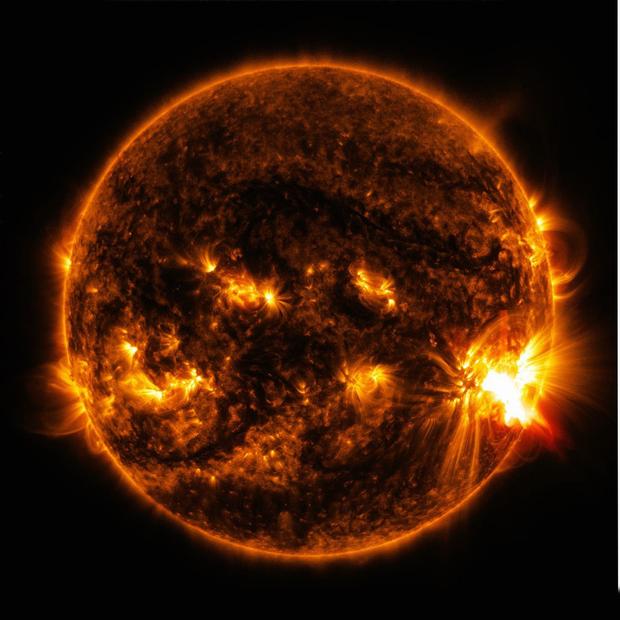
This morning, a large active region on the sun erupted with another X-class flare, its fourth since Oct. 24th. 

Solar flares are powerful bursts of radiation. Harmful radiation from a flare cannot pass through Earth's atmosphere to physically affect humans on the ground, however -- when intense enough -- they can disturb the atmosphere in the layer where GPS and communications signals travel.