Banner
Here's Where Your Backyard Was 300 Million Years Ago

We may use terms like "grounded" and terra firma to mean stability and consistency but geology...

Convergent Evolution Cheat Sheet Now 120 Million Years Old

One tenet of natural selection is a random walk of genes but nature may be more predictable than...

Synchrotron Could Shed Light On Exotic Dark Photons

There are many hypothetical particles proposed to explain dark matter and one idea to explore how...

The Pain Scale Is Broken But This May Fix It

Chronic pain is reported by over 20 percent of the global population but there is no scientific...

User picture.
News StaffRSS Feed of this column.

News Releases From All Over The World, Right To You... Read More »

Blogroll
Sometimes how humans trade goods are as important as what is traded.    Even when it comes to trading dead humans.

Human cadavers are a legitimate market?  Sure.  Commerce in human cadavers was created centuries ago and is done now by medical schools because of the need to train future doctors in anatomy, requiring the dissection of a cadaver. Finding an adequate supply of cadavers is an ongoing challenge, one which has been answered by both academically-housed programs and by independent, for- and non-profit ventures that are not affiliated with higher education or research institutions.

And we have all seen "Frankenstein" - sometimes small business owners get involved.
Sheng Ding, PhD, has shown a new method for transforming adult skin cells into neurons that are capable of transmitting brain signals - one of the first documented experiments for transforming an adult human's skin cells into functioning brain cells.

Ding, of the Gladstone Institutes, said his work builds on the cell-reprogramming work of another Gladstone scientist, Senior Investigator Shinya Yamanaka, MD, PhD.  Yamanaka's 2006 discovery of a way to turn adult skin cells into cells that act like embryonic stem cells has advanced the fields of cell biology and stem-cell research.     

One of the fundamental precepts we laid out in the original Science 2.0® vision was collaboration.  It's tricky stuff, collaboration, it requires scientists who are often competitors to other labs to be more open - and that may never happen, but for smaller groups who want it to happen, there are tools in the works that can help.  

One of those, Mendeley, has come out of beta and released Mendeley Desktop v1.0 for Windows, Mac, and Linux, following two other milestones for the company, 1 million users who have now downloaded the application and a database with its 100 millionth paper uploaded. 

Astronomers have discovered the largest and farthest reservoir of water ever detected in the universe in a quasar called APM 08279+5255 - enough water to fill Earth's oceans more than 100 trillion times.

The distant quasar is one of the most powerful known objects in the universe and has an energy output of 1,000 trillion suns, about 65,000 times that of our Milky Way galaxy. The power of APM 08279+5255 comes from matter spiraling into the quasar's central supermassive black hole, estimated at some 20 billion times the mass of our sun. 
The Wiedemann-Franz Law, named after German physicists Gustav Wiedemann and Rudolf Franz, is a ratio of the thermal to electrical conductivities of metals.   In 1853, the two studied the thermal conductivity, a measure of a system's ability to transfer heat, of a number of elemental metals and found that the ratio of the thermal to electrical conductivities was approximately the same for different metals at the same temperature.
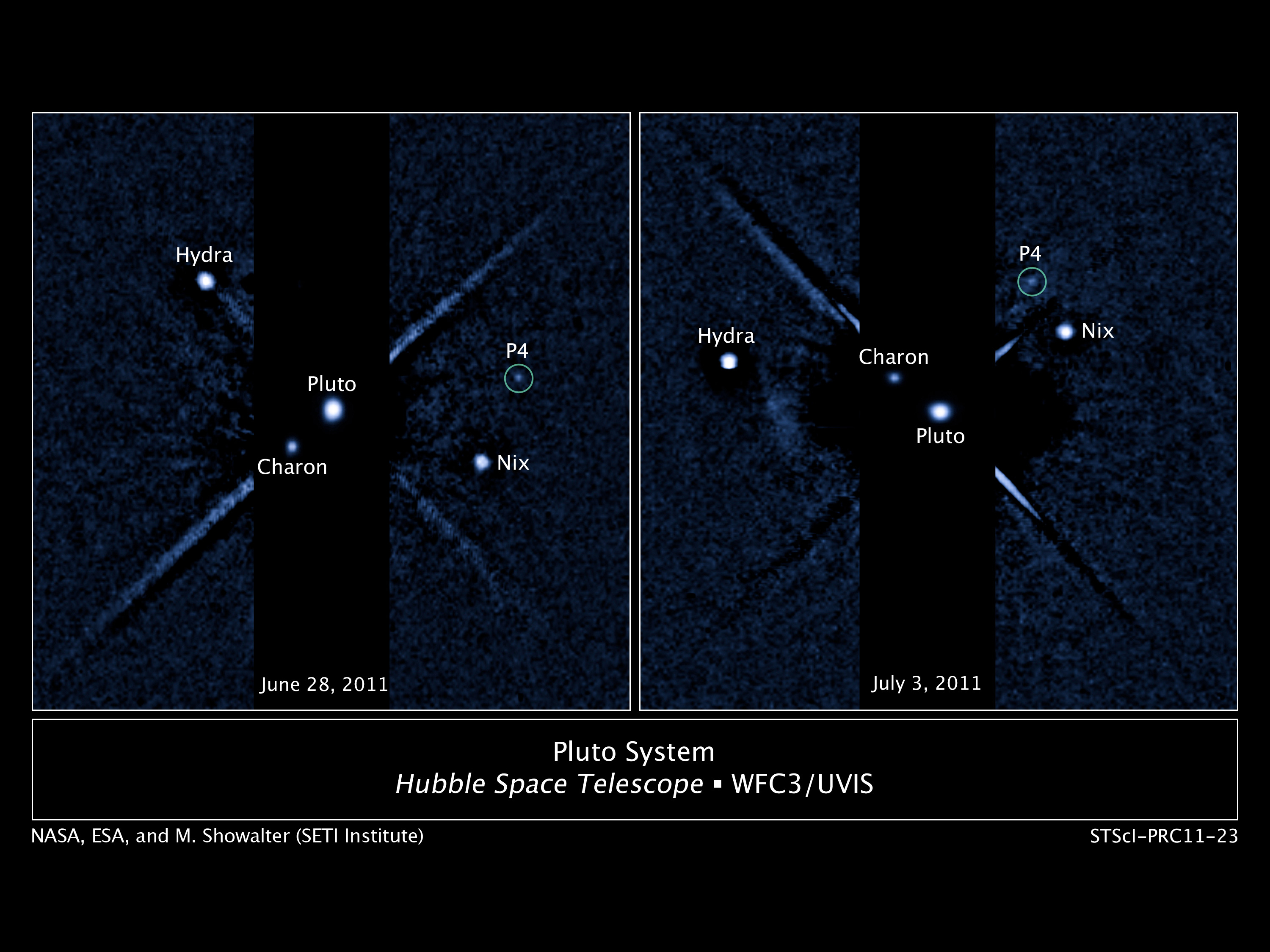
Though 2 percent of astronomers declared Pluto was no longer a planet, for not being a planet, it sure has a lot of moons.   Four so far.

The Hubble Space Telescope discovered this fourth moon, cleverly designated P4, and astronomers say this newest, smallest one has an estimated diameter of 8 to 21 miles.  By comparison, Charon, Pluto's largest moon, is 648 miles (1,043 km) across, and the other moons, Nix and Hydra, are in the range of 20 to 70 miles in diameter (32 to 113 km).

Distance: 3 billion miles.