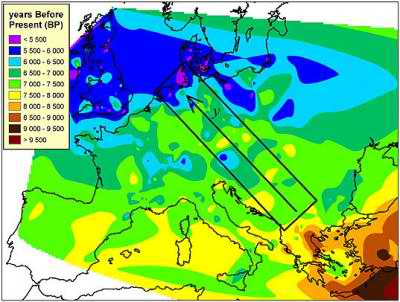
Between 8,000 and 9,000 years ago, the first farmers from Asia were already cultivating land in what is now Greece, according to archaeological remains, but in places like the United Kingdom, Denmark and Northern Germany farming did not happen until around 3,000 years later.
One of the most significant socioeconomic changes in the history of humanity started taking place around 10,000 years ago, when the Near East went from an economy based on hunting and gathering (Mesolithic) to another kind on agriculture (Neolithic) and farming rapidly entered the Balkan Peninsula and then advanced gradually throughout the rest of Europe.
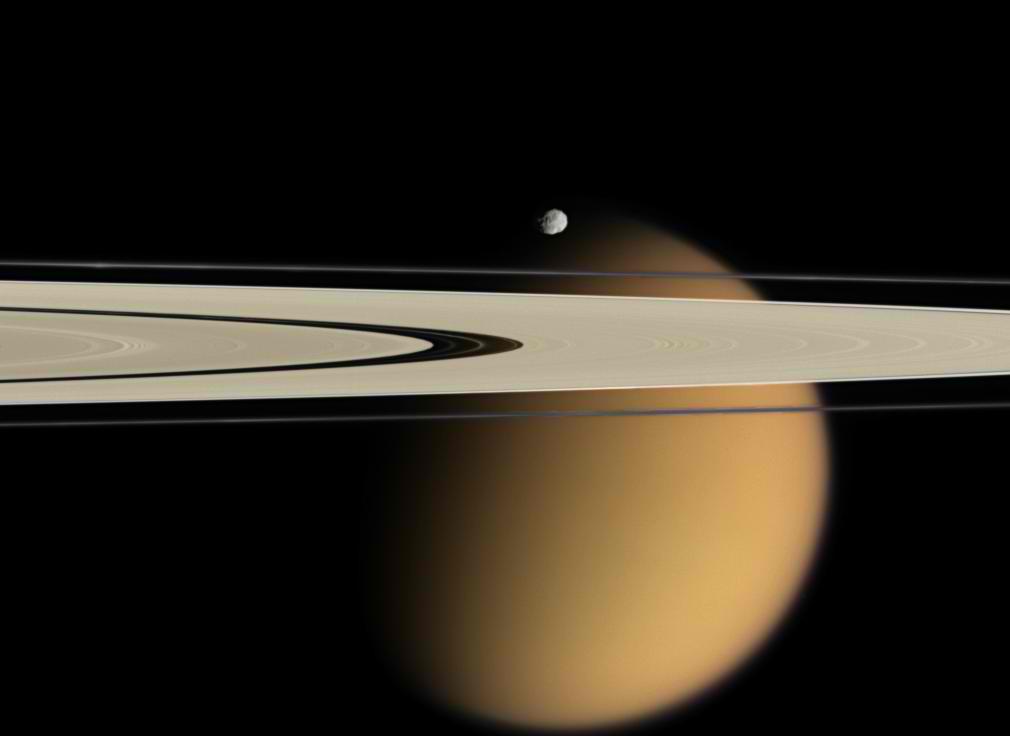
Sure, Los Angeles has a terrible smog issue but it could be worse; movie stars could live on Titan. Titan, Saturn's largest moon, looks like a dirty orange ball but the actual composition is more like crude oil without the sulfur. Titan's haze is made of tiny droplets of hydrocarbons with other, more noxious chemicals mixed in.
But as nasty as that sounds, Titan is the only moon in our solar system with an atmosphere worthy of a planet at all. At least it has lightning, drizzle and occasionally a big, summer-downpour style of cloud made of methane or ethane, hydrocarbons best known for their role in natural gas.
The search for actively 'jumping' genes in humans has found new evidence that the genome contains numerous pesky mobile elements that may help to explain why people have such a variety of physical traits and disease risks.
Using bioinformatics, the study in Genome Research set out to compare the standard assembly of genetic elements as outlined in the reference human genome to raw whole-genome data from 310 individuals recently made available by the 1000 Genomes Project, the team found 1,016 new insertions of retrotransposon insertion polymorphisms (RIPs), expanding the catalog of insertions that are present in some individuals and absent in others.
Mice have a healthy concept of fear and so they fear the scent of a predator. While it seems obvious that brains quickly figure out with a sniff that a predator, like a cat, is nearby, the mechanism is not well understood.
In a Nature study, researchers describe a new technique that makes it possible to map long-distance nerve connections in the brain. The scientists used the technique to map for the first time the path that the scent signals take from the olfactory bulb, the part of the brain that first receives signals from odor receptors in the nose, to higher centers of the mouse brain where the processing is done.
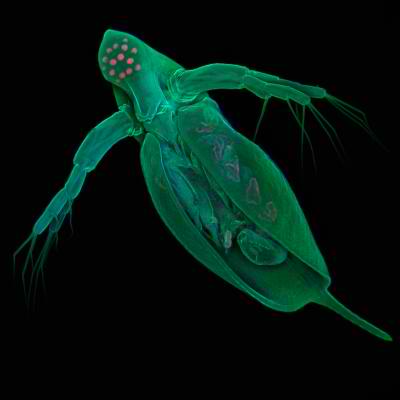
Humans have about 23,000 genes and we are at the top of the food chain but the animal with the most genes is the near-microscopic freshwater crustacean Daphnia pulex, or water flea, clocking in around 31,000.
Daphnia is the first crustacean to have its genome sequenced. The findings are part of a comprehensive report by members of the Daphnia Genomics Consortium, an international network of scientists led by the Center for Genomics and Bioinformatics (CGB) at Indiana University Bloomington and the U.S. Department of Energy's Joint Genome Institute.
Coffee can be quite good for you,
as any number of studies have shown. But you still have to take some personal responsibility for moderation because companies like Starbuck's are not going to do it for you. They're not in the personal responsibility business, they are in the drink business, so when they roll out a new size - the "Trenta" - this spring, all 31 ounces of it, they want you to buy it in any form you want.


 Here's Where Your Backyard Was 300 Million Years Ago
 Convergent Evolution Cheat Sheet Now 120 Million Years Old
 Synchrotron Could Shed Light On Exotic Dark Photons
 The Pain Scale Is Broken But This May Fix It