Banner
Here's Where Your Backyard Was 300 Million Years Ago

We may use terms like "grounded" and terra firma to mean stability and consistency but geology...

Convergent Evolution Cheat Sheet Now 120 Million Years Old

One tenet of natural selection is a random walk of genes but nature may be more predictable than...

Synchrotron Could Shed Light On Exotic Dark Photons

There are many hypothetical particles proposed to explain dark matter and one idea to explore how...

The Pain Scale Is Broken But This May Fix It

Chronic pain is reported by over 20 percent of the global population but there is no scientific...

User picture.
News StaffRSS Feed of this column.

News Releases From All Over The World, Right To You... Read More »

Blogroll
Evolutionary detectives have used century-old bits of DNA from museum specimens to find a place for the extinct passenger pigeon, Ectopistes migratorius, in the family tree of pigeons and doves, identifying for the first time this unique bird's closest living avian relatives. 
New research is challenging the belief that the planet Neptune knocked a collection of planetoids known as the Cold Classical Kuiper Belt to its current location at the edge of the solar system.

The Kuiper Belt is of special interest to astrophysicists because it is a fossil remnant of the primordial debris that formed the planets.  University of Victoria Ph.D. student Alex Parker presented his results at today's meeting of the Division of Planetary Sciences in Pasadena, California.

Today, October 5th, millions of teachers and education workers will be joined by children, young people and parents across the globe to celebrate World Teachers' Day. They will pay tribute to the teaching profession and its unique role - and promote their union. 

 From the global economic crisis which destabilized many developed economies in the last year, to humanitarian disasters such as the earthquake in Haiti and floods in Pakistan, the role of teachers is vital to the social, economic and intellectual rebuilding of communities in which we all live and work. 

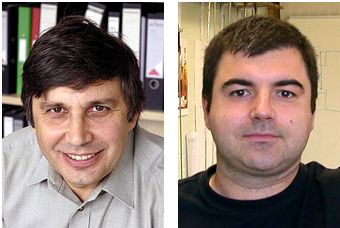
Sorry, cosmic acceleration, this was not your year.   The Nobel Prize in Physics 2010 was awarded jointly to Andre Geim and Konstantin Novoselov "for groundbreaking experiments regarding the two-dimensional material graphene".

Without question ultrathin carbon is here to stay and a lot of terrific work is done with it every month.  Bendable computer screens and ultralight materials could all result from graphene research.
Researchers have made environmentally-friendlier bricks that are also stronger than traditional ones.   That is a big win for everyone.

Untreated clay was one of the earliest building materials to be used by humankind. The oldest examples of this can be found in houses in the Near East dating from between 11,000 and 12,000 years ago, while earthy material mixed with plants and pebbles to make them stronger has also been found in certain archaeological deposits from 1,400BC  in Sardinia, Italy.
The Nobel Prize in Physiology or Medicine 2010 was awarded to Robert G. Edwards "for the development of in vitro fertilization".

Their reasoning seemed to be partly cultural - that Edwards battled societal and establishment resistance to his development of the in vitro fertilization procedure, which has so far led to the birth of around 4 million people.

Edwards, now 85 and professor emeritus at the University of Cambridge, began working on IVF in the 1950s and developed the technique with British gynecologist Patrick Steptoe, who died in 1988 - posthumous prizes are not allowed.  In IVF, egg cells are removed from the mother and fertilized outside her body and then implanted into the womb.