Banner
    The Nobel In Physics 2010: Place Your Bets!
    By Johannes Koelman | September 27th 2010 10:18 AM | 18 comments | Print | E-mail | Track Comments
    About Johannes

    I am a Dutchman, currently living in the US. Following a PhD in theoretical physics (spin-polarized quantum systems*) I entered a Global Fortune

    ...

    View Johannes's Profile
    A week from now, Tuesday October 5th, the winner(s) of the 2010 Nobel Prize for physics will be announced. Predicting the Nobel laureates in physics is notoriously difficult. As part of their overall Nobel prize predictions, each year Thomson Reuters attempts to predict the winners in physics, but despite their habit of listing multiple candidates, so far they never managed to hit any of the annual winner(s).

    This year Thomson Reuters might, for the first time, be lucky.

    My prediction is that the 2010 Nobel Prize in Physics will go to the discoverers of the cosmic acceleration: Saul Perlmutter, Adam Riess and Brian Schmidt. Perlmutter will pocket half of the 10 million SEK prize money, and Riess and Schmidt will share the other half.

    What makes me so confident?

    The discovery of the speeding up of the cosmic expansion twelve years ago turned cosmology on its head. Suddenly the generally accepted model of the cosmos contained more than three time as much stuff. And more importantly, the new observations made it clear that the abundant additional stuff can not be more of the known substance, but rather must be some strange stuff that leads to apparent anti-gravitational effects. This strange stuff became known as 'dark energy'. 

    Twelve years later theorists are still debating the correct interpretation of the enigmatic speeding up of the universe and the nature of dark energy. Regular readers of this blog will know that I am not a fan of the concept of dark energy as an explanation of the speeding up of the universe. In fact, I have entertained an alternative explanation of this cosmic speeding up that does not require any such strange stuff. 

    The fact that more than a decade after the discovery of the cosmic speeding up there is still debate about its interpretation, does not make its presence in any way less certain. On the contrary, several independent observations have corroborated the discovery of Perlmutter's and Riess'/Schmidt's groups. The ongoing debate just highlights the fact that the discovery of the cosmic acceleration forces cosmologists to overhaul their models in such dramatic ways that their is bound to be controversy on what is the right approach.
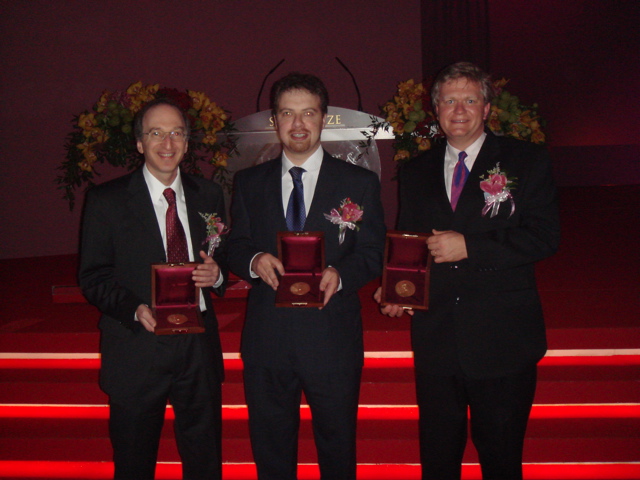
     
    Saul Perlmutter, Adam Riess and Brian Schmidt (from left to right) at the 2006  Shaw prize award ceremony. Soon the same line-up in Stockholm?

    The discovery of the cosmic speeding up has led to truly gigantic numbers of theoretical publications dealing with dark energy or alternative theoretical models attempting to explain the acceleration. The shear number of such publications is perhaps best illustrated by the abundance of news articles on dark energy here at Science2.0.

    A snapshot:

    - Dark energy: is the theory of gravity wrong?

    - Dark matter and dark energy: two faces of the same coin?

    - Dark energy? No, phantom energy, say these cosmologists

    - Dark energy stifling growth in the universe say researchers

    - Dark energy survey camera gets one step closer

    - BigBOSS joins the hunt for elusive dark energy

    - New model suggests dark energy froze the universe

    - Baryon oscillations and the search for dark energy

    - Relic abundance of stable dark energy may be less than thought

    For me it is almost unthinkable that a discovery that changed our view on the cosmos in such a dramatic way would not attract a Nobel prize. And: it's about time. Earlier Nobel prizes for cosmological discoveries such as the prize for Penzias and Wilson in 1978 (discovery of the echo of the big bang) and the prize for Smoot and Matther in 2006 (systematic measurement of this echo) were in both cases awarded about twelve years after the key measurements were published. And twelve years since the discovery of the cosmic acceleration, that is ... now!

    And for those who believe in the predictive value of time trends: the recent Nobel prizes in physics awarded for astrophysical research, were awarded in 2002 (Giacconi, Davis and Koshiba) and 2006 (Smoot and Mather). A prize for Perlmutter, Riess and Schmidt this year would fit perfectly well in a four year cycle. 

    Seven days from now we will know if the Royal Swedish Academy of Sciences has done its homework. 


    --------------

    Want to know more about dark energy and the cosmic acceleration? My initial blogpost holographic dark universe explains the dark energy problem in laymen's terms.

    It also suggests an alternative (holographic) interpretation of the cosmic acceleration. As I am one of those who doubt the existence of dark energy, I have deepened these thoughts in a series of blogposts that explore an entropic origin of the cosmic expansion (for a summary see
    It-from-bit: How to get rid of dark energy).

    Comments

    Hfarmer
    I don't think it will be that. The Nobel committee has been more inclined to award the prize for concrete practical things.  I.e. a few years back the award for the phenomena which underlies the working of a hard disk drive. 
    Dark energy will get a nobel prize when it's more fleshed out.  i.e. When we have a unified explanation for the dark energy and dark matter with the theory of how they interact if at all with eachother. 

    My bet is that the nobel prize will go to whoever discovered the underlying physics behind the touch sensitive screen.  With one share for resistive touch, one for capacitive touch and one for active digitization via a pen. 
    Science advances as much by mistakes as by plans.
    Johannes Koelman
    "The Nobel committee has been more inclined to award the prize for concrete practical things.  I.e. a few years back the award for the phenomena which underlies the working of a hard disk drive."
    That's right. Last year we witnessed another such example.
     
    "Dark energy will get a nobel prize when it's more fleshed out.  i.e. When we have a unified explanation for the dark energy and dark matter with the theory of how they interact if at all with each other."
    I hope the Royal Swedish Academy of Sciences will carefully select their words. It's not the concept of dark energy, but the discovery of the cosmic acceleration that deserves a Nobel in physics. 

    "My bet is that the nobel prize will go to whoever discovered the underlying physics behind the touch sensitive screen.  With one share for resistive touch, one for capacitive touch and one for active digitization via a pen."
    Of the three only the capacitive screen really works. But a Nobel for Steve Jobs? That will attract more comments than last year's Nobel for Peace...
     
    About gravity (for skeptic persons like you )

    “Conjectures and refutations”, chapter 3, part 3, by Karl R. Popper

    About Newton:

    … This explains that he did very deeply feel the unfinished character of his theory, also the necessity to consider gravity. “That Gravity, writes Newton (See the letter to Richard Bentley, 25th of February 1692-3 (so 1693); see also the letter of the 17th of January.), is innate, inherent and essential in matter, in such a way that a body can act on an other at a distance […] is for me a so huge absurdity that I believe that no person a minimum competent in philosophy will never can fall in this error.”

    A bit further:

    “Nonetheless, Newton was an essentialist. He did devote some important efforts in order to search for an ultimate explanation for gravity which could be acceptable by trying to deduce the law of the attraction from the hypothesis of a mechanical thrust, only type of causal action admitted by Descartes because the only one which can be explained by the essential propriety of all bodies, extent. But he did not succeed in it. And we can be sure that if he did succeed, he should have considered that his problem did receive its final solution and that he did find the ultimate explanation of gravity…” But this is true that to think about different ways to explain gravity can help to have some good ideas about other things, even if this is not the final solution for gravity.

    Johannes Koelman
    Sir Isaac: that guy deserved at least three Nobels. Alas, he died 164 years too early...
    Nick Holonyak, inventor of the LED.

    As every year: the italian Antonino Zichichi, the true discoverer of antimatter!

    At best Zichichi could be candidate for the Templeton prize.

    Yakir Aharonov and Michael Berry for their prediction of the Aharonov-Bohm effect and its generalization (the Berry phase).

    Johannes Koelman
    Less than two days to go, and time to take stock. Not surprisingly, many of you vote for the 2010 Nobel to go to applied physics. I did consider this option, but out of all applied physics candidates I see only two as truly eligible: Eli Yablonovitch and Sajeev John for their 1987 work on photonic crystals. However, given that last year's prize already went to applied optics, I consider a prize for them very unlikely this year. Next year they may be my top choice. Aharonov and Berry score high in the polls in recent years, but never really make it. In any case, I don't consider them to be competitors to Perlmutter, Riess and Schmidt. Not mentioned here, but selected as viable choice on several other sites is the WMAP team. However, the WMAP candidacy is severely hampered by the fact that the 2004 Nobel went to the COBE mission. Needless to say: I stick to the 'cosmic acceleration trio'. Thirty-two hours from now we'll know more...
    Hfarmer
    One interesting prediction I saw elsewhere was that the prize would go to the team which invented the LED laser.  That sounds like something right up the current committee's alley.  One award for the hard drive, one award for the CD/DVD player. 

    I really just wonder what theoretical work would ever get a Nobel Physics prize these days.  The cutting edge theories are so esoteric and so far from having applications.  I doubt their will be any theorist awarded the Nobel in this generation.  Theorist were at a disadvantage in the Nobel race from very early on.  Theory, it seems, cannot stand as an achievement worthy enough by itself.

    Science advances as much by mistakes as by plans.
    Hank
    It's obvious why - most theoretical physics hypotheses are not theories in the science sense - neither the Standard Model nor the String Model can even be theories yet (despite the marketing success of everyone calling one of those 'string theory'), much less confirmed enough to win a physics popularity contest - plus, a theory takes time to flesh out: Babbage could not have gotten a Nobel for his computer design nor Mendel for genetics because they died before the ideas they had became recognized even as theories much less confirmed.   Science fiction can't earn a Nobel.

    The Peace prize gets all of the attention anyway.   3 years ago a US politician got one for making a successful documentary and last year a politician got one for his inaugural address - this is an even numbered year so perhaps the prize will go to a worthy Chinese dissident trapped in jail or something but I assume the one after will again go to a politician, maybe for a campaign speech.   Or Fidel Castro, since he is dying.
    Hfarmer
    I don't know about putting the standard model in the same boat as string theory.  One of those has had numerous numerous experiments done on it to fill in many of the blanks.  The other is beyond being testable and may not even be predictive.  
    Your point is well taken though.  It will be a long time before a physics theory is both significant enough to be worthy of a nobel, and straight forward enough to be tested within the lifetime of whoever proposed it.  The big problems that are left to theorize about just don't seem amenable to such a theory. 
    Science advances as much by mistakes as by plans.
    My bet is that the physics prize will go to

    Leon Chua & Stan Williams

    for predicting & discovering memristor - the fourth element in electricla circuits.

    Yes, for 2012, my wish is that the 2012 Nobel Prize in physics will go to

    Leon Chua & Stan Williams

    for predicting & discovering memristor - the fourth element in electrical circuits.
    Now, memristive effets are ubiquitous in life sciences
    Coyotte

    Johannes Koelman
    Hmmm...

    Ah well, we all make errors once in a while. And that also holds for the Swedish Academy of Sciences...

    Although I should have known better: history proves the best chance for a successful prediction is a position contrarian to Thomson Reuters. And a Nobel for graphene is certainly not the worst choice. Congrats to Andre Geim and Konstantin Novoselov.
    It went to Kostya and Andre!!!! Difficult to predict this!!!

    Johannes Koelman
    If you want to know more about the research on graphene, a free PDF of Geim and Novoselov's Nature paper is available at http://arxiv.org/abs/cond-mat/0702595. (click on link in top-right hand corner).
    Your predictions were correct - for 2011

    Add a comment

    The content of this field is kept private and will not be shown publicly.
    • Allowed HTML tags: <sup> <sub> <a> <em> <strong> <center> <cite><TH><ul> <ol> <li> <dl> <dt> <dd> <img> <br> <p> <blockquote> <strike> <object> <param> <embed> <del> <pre> <b> <i> <table> <tbody> <div> <tr> <td> <h1> <h2> <h3> <h4> <h5> <h6> <hr> <iframe><u><font>
    • Web page addresses and e-mail addresses turn into links automatically.
    CAPTCHA
    If you register, you will never be bothered to prove you are human again. And you get a real editor toolbar to use instead of this HTML thing that wards off spam bots.