A University of Colorado at Boulder research team say their discovery of shorelines on Mars is an indication of a deep, ancient lake there and a finding with implications for the discovery of past life on the Red Planet.
Estimated to be more than 3 billion years old, the lake appears to have covered as much as 80 square miles and was up to 1,500 feet deep, roughly the equivalent of Lake Champlain bordering the United States and Canada, said CU-Boulder Research Associate Gaetano Di Achille, who led the study. The shoreline evidence, found along a broad delta, included a series of alternating ridges and troughs thought to be surviving remnants of beach deposits.
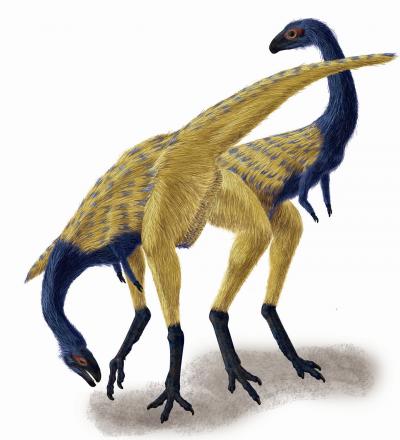
Scientists who discovered a beaked, plant-eating dinosaur in China called Limusaurus inextricabilis ("mire lizard who could not escape") say it demonstrates that theropod, or bird-footed, dinosaurs were more ecologically diverse in the Jurassic period than previously thought. Even more, they write in Nature that it offers important evidence about how the three-fingered hand of birds evolved from the hand of dinosaurs.
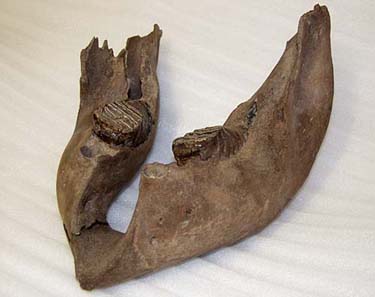
Some mammoths remained part of British wildlife long after they were believed (scientifically) to have become extinct, according to research published today in the Geological Journal.
Analysis of both the bones and the surrounding environment in Shropshire, England provide the most geologically recent evidence of woolly mammoths in western Europe, they say.
When a steep decline in the wool trade prompted an 18th century credit crunch, folks in Yorkshire took up a new (and dangerous) business venture - counterfeiting.
In the 18th century, coining was a treasonable offense and therefore punishable by death but in the 1760s and 1770s, a decline in the textile trade motivated hundreds of Yorkshire people from rural communities to risk the gallows by counterfeiting British and Spanish coins.
Living in an area with more fast food outlets and convenience stores than supermarkets and grocers has been associated with obesity in a Canadian study published by BMC Public Health.
Correlation/causation misfire? Sure, unless you want to believe that the government should put up a fresh food stand within a half mile of your house to keep you from becoming obese.
The clothing industry discovered decades ago that a mix of natural and synthetic fibers, like taking cotton and adding polyester, can make clothing that's soft, breathable and wrinkle free.
Now researchers at the University of Washington are using the same principle for biomedical applications. Mixing chitosan, found in the shells of crabs and shrimp, with an industrial polyester creates a promising new material for the tiny tubes that support repair of a severed nerve, and could serve other medical uses. The hybrid fiber combines the biologically favorable qualities of the natural material with the mechanical strength of the synthetic polymer.


 Here's Where Your Backyard Was 300 Million Years Ago
 Convergent Evolution Cheat Sheet Now 120 Million Years Old
 Synchrotron Could Shed Light On Exotic Dark Photons
 The Pain Scale Is Broken But This May Fix It