




"This new animal is fascinating, and when placed into an evolutionary context it offers intriguing evidence about how the hand of birds evolved," said scientist James Clark of George Washington University. Clark, along with Xu Xing of the Chinese Academy of Science's Institute of Vertebrate Paleontology and Paleoanthropology in Beijing, made the discovery.
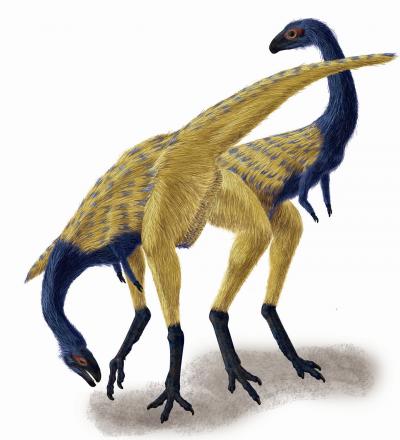
A reconstruction of Limusaurus with no evidence of feather structures. Credit: Portia Sloan
"This finding is truly exciting, as it changes what we thought we knew about the dinosaur hand," said Xu. "It also brings conciliation between the data from million-year-old bones and molecules of living birds."
Limusaurus inextricabilis was found in 159 million-year-old deposits located in the Junggar Basin of Xinjiang, northwestern China. The dinosaur earned its name from the way its skeletons were preserved, stacked on top of each other in fossilized mire pits.
A close examination of the fossil shows that its upper and lower jaws were toothless, demonstrating that the dinosaur possessed a fully developed beak. Its lack of teeth, short arms without sharp claws and possession of gizzard stones suggest that it was a plant-eater, though it is related to carnivorous dinosaurs.
The newly discovered dinosaur's hand is unusual and provides surprising new insights into a long-standing controversy over which fingers are present in living birds, which are theropod dinosaur descendants. The hands of theropod dinosaurs suggest that the outer two fingers were lost during the course of evolution and the inner three remained.
Conversely, embryos of living birds suggest that birds have lost one finger from the outside and one from the inside of the hand. Unlike all other theropods, the hand of Limusaurus strongly reduced the first finger and increased the size of the second. Clark and Xu argue that Limusaurus' hand represents a transitional condition in which the inner finger was lost and the other fingers took on the shape of the fingers next to them.
The three fingers of most advanced theropods are the second, third and fourth fingers-the same ones indicated by bird embryos-contrary to the traditional interpretation that they were the first, second and third.
Limusaurus is the first ceratosaur known from East Asia and one of the most primitive members of the group. Ceratosaurs are a diverse group of theropods that often bear crests or horns on their heads, and many have unusual, knobby fingers lacking sharp claws.
The fossil beds in China that produced Limusaurus have previously yielded skeletons of a variety of dinosaurs and contemporary animals described by Clark and Xu.
These include the oldest tyrannosaur, Guanlong wucaii; the oldest horned dinosaur, Yinlong downsi; a new stegosaur, Jiangjunosaurus junggarensis; and the running crocodile relative, Junggarsuchus sloani.
"This work on dinosaurs provides a whole new perspective on the evolution of bird manual digits," said H. Richard Lane, program director in the National Science Foundation (NSF)'s Division of Earth Sciences, which funded the research.
Clark's graduate student, Jonah Choiniere, also was involved in analyzing the new animal.



Comments