Banner
Here's Where Your Backyard Was 300 Million Years Ago

We may use terms like "grounded" and terra firma to mean stability and consistency but geology...

Convergent Evolution Cheat Sheet Now 120 Million Years Old

One tenet of natural selection is a random walk of genes but nature may be more predictable than...

Synchrotron Could Shed Light On Exotic Dark Photons

There are many hypothetical particles proposed to explain dark matter and one idea to explore how...

The Pain Scale Is Broken But This May Fix It

Chronic pain is reported by over 20 percent of the global population but there is no scientific...

User picture.
News StaffRSS Feed of this column.

News Releases From All Over The World, Right To You... Read More »

Blogroll
MicroRNAs are single-stranded snippets that, not long ago, were given short shrift as genetic junk. Now that studies have shown they regulate genes involved in normal functioning as well as diseases such as cancer, everyone wants to know: What regulates microRNAs?

Scientists at Johns Hopkins were surprised to find an elegantly simple answer: touch.

In a new study, published in the Proceedings of the National Academy of Sciences, the researchers discovered that cell-to-cell contact revs up the manufacture of these small but mighty molecules.
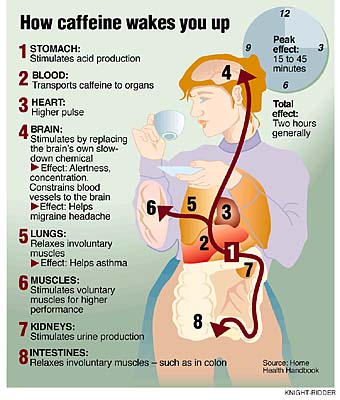
Ever miss your daily cup of coffee and subsequently get a pounding headache? According to reports from consumers of coffee and other caffeinated products, caffeine withdrawal is often characterized by a headache, fatigue, feeling less alert, less energetic and experiencing difficulty concentrating.  Caffeine withdrawal is at its worst between 24 to 48 hours and lasts up to a week.

 Everyone is blaming H1N1, but could a different strain of Influenza be the cause of Mexican deaths?

A new study by University of Maryland researchers suggests that the potential for an avian influenza virus to cause a human flu pandemic is greater than previously thought and the results also illustrate how the current H1N1 swine flu outbreak likely came about. 

Regular hand washing is recommended by both the WHO and the NHS as one of the most effective ways of controlling infections.   Using a hand sanitizer when soap and water are not available is also a good idea.

With swine flu topping the agenda of business around the world, global risks specialist, Maplecroft has released three new maps and indices revealing the countries most at risk from an influenza pandemic.

The Influenza Pandemic Risk Index (IPRI) consists of three categories: Risk of Emergence, Risk of Spread and Capacity to Contain. Each index generates a list of countries most at risk and that require a tailored policy response on the part of government and business. Maplecroft's research focuses on global risks to business.

The map of Risk of Spread shows the United Kingdom most at risk to the spread of an influenza pandemic, ranking number 1 out of 213 countries.