Banner
How To Overcome Leadership Battles

In times of social rancor and strife, most will fight each other, but societies are saved by those...

Thousands Of Unpublished Studies Show Why Conservation Efforts Miss The Mark

Europe alone has so much unpublished, un-catalogued biological data that it is challenging to take...

Why Antarctic Sea Ice Stopped Growing In 2015

Though numerical models and popular films like An Inconvenient Truth projected Arctic ice...

Wealth Correlated To Loneliness

You may have read that Asian cultures respect the elderly more than Europe but Asian senior citizens...

User picture.
News StaffRSS Feed of this column.

News Releases From All Over The World, Right To You... Read More »

Blogroll

It is time for NHS England to "do the right thing" and fund pre-exposure prophylaxis (PrEP) for HIV prevention, argue two senior public health doctors in The BMJ today.

Directors of public health Jim McManus and Dominic Harrison, say despite overwhelming evidence that PrEP against HIV infection is largely safe, effective, and cost effective, NHS England has declined to make it available on the NHS, arguing that HIV prevention is the responsibility of local government.

Such an approach, they write, "confounds its advocacy of a health and care system integrated around the best outcomes for the citizen and perpetuates an incoherent national approach to HIV prevention."

Current federal agricultural subsidies focus on financing production of food commodities, a large portion of which are converted into high-fat meat and dairy products, refined grains, high-calorie juices and soft drinks (sweetened with corn sweeteners), and processed and packaged foods.

Karen R. Siegel, Ph.D., of the Centers for Disease Control and Prevention, Atlanta, and coauthors used data from the National Health and Nutrition Examination Survey from 2001 to 2006 to calculate an individual-level "subsidy score" for consumption of subsidized food commodities as a percentage of total calorie intake.

The study, which relied on a single day of 24-hour dietary recall, included 10,308 participants, about half of whom were men, with an average age of about 40.

In the insect world, smells are important. Insects of course do not have noses, but they do have receptors on their antennae, feet, and other body parts that allow them to sense chemicals and odors.

Female parasitoid wasps and flies are known to hone in on their hosts (caterpillars, cicadas, and other insects and arthropods) by "smelling" them -- that is, they sense chemicals from other insects that attract them. Once they find the hosts, they lay eggs on or inside them, and the young that emerge from the eggs feed on them.

ANN ARBOR -- A new reconstruction of Antarctic ocean temperatures around the time the dinosaurs disappeared 66 million years ago supports the idea that one of the planet's biggest mass extinctions was due to the combined effects of volcanic eruptions and an asteroid impact.

Two University of Michigan researchers and a Florida colleague found two abrupt warming spikes in ocean temperatures that coincide with two previously documented extinction pulses near the end of the Cretaceous Period. The first extinction pulse has been tied to massive volcanic eruptions in India, the second to the impact of an asteroid or comet on Mexico's Yucatan Peninsula.

Goats have the capacity to communicate with people like other domesticated animals, such as dogs and horses, according to scientists from Queen Mary University of London (QMUL).

In a new paper in the journal Biology Letters, researchers from QMUL's School of Biological and Chemical Sciences found that goats respond to people by gazing at them when facing a problem they cannot solve alone, and their responses change depending on the person's behaviour.

To investigate, the team trained goats to remove a lid from a box to receive a reward. In the final test, they made the reward inaccessible and recorded their reaction towards the experimenters, who were either facing the goats or had their backs to them.

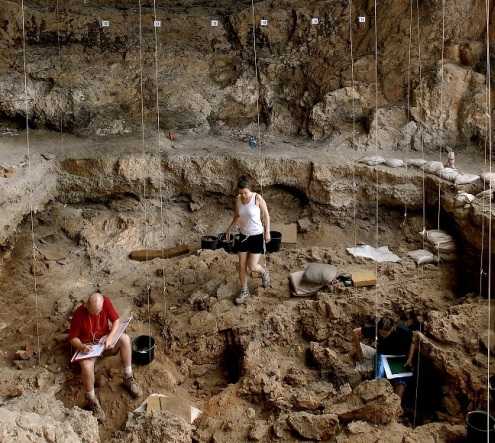
The woman was laid on a bed of specially selected materials, including gazelle horn cores, fragments of chalk, fresh clay, limestone blocks and sediment. Tortoise shells were placed under and around her body, 86 in total. Sea shells, an eagle's wing, a leopard's pelvis, a forearm of a wild boar and even a human foot were placed on the body of the mysterious 1.5 meter-tall woman. Atop her body, a large stone was laid to seal the burial space.