Banner
How To Overcome Leadership Battles

In times of social rancor and strife, most will fight each other, but societies are saved by those...

Thousands Of Unpublished Studies Show Why Conservation Efforts Miss The Mark

Europe alone has so much unpublished, un-catalogued biological data that it is challenging to take...

Why Antarctic Sea Ice Stopped Growing In 2015

Though numerical models and popular films like An Inconvenient Truth projected Arctic ice...

Wealth Correlated To Loneliness

You may have read that Asian cultures respect the elderly more than Europe but Asian senior citizens...

User picture.
News StaffRSS Feed of this column.

News Releases From All Over The World, Right To You... Read More »

Blogroll

Diabetes researchers, investigating how the body supplies itself with insulin, discovered to their surprise that adult stem cells, which they expected to play a crucial role in the process, were nowhere to be found. Many researchers had proposed that adult stem cells develop into insulin-producing cells, called beta cells, in the pancreas.

Instead, the beta cells themselves divide, although slowly, to replenish their own population.


In animal tissue, insulin-producing beta cells glow red and green with dyes that indicate mulitple rounds of cell division. Credit: Children's Hospital of Philadelphia

Researchers at the University of Illinois have developed a simple and economical technique for imaging and mapping fruit fly chromosomes. This new approach will enable them to construct the first accurate map of the chromosomes and tease out the secrets hidden in their stripes.


Developers of the new approach use a technology called Computer Vision to analyze hundreds of crisp images of the same chromosomes. This will allow the production of a much more precise map of the chromosome bands. Credit: Photo courtesy of Dmitri Novikov

Don't feel bad if you want to be part of the "in" crowd. It may be hardwired in our brain cells.

Even newborn brain cells reach out to mature brain cells that are already well connected within the established circuitry, report scientists at the Salk Institute for Biological Studies in the online edition of Nature Neuroscience.


Top: Newborn neurons send out tiny dendritic protrusions (shown in green) that seek out pre-synaptic areas -- the sending terminals of nerve cells (shown in purple) -- that are already well-connected within the established circuitry (shown in red).

Increasing the amount of SUMO, a small protein in the brain, could be a way of treating diseases such as epilepsy and schizophrenia, reveal scientists at the University of Bristol, UK. Their findings are published online today in Nature.


Distribution of kainate receptors (blue) and SUMOylation enzymes (red) in the synaptic areas (green) of a hippocampal neurone. Credit: Stephane Martin

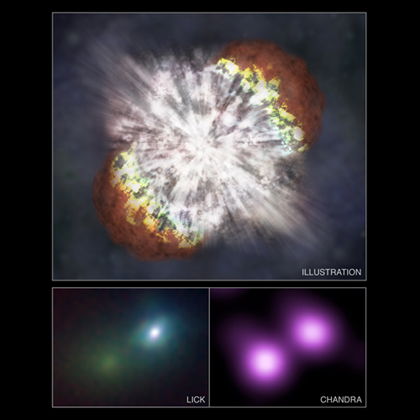
The brightest stellar explosion ever recorded may be a long-sought new type of supernova, according to observations by NASA's Chandra X-ray Observatory and ground-based optical telescopes. This discovery indicates that violent explosions of extremely massive stars were relatively common in the early universe, and that a similar explosion may be ready to go off in our own Galaxy.


Credit: Illustration: NASA/CXC/M.Weiss; X-ray: NASA/CXC/UC Berkeley/N.Smith et al.; IR: Lick/UC Berkeley/J.Bloom & C.Hansen

Coral reefs, among Earth's richest ecosystems, traditionally teem with an abundance of life. But in recent years, corals have been dying in droves. Scientists suspect a variety of factors, ranging from accidental damage from fishing activity to the effects of polluted runoff from land.

One threat that appears to be growing dramatically in Australia's famed Great Barrier Reef is white syndrome, a disease that is spreading rapidly, leaving stripes of dead corals like ribbons of death in its wake.