Banner
How To Overcome Leadership Battles

In times of social rancor and strife, most will fight each other, but societies are saved by those...

Thousands Of Unpublished Studies Show Why Conservation Efforts Miss The Mark

Europe alone has so much unpublished, un-catalogued biological data that it is challenging to take...

Why Antarctic Sea Ice Stopped Growing In 2015

Though numerical models and popular films like An Inconvenient Truth projected Arctic ice...

Wealth Correlated To Loneliness

You may have read that Asian cultures respect the elderly more than Europe but Asian senior citizens...

User picture.
News StaffRSS Feed of this column.

News Releases From All Over The World, Right To You... Read More »

Blogroll

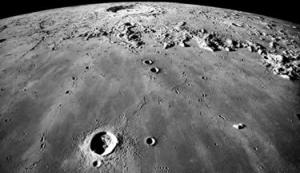
Light has been shed on the dark parts of the Moon with experiments by University of Edinburgh researchers simulating billions of years of lunar evolution.

It is generally believed the Moon was created after an early, semi molten, Earth collided with a planet the size of Mars.

The collision was so great that the orbiting debris would have formed a so-called lunar magma ocean, or liquefied rock, up to several hundred kilometres deep that would have covered the Moon's surface.

Yet until now, it has remained a mystery as to how this magma ocean cooled and how the lunar landscape evolved into white highlands and dark valleys.

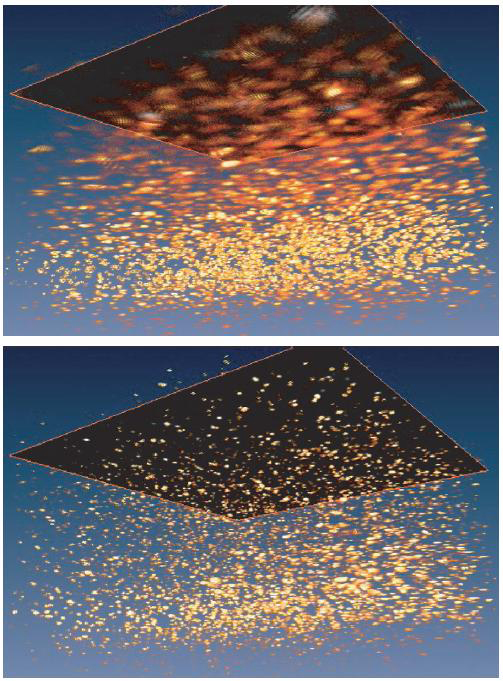
Researchers at the University of Illinois at Urbana-Champaign have developed a novel computational image-forming technique for optical microscopy that can produce crisp, three-dimensional images from blurry, out-of-focus data.

Called Interferometric Synthetic Aperture Microscopy, ISAM can do for optical microscopy what magnetic resonance imaging did for nuclear magnetic resonance, and what computed tomography did for X-ray imaging, the scientists say.


Photo courtesy of Beckman Institute
Representations of a tissue phantom where the scattering points
would represent cells, and images before and after ISAM are shown.

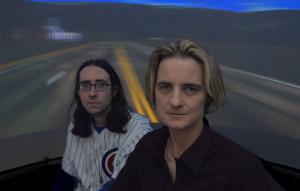
Video games that contain high levels of action, such as Unreal Tournament, can actually improve your vision.

Researchers at the University of Rochester have shown that people who played action video games for a few hours a day over the course of a month improved by about 20 percent in their ability to identify letters presented in clutter—a visual acuity test similar to ones used in regular ophthalmology clinics.

In essence, playing video game improves your bottom line on a standard eye chart.


Perhaps Daphne Bavelier and Shawn Green will work on reasons to skip school and eat Fritos next. (Image courtesy of University of Rochester)

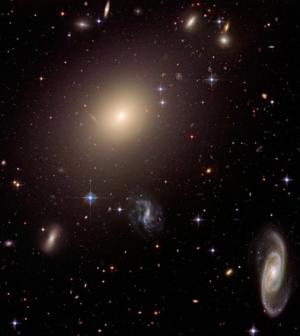
A giant elliptical galaxy seen in an image from the Hubble Space Telescope is the closest gravitational lens yet known, according to information released by the Hubble Heritage Project Tuesday (Feb. 6).

John Blakeslee, an assistant professor with the Department of Physics and Astronomy at Washington State University, working with colleagues from the University of Hawaii and the University of Durham in England, targeted the galaxy for a closer look by Hubble.

Elliptical Galaxy ES) 325-G004 in the Abell Cluster S0740. (Credit: NASA, ESA, and The Hubble Heritage Team (STScI/AURA) / Acknowledgment: J. Blakeslee (Washington State University))

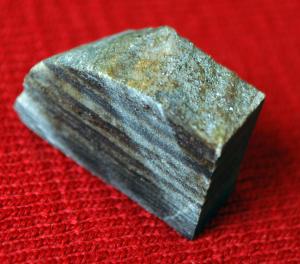
A greenhouse gas that has become the bane of modern society may have saved Earth from completely freezing over early in the planet's history, according to the first detailed laboratory analysis of the world's oldest sedimentary rocks.

Scientists have for years theorized that high concentrations of greenhouse gases could have helped Earth avoid global freezing in its youth by allowing the atmosphere to retain more heat than it lost.