Banner
How To Overcome Leadership Battles

In times of social rancor and strife, most will fight each other, but societies are saved by those...
Thousands Of Unpublished Studies Show Why Conservation Efforts Miss The Mark

Europe alone has so much unpublished, un-catalogued biological data that it is challenging to take...

Why Antarctic Sea Ice Stopped Growing In 2015

Though numerical models and popular films like An Inconvenient Truth projected Arctic ice...

Wealth Correlated To Loneliness

You may have read that Asian cultures respect the elderly more than Europe but Asian senior citizens...

User picture.
News StaffRSS Feed of this column.

News Releases From All Over The World, Right To You... Read More »

Blogroll

The levels of virus in the blood (viremia) for patients with Ebola virus disease (EVD) are strong predictors of fatality, according to a study published in PLOS Medicine this week. The study, conducted by the teams of Amadou Alpha Sall (Institut Pasteur, Dakar, Senegal) and of Simon Cauchemez (Institut Pasteur, Paris, France) and scientists from Guinea and Canada, found that in the week following symptom onset, viremia remained stable, and that the case fatality ratio (CFR, the proportion of deaths from the disease to total cases) increased with level of viremia.

What is the climate waiting for Russia and Europe in 15-20 years? Will be there weather abnormalities in the coming decades? Will some areas experience more severe winter, while the others will have hot summer? It all depends on how much the climate will be affected by the dynamics of the possible onset of minimum solar magnetic activity. The Sun's behaviour in future cycles is the main theme of a publication on the forecast and explanation of the minima of solar activity. The paper was prepared with contributions from Elena Popova from the Skobeltsyn Institute of Nuclear Physics (Lomonosov Moscow State University) and was published in Scientific Reports.

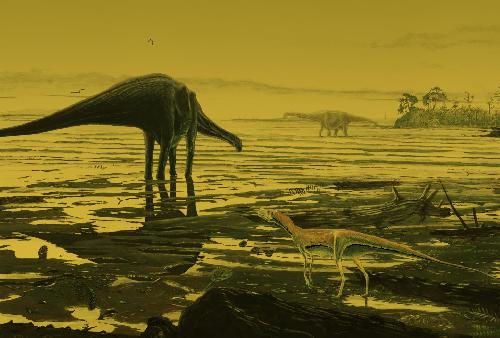
A newly discovered collection of rare dinosaur tracks is helping scientists shed light on some of the biggest animals ever to live on land.

Hundreds of footprints and handprints made by plant-eating sauropods around 170 million years ago have been found on the Isle of Skye in Scotland.

The discovery - which is the biggest dinosaur site yet found in Scotland - helps fill an important gap in the evolution the huge, long-necked animals, which were the biggest of the dinosaurs.

pic

This is an artist's impression of sauropod dinosaurs on the Isle of Skye. Credit: Jon Hoad

Researchers from North Carolina State University have confirmed that blood vessel-like structures found in an 80 million-year-old hadrosaur fossil are original to the animal, and not biofilm or other contaminants. Their findings add to the growing body of evidence that structures like blood vessels and cells can persist over millions of years, and the data not only confirm earlier reports of protein sequences in dinosaurs, they represent a significant advance in methodology.

University of Groningen scientists have designed a unique experiment to study ageing in yeast cells. By following molecular processes inside ageing yeast, they discovered that an overproduction of the proteins needed to make new proteins could be the root cause of the cellular processes that eventually kill the cells. Their results have been published online in the journal eLife.

COLUMBIA, Mo. - In 2014, 75.4 million Baby Boomers lived in the United States, according to Pew Research. As this generation continues to age, dialogue will increase on how to manage concerns associated with aging, such as the decline in cognitive ability and retirement decisions. Now, a researcher at the University of Missouri has found that older individuals with lower cognitive abilities are susceptible to behavioral biases, such as being adverse to upfront costs. Michael Guillemette, an assistant professor of personal financial planning in the University of Missouri's College of Human Environmental Sciences, says that risk aversion, along with lower cognitive ability among older Americans, might explain the lack of demand for certain retirement savings products.