Tuesday, June 5th, 2012 at 3:03 PM PDT (California), Venus will do something we on Earth will have witnessed for only the eighth since the invention of the telescope - it will cross in front of the sun. This transit is among the rarest of planetary alignments and it has an interesting cycle. Two Venus transits always occur within eight years of each other and then there is a break of either 105 or 121 years before it happens again.
What evolutionary reason would tiny insects 100 million years ago have for collecting and transporting Gingko pollen? They had highly specialized hairs with a ringed structure to increase their ability to collect pollen grains. Their ringed hairs cannot have grown due to an evolutionary selection benefiting the trees so ancient thysanopterans, so-called thrips (a group of minute insects of less than 2 mm in length) must have fed their larvae with pollen. This suggests that this species formed colonies with larvae living in the ovules of some kind of gingko for shelter and protection, and female insects transporting pollen from the male Gingko cones to the female ovules to feed the larvae and at the same time pollinate the trees.
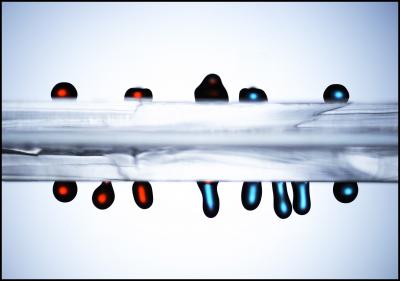
Diagnostic tools are getting small, small enough to fit in a person's pocket, and one huge benefit for medical researchers would be a way to easily move and even mix small samples of a liquid.
A newly patented surface moves drops along certain paths - all it takes is a shake.
Honduras is now a permanent shark sanctuary so any shark fins found are illegal - the International Union for Conservation of Nature says that 30 percent of all shark populations around the world are threatened or near threatened with extinction.
The remains of newborn twin girls have been found in the archaeological site of Sant Miquel d'Olèrdola in Catalonia and it is expected that they belong to two girls between 38 and 40 weeks of gestation, who were buried at the same time in the same grave with their legs entwined.
The remains date between the middle of the 4th century B.C. to the beginning of the 2nd century B.C. and are the first bone remains of twins to be recorded in the Iberian peninsula.
If you think about it rationally, sex may be fun but it's too much work and, from a reproduction standpoint, the payoff is uncertain. Scientists have speculated for a long time on why all living things don't simply make like amoebas and split.
Scientists believe that sexual reproduction offers two big advantages: It can sweep bad mutations out of the gene pool more quickly. Also, by shuffling parents' genetic material each generation, it increases the likelihood that new genetic combinations will arise that help organisms adapt to their environment.


 Here's Where Your Backyard Was 300 Million Years Ago
 Convergent Evolution Cheat Sheet Now 120 Million Years Old
 Synchrotron Could Shed Light On Exotic Dark Photons
 The Pain Scale Is Broken But This May Fix It