Banner
Here's Where Your Backyard Was 300 Million Years Ago

We may use terms like "grounded" and terra firma to mean stability and consistency but geology...

Convergent Evolution Cheat Sheet Now 120 Million Years Old

One tenet of natural selection is a random walk of genes but nature may be more predictable than...

Synchrotron Could Shed Light On Exotic Dark Photons

There are many hypothetical particles proposed to explain dark matter and one idea to explore how...

The Pain Scale Is Broken But This May Fix It

Chronic pain is reported by over 20 percent of the global population but there is no scientific...

User picture.
News StaffRSS Feed of this column.

News Releases From All Over The World, Right To You... Read More »

Blogroll
Researchers have documented the first fossil-based evidence supporting an evolutionary theory of aging, which predicts that species evolving in low mortality and resource-limited ecosystems tend to be more long-lived.

But that is not an endorsement of banning guns and caloric restriction. It's a little more complicated than that.
Climate change is in its fifth decade of being the big concern. In the 1960s and 70s, it was a cooling worry but now there is a warming one.  A constant in mammal's surviving numerous climate upheavals throughout earth history has been diversity - the relative range and distribution of mammalian families remained strikingly consistent throughout major climate changes over the past 56 million years.

During the Middle Palaeolithic, between 127,000 and 40,000 years ago, humans that lived along the banks of the river Manzanares (now Madrid, Spain) ate pachyderm meat and bone marrow, according to a study that found percussion and cut marks on elephant remains in the site of Preresa.

So if you want to try a fad paleolithic diet, get a cheap spear and see how you do bringing one of those babies down first.

Is it a shrub?  No one really knows. A fossilized specimen, a roughly elliptical shape with multiple lobes, totaling almost seven feet in length, was unveiled today at the North-Central Section 46th Annual Meeting of the Geological Society of America, in Dayton, Ohio.

Around 450 million years ago, shallow seas covered the Cincinnati region and harbored one very large and now very mysterious organism. Despite its size, no one has ever found a fossil of this "monster" until its discovery by an citizen paleontologist, Ron Fine of Dayton, last year. 

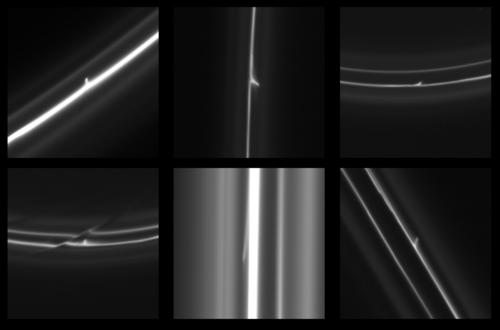
Half-mile-sized objects have been seen punching through parts of Saturn's F ring, leaving glittering trails behind them.  These mini-jets' trails in the rings fill in a missing link in our understanding of the curious behavior of the F ring. 

Scientists have known that relatively large objects like the moon Prometheus, 92 miles across, can create channels, ripples and snowballs in the F ring but what happened to these snowballs after they were created was unclear. 

Commonly prescribed anti-depressants appear to be doing patients more harm than good, say researchers who have published a paper examining the impact of the medications on the entire body.