Banner
You Didn't Feel Continental Mantle Earthquakes, But They Happened. A Lot

A 1979 seismic event was a different kind of earthquake, and it is has intrigued scientists ever...

How To Overcome Leadership Battles

In times of social rancor and strife, most will fight each other, but societies are saved by those...

Thousands Of Unpublished Studies Show Why Conservation Efforts Miss The Mark

Europe alone has so much unpublished, un-catalogued biological data that it is challenging to take...

Why Antarctic Sea Ice Stopped Growing In 2015

Though numerical models and popular films like An Inconvenient Truth projected Arctic ice...

User picture.
News StaffRSS Feed of this column.

News Releases From All Over The World, Right To You... Read More »

Blogroll

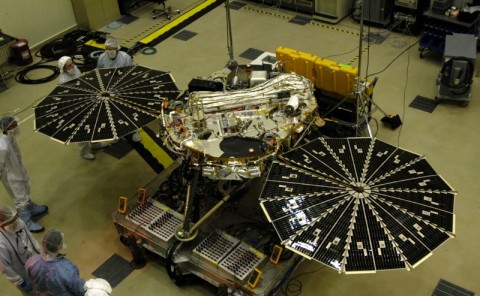
In just over a week's time NASA's Phoenix Lander is due to launch for Mars where it will probe the arctic landscape searching for conditions favourable for past or present life. UK scientists from Imperial College London and the University of Bristol have provided hardware and are involved in the science operations.

The launch is scheduled for 1035 am GMT (0535 am EDT) on 3rd August (3 week launch window) with the spacecraft starting its journey onboard a Delta II rocket from Cape Canaveral, Florida. Phoenix will descend and land on the Red Planet's northern plains, in the area known as Vastitas Borealis, in May 2008, where it will claw down into the icy soil.

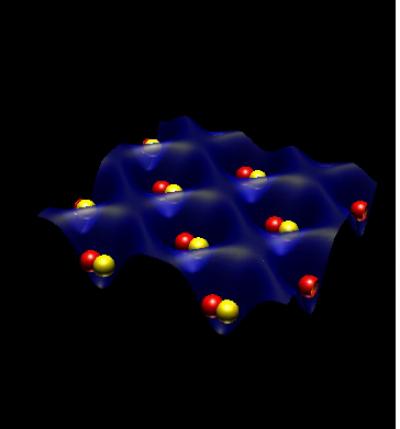
Physicists at the Commerce Department’s National Institute of Standards and Technology (NIST) have induced thousands of atoms trapped by laser beams to swap “spins” with partners simultaneously.

The repeated exchanges, like a quantum version of swinging your partner in a square dance but lasting a total of just 10 milliseconds, might someday carry out logic operations in quantum computers, which theoretically could quickly solve certain problems that today's best supercomputers could not solve in years.

The atomic dance advances prospects for the use of neutral atoms as quantum bits (qubits) for storing and processing data in quantum computers.

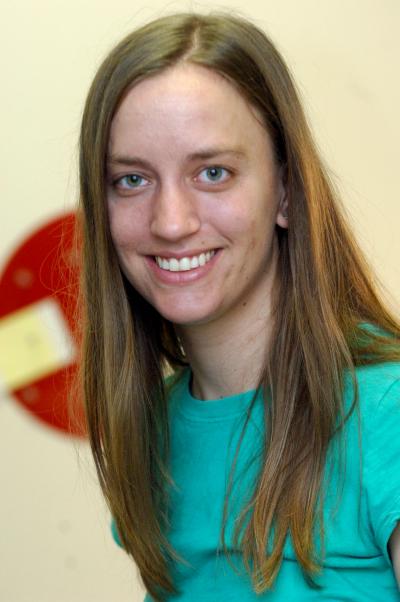
Kids asked to physically gesture at math problems are nearly three times more likely than non-gesturers to remember what they’ve learned. In today’s issue of the journal Cognition, a University of Rochester scientist suggests it’s possible to help children learn difficult concepts by providing gestures as an additional and potent avenue for taking in information.

“We’ve known for a while that we use gestures to add information to a conversation even when we’re not entirely clear how that information relates to what we’re saying,” says Susan Wagner Cook, lead author and postdoctoral fellow at the University.

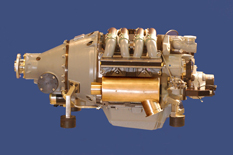
Rotary engines were developed by Wankel of Germany in the 1930s. They never really gained acceptance in the mass market, aside from Mazda in its RX-7 and later models. But a project team says they can take the Mazda rotary engine block and build an aero engine around it that could be retrofitted to all aircraft - and it will change aviation.

The four-stroke piston engine technology used by the majority of planes in general aviation dates back 60 years.

There's nothing wrong in sticking with what works but those motors require 70 to 80 moving parts and still use 100-octane low-leaded (100 LL) fuel that has long been displaced by kerosene for commercial aircraft.

A century-old dream of neuroscientists to visualize a memory has been fulfilled, as University of California, Irvine researchers, using newly developing microscopic techniques, have captured first-time images of the changes in brain cell connections following a common form of learning.

The study shows that synaptic connections in a region of rats’ brains critical to learning change shape when the rodents learn to navigate a new, complex environment. In turn, when drugs are administered that block these changes, the rats don’t learn, confirming the essential role the shape change plays in the production of stable memory.

“This is the first time anyone has seen the physical substrate, the ‘face,’ of newly encoded memory.

Carnegie Mellon University scientists have made an important discovery that aids the understanding of why HIV enters immune cells with ease. The researchers found that after HIV docks onto a host cell, it dramatically lowers the energy required for a cell membrane to bend, making it easier for the virus to infect immune cells. The finding, in press in Biophysical Journal, will provide vital data to conduct future computer simulations of HIV dynamics to help further drug discovery and prevent deadly infections.

“We found that HIV fusion peptide dramatically decreases the amount of energy needed to bend a cell-like membrane,” said Stephanie Tristram-Nagle, associate research professor of biological physics at Carnegie Mellon.