Banner
You Didn't Feel Continental Mantle Earthquakes, But They Happened. A Lot

A 1979 seismic event was a different kind of earthquake, and it is has intrigued scientists ever...

How To Overcome Leadership Battles

In times of social rancor and strife, most will fight each other, but societies are saved by those...

Thousands Of Unpublished Studies Show Why Conservation Efforts Miss The Mark

Europe alone has so much unpublished, un-catalogued biological data that it is challenging to take...

Why Antarctic Sea Ice Stopped Growing In 2015

Though numerical models and popular films like An Inconvenient Truth projected Arctic ice...

User picture.
News StaffRSS Feed of this column.

News Releases From All Over The World, Right To You... Read More »

Blogroll

The double sunset that Luke Skywalker gazed upon in the film "Star Wars" might not be a fantasy.

Astronomers using NASA's Spitzer Space Telescope have observed that planetary systems – dusty disks of asteroids, comets and possibly planets – are at least as abundant in twin-star systems as they are in those, like our own, with only one star. Since more than half of all stars are twins, or binaries, the finding suggests the universe is packed with planets that have two suns.

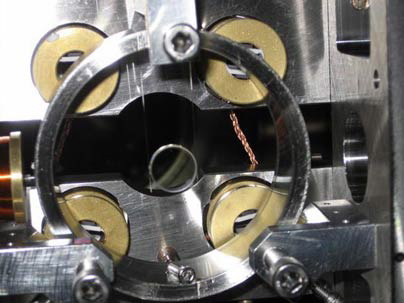
Using a laser-cooling technique that could one day allow scientists to observe quantum behavior in large objects, MIT researchers have cooled a coin-sized object to within one degree of absolute zero.

This study marks the coldest temperature ever reached by laser-cooling of an object of that size, and the technique holds promise that it will experimentally confirm, for the first time, that large objects obey the laws of quantum mechanics just as atoms do.


MIT researchers have developed a technique to cool this dime-sized mirror (small circle suspended in the center of large metal ring) to within one degree of absolute zero. Photo / Christopher Wipf

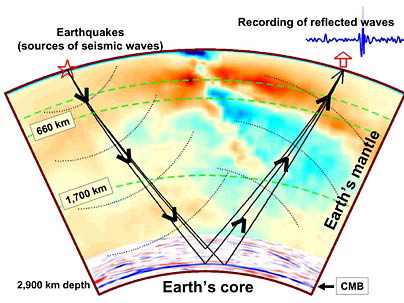
High-resolution images that reveal unexpected details of the Earth's internal structure are among the results reported by MIT and Purdue scientists in the March 30 issue of Science.

The researchers adapted technology developed for near-surface exploration of reservoirs of oil and gas to image the core-mantle boundary some 2,900 kilometers, or 1,800 miles, beneath Central and North America.


Seismic waves from earthquakes penetrate the Earth's mantle and scatter back at the core-mantle boundary to detectors on the surface. Nearly 100,000 such recordings are used to illuminate the planet's deep internal structures. Image courtesy / Robert van der Hilst, MIT

Flexible electronic membranes may overcome a longstanding dilemma faced by brain researchers: How to replicate injuries in the lab without destroying the electrodes that monitor how brain cells respond to physical trauma.

Developed by a team of engineers at Princeton University, Columbia University and the University of Cambridge, the membranes feature microelectrodes that are able to withstand the sudden stretching that is used to simulate severe head trauma. The systems could allow far more nuanced studies of brain injury than previously possible and may lead to better treatments in the minutes and hours immediately following the injury.

Synovial fluid is slime with a serious purpose: Protecting shoulders, hips and other joints from wear, reducing the likelihood of injuries and arthritis.

Scientists have long believed that synovial fluid gets its surface-slicking, shock-absorbing properties from the "goo molecule" hyaluronate. But new research led by Brown University physician and engineer Gregory Jay, M.D., shows that the protein lubricin is also a player, not only lubricating cartilage but also giving synovial fluid its spring.

Livermore researchers have moved one step closer to being able to turn on and off the decay of a nuclear isomer.

The protons and neutrons in a nucleus can be arranged in many ways. The arrangement with the lowest energy is called the ground state and all others are called excited states. (This is analogous to the ground and excited states of electrons in an atom except that nuclear excited states are typically thousands of times higher in energy.) Excited nuclear states eventually decay to the ground state via gamma emission or to another nucleus via particle emission. Most excited states are short-lived (e.g., billionth of a second). However, a few are long-lived (e.g., hours) and are called isomers.