Banner
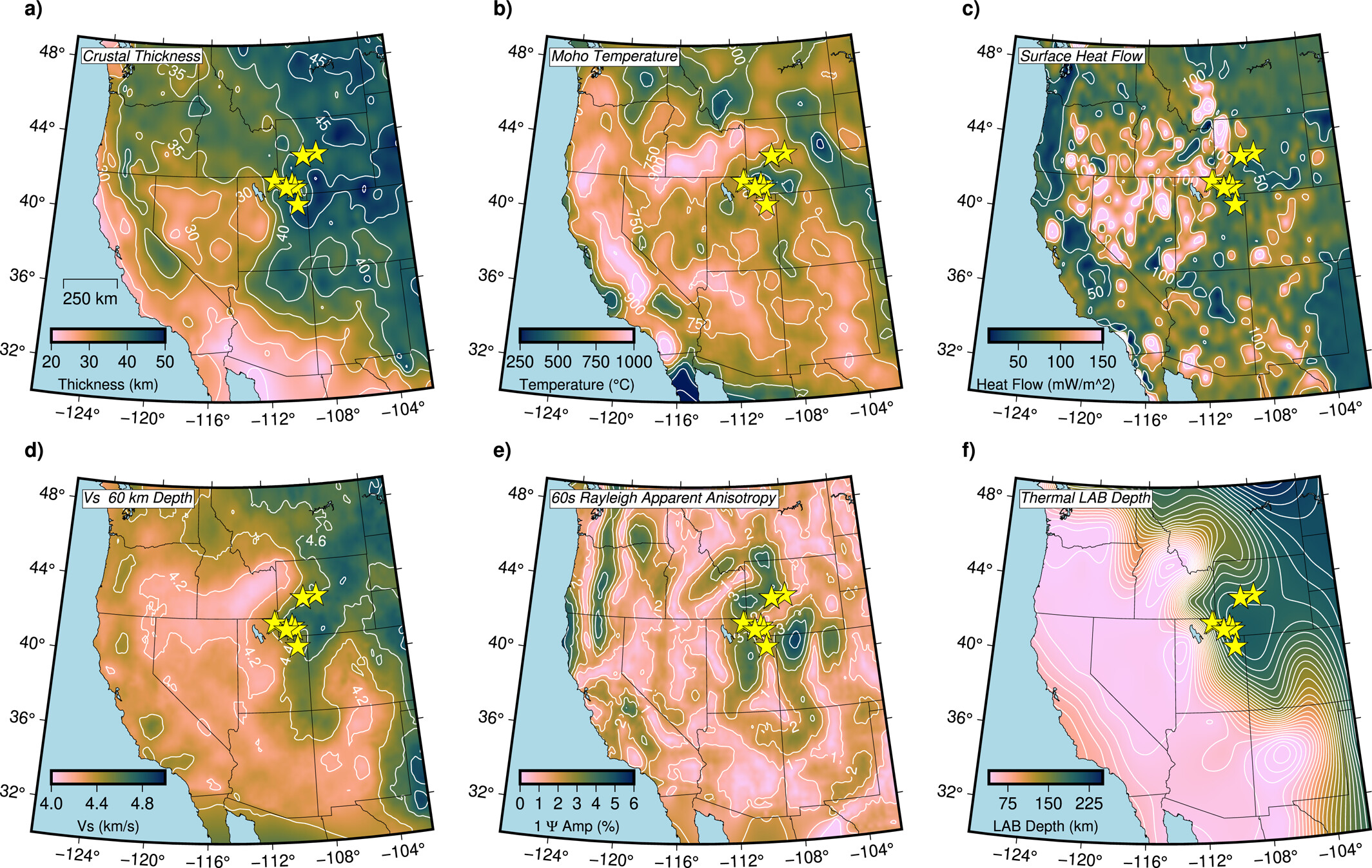
You Didn't Feel Continental Mantle Earthquakes, But They Happened. A Lot

A 1979 seismic event was a different kind of earthquake, and it is has intrigued scientists ever...
How To Overcome Leadership Battles

In times of social rancor and strife, most will fight each other, but societies are saved by those...
Thousands Of Unpublished Studies Show Why Conservation Efforts Miss The Mark

Europe alone has so much unpublished, un-catalogued biological data that it is challenging to take...

Why Antarctic Sea Ice Stopped Growing In 2015

Though numerical models and popular films like An Inconvenient Truth projected Arctic ice...

User picture.
News StaffRSS Feed of this column.

News Releases From All Over The World, Right To You... Read More »

Blogroll

The first major global assessment of climate change science in six years has concluded that changes in the atmosphere, the oceans and glaciers and ice caps show unequivocally that the world is warming.

The Intergovernmental Panel on Climate Change (IPCC) concludes that major advances in climate modelling and the collection and analysis of data now give scientists “very high confidence” (at least a 9 out of 10 chance of being correct) in their understanding of how human activities are causing the world to warm.

In an advance that could lead to composite materials with virtually limitless performance capabilities, a University of Wisconsin-Madison scientist has dispelled a 50-year-old theoretical notion that composite materials must be made only of "stable" individual materials to be stable overall.

Writing in the Feb. 2 issue of the journal Physical Review Letters, Engineering Physics Professor Walter Drugan proves that a composite material can be stable overall even if it contains a material having a negative stiffness, or one unstable by itself-as long as it is contained within another material that is sufficiently stable.

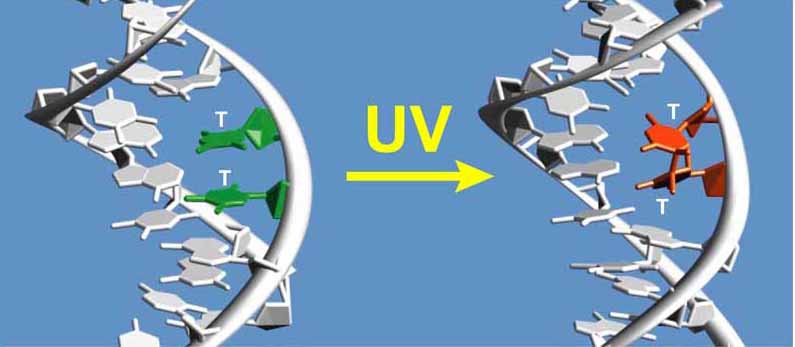
For the first time, scientists have observed DNA being damaged by ultraviolet (UV) light.

Ohio State University chemists and their colleagues in Germany used a special technique to watch strands of DNA in the laboratory sustain damage in real time.

They observed the most common chemical reaction among a family of reactions on the DNA molecule that are linked to sunburn, and discovered that this key reaction happens with astounding speed -- in less than one picosecond, or one millionth of one millionth of a second.


An undamaged stack of thymine bases is colored green in the DNA double helix on the left.

Malaria kills more than one million people each year, most of them young children living in Africa. Now physicists in the UK have shared their computers with biologists from countries including France and Korea in an effort to combat the disease.

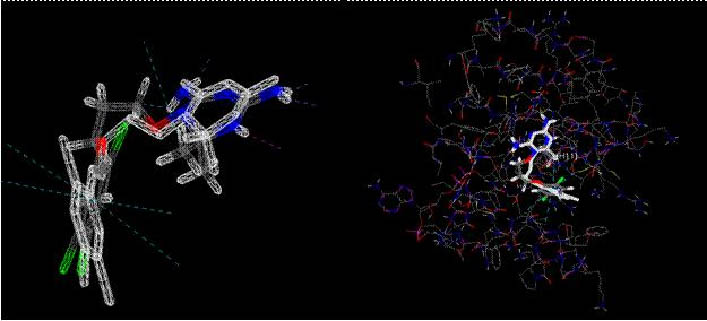
Using an international computing Grid spanning 27 countries, scientists on the WISDOM project analysed an average of 80,000 possible drug compounds against malaria every hour. In total, the challenge processed over 140 million compounds, with a UK physics Grid providing nearly half of the computing hours used.

The computers are all part of EGEE (Enabling Grids for E-sciencE), which brings together computing Grids from different countries and disciplines.