

If you're a long-time reader of this site, you might get the idea that Albert Einstein was a pretty smart guy - that comes across because he tends to proven right a lot even today.
PSR J0737-3039A/B is a unique system of two dead stars, pulsars, and one of the pair is 'wobbling' in space just like a spinning top, according to a team of researchers. The effect, called precession, was predicted by Albert Einstein and is yet another confirmation of his theory.
The binary pulsars were formed when a pair of massive stars exploded and their cores collapsed to create objects whose mass is greater than that of our Sun, but compressed to the size of a city. They are spinning at incredible speeds and emit powerful beams of radio waves which sweep across our radio-telescopes like cosmic lighthouses producing regular pulses of energy - hence their name, pulsars. PSR J0737-3039A/B is the only known system in our galaxy where two pulsars are locked into such close orbit around one another - the entire system could fit inside our Sun.
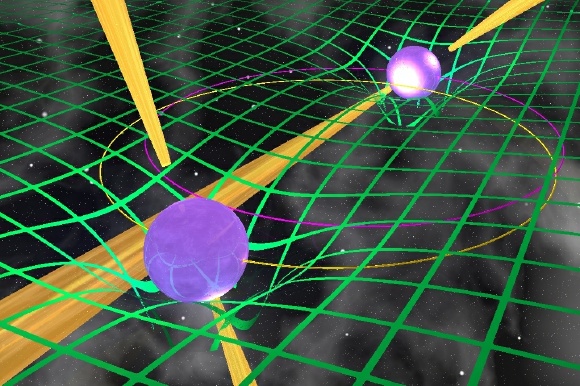
The illustration shows the two pulsars which orbit the common centre of mass in only 144 minutes. The system was discovered by astronomers from the University of Manchester as part of an international team in 2003 and it is the eclipses observed in this system that have lead to this study. CREDIT: Michael Kramer, University of Manchester
Prof Michael Kramer of The University of Manchester explained: "We discovered the double pulsar in 2003 using the Parkes Radio Telescope in Australia and have since been carefully timing the arrival of its pulses using several telescopes, including the Lovell Telescope at Jodrell Bank, and the Green Bank Telescope in the US. It has proved to be the best test we have for the predictions of Einstein's theory of gravity, general relativity."
René Breton of McGill University added: "The double pulsar creates ideal conditions for testing general relativity's predictions because the larger and the closer two massive objects are to one another, the more important relativistic effects are."
"Binary pulsars are the best place to test general relativity in a strong gravitational field," agreed Prof Victoria Kaspi, also of McGill University. "Einstein predicted that, in such a field, the axis about which an object rotates will precess - or change direction slowly as the pulsar orbits around its companion. Imagine a spinning top tilted over slightly to one side - the spin axis wobbles.
"Pulsars are too small and too distant to allow us to observe this wobble directly", Breton explained. "However, as they orbit each other every 145 minutes, each passes in front of the other and the astronomers soon realized they could measure the direction of the pulsar's spin axis as the highly magnetized region surrounding it blocks the radio waves being emitted from the other. After patiently collecting the radio pulses over the past four years, they have now determined that its spin axis precesses exactly as Einstein predicted."
Breton explained that even though spin precession has been observed in Earth's solar system, differences between general relativity and alternative theories of gravity might only become apparent in extremely powerful gravity fields such as those near pulsars.
"So far, Einstein's theory has passed all the tests that have been conducted, including ours," said Breton. "We can now say that if anyone wants to propose an alternative theory of gravity in the future, it must agree with the results that we have obtained here.
"I think that if Einstein were alive today, he would have been absolutely delighted with these results," concluded Prof Kramer. "Not only because it confirms his theory, but also because of the novel and amazing way the confirmation has come about."

PSR J0737-3039A/B is a unique system of two dead stars, pulsars, and one of the pair is 'wobbling' in space just like a spinning top, according to a team of researchers. The effect, called precession, was predicted by Albert Einstein and is yet another confirmation of his theory.
The binary pulsars were formed when a pair of massive stars exploded and their cores collapsed to create objects whose mass is greater than that of our Sun, but compressed to the size of a city. They are spinning at incredible speeds and emit powerful beams of radio waves which sweep across our radio-telescopes like cosmic lighthouses producing regular pulses of energy - hence their name, pulsars. PSR J0737-3039A/B is the only known system in our galaxy where two pulsars are locked into such close orbit around one another - the entire system could fit inside our Sun.

Prof Michael Kramer of The University of Manchester explained: "We discovered the double pulsar in 2003 using the Parkes Radio Telescope in Australia and have since been carefully timing the arrival of its pulses using several telescopes, including the Lovell Telescope at Jodrell Bank, and the Green Bank Telescope in the US. It has proved to be the best test we have for the predictions of Einstein's theory of gravity, general relativity."
René Breton of McGill University added: "The double pulsar creates ideal conditions for testing general relativity's predictions because the larger and the closer two massive objects are to one another, the more important relativistic effects are."
"Binary pulsars are the best place to test general relativity in a strong gravitational field," agreed Prof Victoria Kaspi, also of McGill University. "Einstein predicted that, in such a field, the axis about which an object rotates will precess - or change direction slowly as the pulsar orbits around its companion. Imagine a spinning top tilted over slightly to one side - the spin axis wobbles.
"Pulsars are too small and too distant to allow us to observe this wobble directly", Breton explained. "However, as they orbit each other every 145 minutes, each passes in front of the other and the astronomers soon realized they could measure the direction of the pulsar's spin axis as the highly magnetized region surrounding it blocks the radio waves being emitted from the other. After patiently collecting the radio pulses over the past four years, they have now determined that its spin axis precesses exactly as Einstein predicted."
Breton explained that even though spin precession has been observed in Earth's solar system, differences between general relativity and alternative theories of gravity might only become apparent in extremely powerful gravity fields such as those near pulsars.
"So far, Einstein's theory has passed all the tests that have been conducted, including ours," said Breton. "We can now say that if anyone wants to propose an alternative theory of gravity in the future, it must agree with the results that we have obtained here.
"I think that if Einstein were alive today, he would have been absolutely delighted with these results," concluded Prof Kramer. "Not only because it confirms his theory, but also because of the novel and amazing way the confirmation has come about."




Einstein failed more times than he scucceeded
How about DI HER Binary stars?
How about AS Cam Stars?
How about V1143cgyni?
How about V541vgyni?
Stop lying
How about the Total failure of Einstein and the 100,000 space-time physicists at the Large hadronic Collider in France in October of 2008 that cost 20 billions and 20 billions donations that took 12 years to build and predicted creation and lasted less than 1/12 of a second and ended up burning itself because of handymen in white ropes conducting "junk" experimentation based on bad physics and bad physics is einstein's space-time garbage