




A new study finds that some parts of the animal kingdom don't even stop growing until what it middle age for humans. An analysis of 17 tyrannosaurus rex specimens, from early juveniles to older adults, concludes they took 40 years to reach their full size of around eight tons.
Estimates are done using annual growth rings, like rings for aging trees except only for the last 20 years of life, inside fossilized leg bones of Tyrannosaurus rex and the new work used circularly polarized and cross-polarized light, which found rings the authors say were not discovered before. This led them to concluding that growth happened at 40 years rather than the 25 years commonly believed.
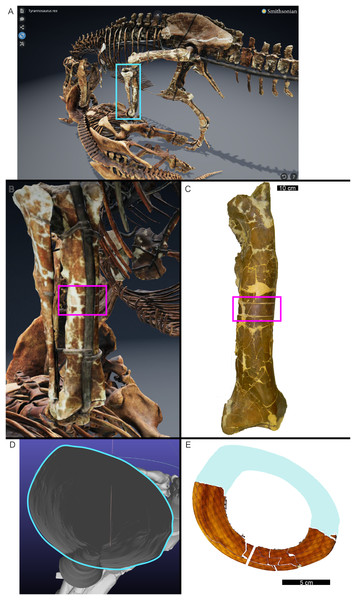
The cortical perimeter of the left tibia from USNM 555000 was reconstructed using the digital skeleton publicly available from Smithsonian 3D Digitization (https://3d.si.edu/). (A) Screen-capture of the Tyrannosaurus digital model. Blue box indicates the region of interest in panel B, which includes the left tibia. (B) The digitized left tibia. The purple box indicates the region of sample removal and replica cast restoration. (C) Photograph of left tibia after replica cast restoration. Purple box indicates the same region visible in panel B. (D) A transverse slice through the digital model was obtained at the region of interest indicated in panels B and C using Meshlab software. A screen capture of the slice was imported into Photoshop CC and the perimeter digitally traced using the pencil tool (blue outline). (E) The layer of digital tracing was fitted to the digitized thin section of tibia USNM 555000 to restore the missing cortex, indicated in blue.
And now they say some of the specimens may not be T. rex at all.
Some T. Rex samples are not T. Rex
T. rex is the best-known species of this group of dinosaurs but some scientists argue that certain smaller specimens represent a small-bodied species, dubbed Nanotyrannus, rather than juvenile specimens of Tyrannosaurus rex. Others have suggested that even the large specimens might belong to two or three different species.
The new work included two of the more famous specimens, “Jane” and “Petey,” and found they are statistically incompatible with the others, meaning they might belong to a different species of Nanotyrannus.
Citation: Woodward HN, Myhrvold NP, Horner JR. 2026. Prolonged growth and extended subadult development in the Tyrannosaurus rex species complex revealed by expanded histological sampling and statistical modeling. PeerJ 14:e20469 https://peerj.com/articles/20469/



Comments