




Recent work showed that a cocktail of antibodies offered protection mice from nearly every strain of influenza. Even avian and swine flu. Their cocktail did not allow viral escape, even after a month of repeated exposure.
It's only in a mice and therefore only EXPLORATORY. Mice are not little people, no matter how often epidemiologists and corporate media claim correlation is causal in everything from vaccines and autism to weedkillers and cancer. FDA does not approve anything based on mouse studies, and you also should not believe anything you read about miracles benefits or harms based on any animal models
Some believe that for antibodies to be useful as a therapy against viruses they must be “neutralizing” antibodies that bind directly to viruses and block them from infecting cells but these were “non-neutralizing” antibodies, which don’t prevent infection but tag infected lung cells and recruit the body’s immune system to clear the infection. The work focused on a small, highly conserved region of the influenza A virus’s Matrix Protein 2, called M2e. This part of the virus is essential for its life cycle and remains nearly unchanged across infected cells in all flu strains, including human, avian, and swine variants.
The M2e-mAb triple cocktail therapy did not lead to viral resistance even after repeated exposure, and sequencing confirmed no mutations in the virus’s M2 region after 24 days of treatment. While the team tested the efficacy of the three antibodies individually, the success came from combining them, as this approach reduces the virus’ chances of escaping three different antibodies.
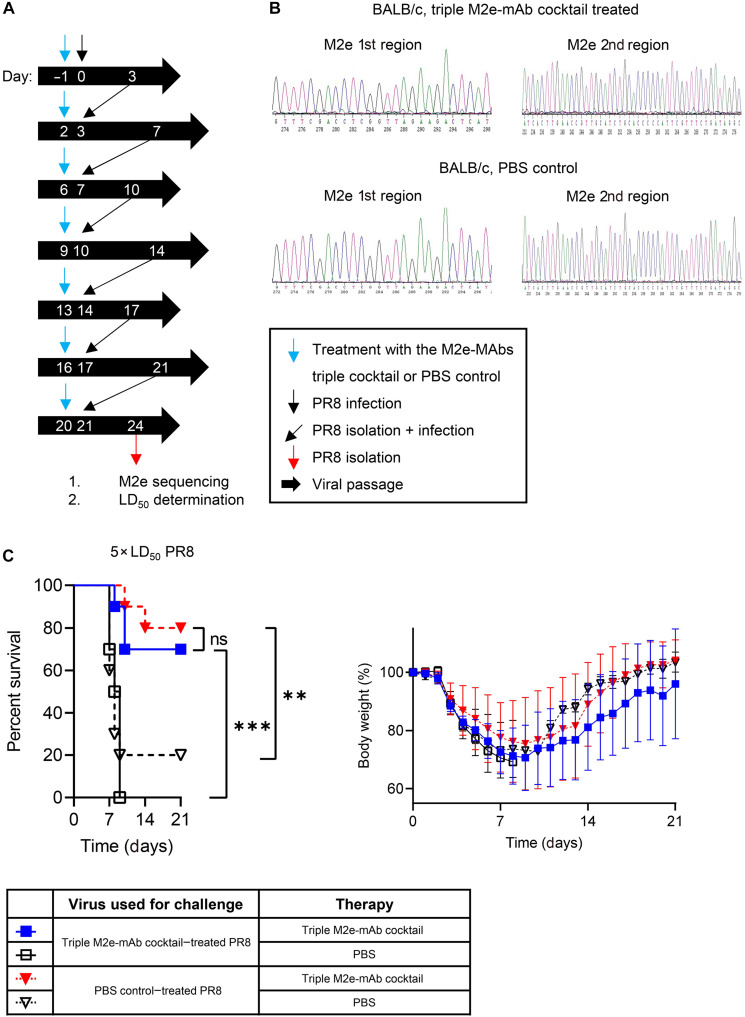
PR8 “stock virus” was passaged through WT mice for 24 days, and the final viral isolates were analyzed by Sanger sequencing. See note 1.
The team found that the antibodies were effective at low doses, both before and after influenza infection. The cocktail significantly reduced disease severity and viral load in lungs, and improved survival rates in both healthy and immunocompromised mice.
When testing H7N9, a type of bird flu that can be deadly to both animals and people, the team found that just one dose of the treatment reduced the amount of virus in the lungs, even when it was given four days after infection. The reduced viral loads correlated with better survival rates. All mice survived when treated with the antibody cocktail on the first three days after infection, while 70% and 60% survived on days four and five, respectively.
The team is working on designing antibodies for clinical trials. The idea is to make a “humanized” antibody with the same specificity to target the M2 protein, but without triggering an immune response against the therapy itself or diminishing its efficacy in humans. The team envisions a future where the cocktail could work as a standalone prophylactic for elderly, immunocompromised, and other high-risk groups, in addition to serving as a therapy for those severely ill with flu.
NOTE:
(A) Outline of the time points for mouse-to-mouse passaging of lung PR8 isolates and the indicated M2e-mAb triple cocktail treatments [clones 472 (IgG2a), 522 (IgG1), and 602 (IgG2a)] in WT mice. At each passage, virus was isolated from lung homogenates of M2e-mAb triple cocktail or PBS control–treated mice and used to infect a group of naïve prophylactically M2e-mAb triple cocktail therapy or PBS (control) treated groups of mice. Intraperitoneal injections of the M2e-mAb triple cocktail or PBS (control) are indicated by a blue arrow. (B) Sequencing chromatograms from the viral isolates isolated from therapeutically or PBS control–treated groups of WT mice. (C) BALB/c mice were treated with 60 μg of the M2e-mAb triple cocktail [clones 472 (IgG2a), 522 (IgG1), and 602 (IgG2a)] 1 day before infection with a lethal dose of (5× LD50) of PR8 that had been isolated from either M2e-mAb triple cocktail–treated or PBS control–treated WT mice. Then, their survival and percent weight loss were determined. N = 10 mice per group. Log-rank analysis (Mantel-Cox) test for survival, ***P < 0.001, **P < 0.01, and ns, not significant.



Comments