

Banner
    MAVEN, Deuterium And A Mission To Mars
    By Ashley Cox | September 20th 2008 11:12 AM | 4 comments | Print | E-mail | Track Comments
    About Ashley

    I'm an undergrad in chemistry on my way to getting a Ph.D.

    I have many different interests including genetics, fire fighting, rock

    ...

    View Ashley's Profile

    A new proposed spacecraft named MAVEN (Mars Atmosphere and Volatile EvolutioN) is expected to be launched in 2013, a $485 million mission to collect atmospheric data on Mars. The purpose of the NASA’s Mars Exploration Program is to gain further knowledge on the history of the planet’s climate and atmosphere, as well as the planet’s availability of water and its future habitability.

    Photo Credit: NASA.gov

    “Today, the martian atmosphere is about half a percent as dense as the Earth’s and it’s about 95 percent carbon dioxide, which makes it very thin and very dry,” states John T. Clarke, an Astronomy Professor at Boston University, who predicts two possible happenings for Mars’ missing atmosphere: Either it had been pulled from the planet’s weak gravitational hold and escaped into the vastness of space, or it became a frozen layer within the planet’s current crust such as the permafrost layer on Earth.


    Boston University’s center for Space Physics was initially recruited, along with University of Colorado at Boulder, to develop an instrument that will be able to determine the presence of a heavier atom of Hydrogen, named deuterium. Deuterium is an isotope of hydrogen having most of the same chemical properties, except for the atomic mass. Unlike its parent atom, deuterium contains not one, but two neutrons, resulting in a heavier particle.

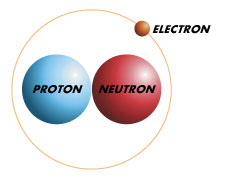
                  hydrogen atom                         deuterium atom


    Hydrogen Atom                                     Deuterium Atom


    Clarke is an expert in detecting the unique characteristics of different types of water molecules, and will prove to be a sufficient addition to the Mars’ team. In 2009 he is expected to lead an engineering and astronomy team toward developing instruments for NASA’s spacecraft to test for these isotopes.  The findings will be important in determining water percentages that have escaped off Mars and into the atmosphere.


    “Mars once had a denser atmosphere that supported the presence of liquid water on the surface,” Said Douglas McCuistion, Director of the Mars Exploration Program with NASA.  “The loss …has been an ongoing mystery, and MAVEN will help us solve it,”


    MAVEN is expected to launch as scheduled and will arrive near Mars late 2014 where it will elliptically orbit the planet between 90 and 3,870 miles above the surface. The spacecraft will be equipped with eight instruments which are planned to take recording of the atmosphere for a full year. It will then drop to a measure of 80 miles from the surface to gather data samples of Mars’ entire upper atmosphere.


    “MAVEN will obtain critical measurements,” says Michael Meyer, the Chief Scientist on Mars at NASA headquarters.


    NASA's Mars Exploration Program seeks to understand Mars as a dynamic planet, including its present and past environment, climate cycles, geology and biological potential, and the possibilities of future habitability.


    mars
    Photo Credit: Current.com


     References:


    Harold C. Urey and Gordon K. Teal, Hydrogen Isotope of Atomic Weight Two. Reviews of Modern Physics Vol. VII, No. 1. (1935); NASA Selects 'MAVEN' Mission to Study Mars Atmosphere. 15 September 2008. NASA.; Boston University astronomers en route to Mars. 17, September 2008. Eurekalert.





    Comments

    rholley
    For some more on deuterium, see What color is water? http://www.webexhibits.org/causesofcolor/5B.html. "Ordinary" water is blue, but heavy water isn't! Robert H. Olley Physics Department University of Reading England
    Robert H. Olley Quondam Physics Department University of Reading England
    During the explanation of what deuterium is, I believe you made a mistake. Deuterium, at least according to the figure below the explanation, contains only one neutron instead of two neutrons stated in the explanation.

    rholley
    Since from time to time I engage in neutron scattering, I have a "thing" about deuterium, and I've been hunting down this particular item. The method that MAVEN will use is to examine Lyman alpha emission from hydrogen and deuterium atoms at the top of the Martian atmosphere. These atoms are excited by a range of solar UV which is about 2½ times as energetic as the UVB that stimulates melanin and Vitamin D production in the skin (fortunately we have 14.7 pounds per square inch of natural sunscreen that protects us from such). They may also arise from HDO molecules that are disrupted by the hard UV. The emission occurs when an electron drops from the 2p orbital to the ground state 1s orbital of the hydrogen (or deuterium) atom. Deuterium was first thus detected in the Earth's upper atmosphere by Spacelab 1 [1] and not long after by telescopic observations of Venus [2]. More recently, Hubble and a number of other spacecraft have been involved in interplanetary studies. Intergalactic studies are also possible since the galaxies' redshift means that the Lyman α from these distant objects does not get absorbed by intervening hydrogen. What allows deuterium to be detected in this way is that while the Lyman α wavelength for H is 1215.67 Å, that for D is 1215.34 Å. The Lyman α of tritium (T) is close to that of deuterium, but this is unlikely to be a problem in planetary environments because T is radioactive with a half-life of 12 years. Muonium is a very short lived "atom" with a nucleus consisting of an antimuon+) instead of a proton and is effectively an isotope of hydrogen whose Lyman α line is at 1220.9 Å. However, its mean lifetime is only 2.2μs (microseconds). It requires special laser mixing techniques to produce Lyman α radiation to sensitively detect these isotopes when produced in nuclear reactions [3]. [1] J. L. Bertaux et al; Nature 309, 771 - 773 (28 June 1984) [2] Jean-Loup Bertaux & John T. Clarke; Nature 338, 567 - 568 (13 April 1989) [3] Miyake Y et al; Journal of NUCLEAR SCIENCE and TECHNOLOGY, Vol. 39, No. 4, p. 287–291 (April 2002) Robert H. Olley Physics Department University of Reading England
    Robert H. Olley Quondam Physics Department University of Reading England
    Nicholas Horton
    Great article.  I love anything about missions to mars. 

    Add a comment

    The content of this field is kept private and will not be shown publicly.
    • Allowed HTML tags: <sup> <sub> <a> <em> <strong> <center> <cite><TH><ul> <ol> <li> <dl> <dt> <dd> <img> <br> <p> <blockquote> <strike> <object> <param> <embed> <del> <pre> <b> <i> <table> <tbody> <div> <tr> <td> <h1> <h2> <h3> <h4> <h5> <h6> <hr> <iframe><u><font>
    • Web page addresses and e-mail addresses turn into links automatically.
    CAPTCHA
    If you register, you will never be bothered to prove you are human again. And you get a real editor toolbar to use instead of this HTML thing that wards off spam bots.