Fake Banner
Enrico Stomeo - A Lifelong Passion For Meteor Studies

I was reached this evening by the news of the passing of a dear friend, Enrico Stomeo. Enrico was...

Surviving Queues: 1 - At The Airport

Nobody likes to wait in line. Whether you are sitting in your car waiting to reach the toll booths...

Choosing Your Bets: The Selection Bias

As some of the long-time readers of this blog know, in this column I have occasionally discussed...

Have A Master In Science, Want A Post-Doc Position Directly?

Do you have a master in Science, and want to start a Post-Doc position directly? You can have it...

User picture.
picture for Hank Campbellpicture for Heidi Hendersonpicture for Patrick Lockerbypicture for Bente Lilja Byepicture for Sascha Vongehrpicture for Johannes Koelman
Tommaso DorigoRSS Feed of this column.

Tommaso Dorigo is an experimental particle physicist, who works for the INFN at the University of Padova, and collaborates with the CMS and the SWGO experiments. He is the president of the Read More »

Blogroll
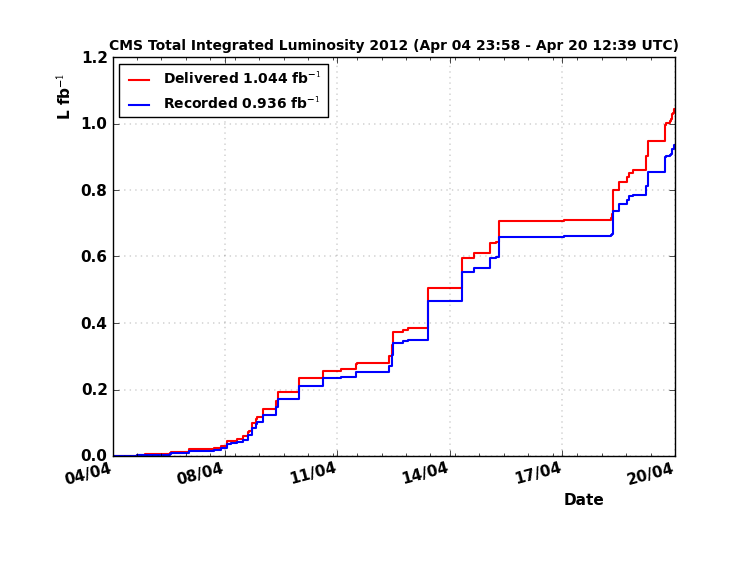
The LHC is ramping up in instantaneous luminosity according to schedules, and has just surpassed the measure of one inverse femtobarn of collisions delivered to the CMS experiment, as shown in the picture below.

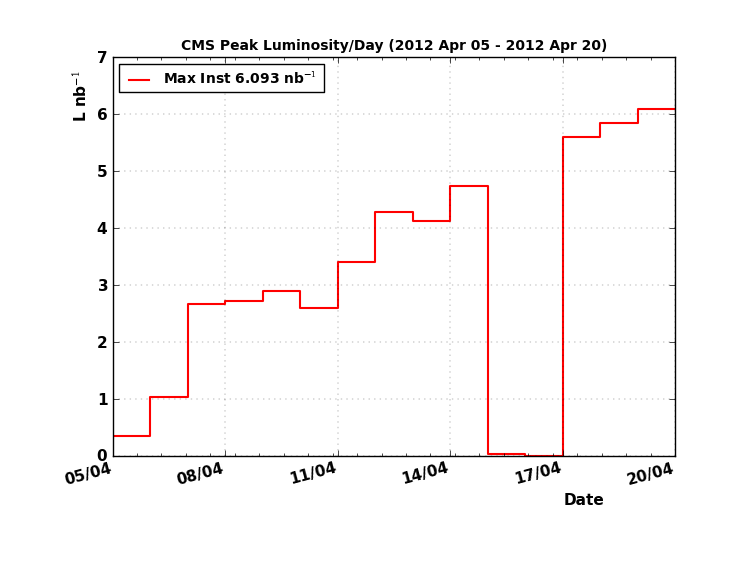
The peak instantaneous luminosity shown below exhibits a nice smooth increase:

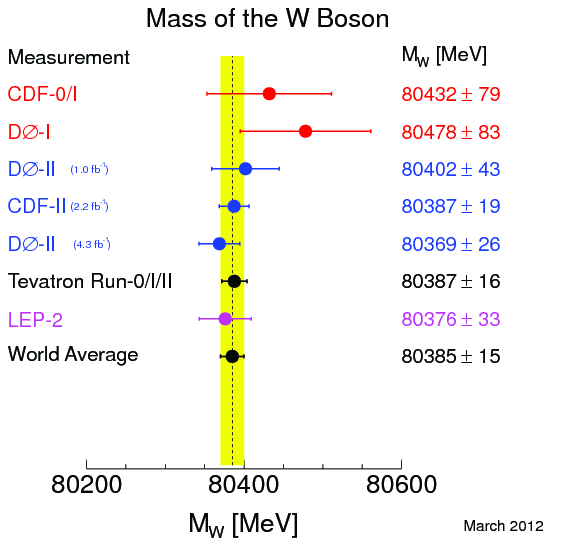
A couple of weeks ago the CDF and DZERO experiments have produced a combination of their measurements of the W boson mass. Besides two older determinations of this fundamental parameter of the Standard Model, the new 2.2/fb measurement by CDF and the 4.3/fb measurement by DZERO have been averaged together, accounting for correlated systematics. [x/fb is a shorthand for the amount of collisions from which the W boson datasets have been extracted by the experiments: 1/fb is about 80 trillion proton-antiproton collisions.]
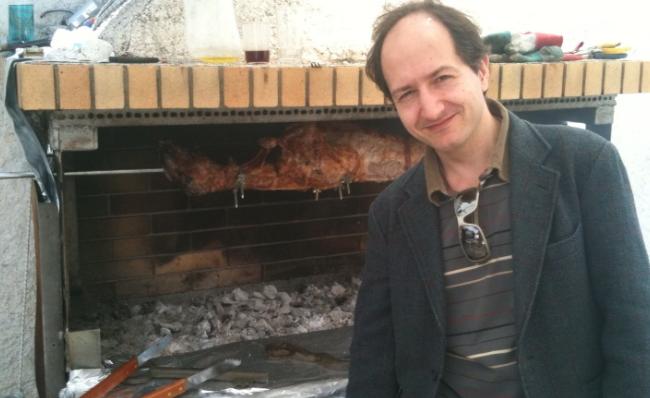
I am just back from a vacation to Greece, where last Sunday was orthodox Easter. My fiancee Kalliopi is Greek, and it was about time for me for me to experience a bit of Greek customs. So we flew to Athens, and then headed to Salamina, where I had a lot of fun the Greek way in the company of a very cheerful dozen of relatives and friends.

Among the obligatory ingredients of a Greek Easter is the roasted lamb. It is cooked all in one piece, on a huge skewer, by rolling it for hours over hot coals. Its appearance is a bit disturbing at first, that is until the smell start to turn from that of a corpse to that of delicious food.  Below you can see me in front of the thing as it was already in the good-smelling and edible-looking phase.
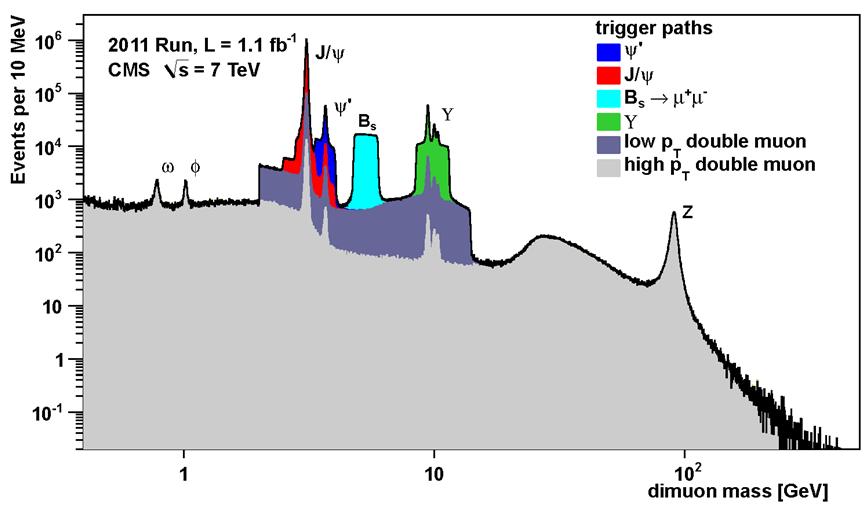
For once I allow myself some self-advertising... I just published on the Cornell arXiv the preprint of a proceedings paper I wrote for the Bormio 2012 conference on Nuclear Physics, where I presented the most recent results from the CMS experiment in a review talk. The paper is titled "Recent Results of the CMS Experiment".

The paper is 33-pages long, and thus configures as a general review of the results that CMS produced from the analysis of data collected during 2011, the 5 inverse femtobarns of proton-proton collisions, which among other things granted a first feeble but trustworthy evidence of a Higgs boson when read together with similar ATLAS results.
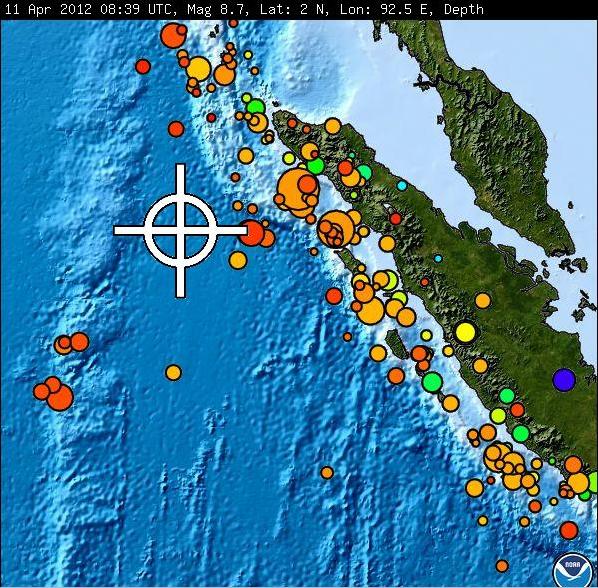
A powerful earthquake has struck an hour ago, at 8.30UT, very close to the place where a similar event occurred on December 26th 2004. The earthquake has an estimated magnitude of 8.7 and occurred at a depth of 33km, according to NOAA. The map below shows the location of the event and the potentially affected areas.


Last week the Large Hadron Collider has started producing collisions at the record high 8-TeV centre-of-mass energy to the ATLAS and CMS detectors.

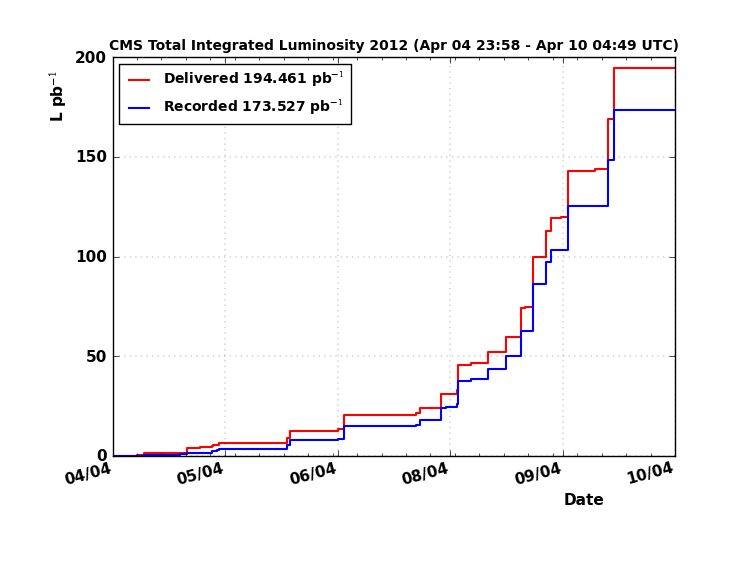
In the course of the first week of run almost 200 inverse picobarns have been delivered to CMS, which is absolutely satisfactory.

The integrated luminosity versus time is shown below.


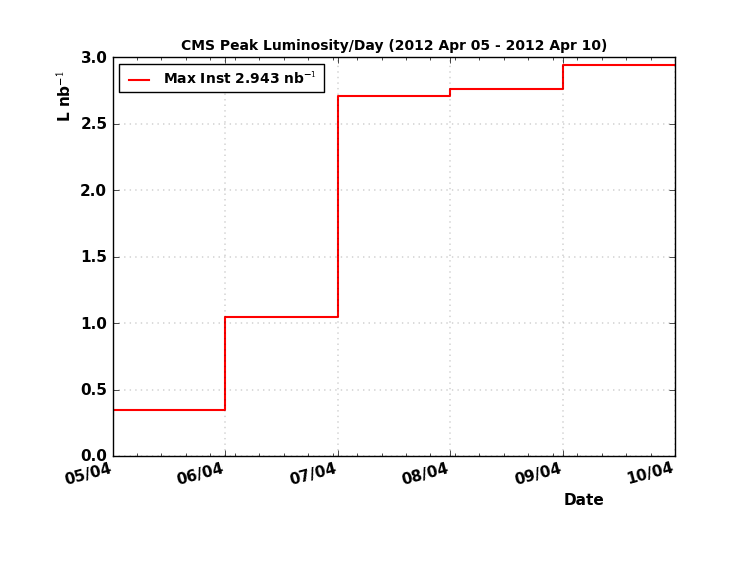
And here is the peak instantaneous luminosity reached during these first few days of running:


(NB: I believe the above figure lacks a "s^-1" units).