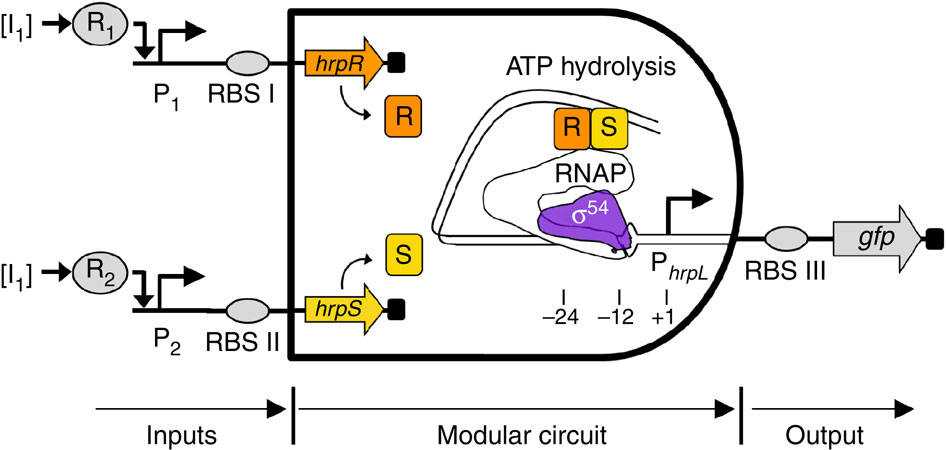



Earlier this year, a DNA computer was reported that could calculate square roots. A little later, a neural network was constructed out of ‘the stuff of life’. These advances strongly hinted at the possibility of using biochemicals in order to do computational operations. Now, a new study, published in Nature Communications, presents another step towards this goal.

Quick, which British cell phone do you use?   No?  Okay, which French microprocessor is in your PC?  No again?

America leads the world in innovation, the legacy of historical laissez-faire approaches to fixing big problems using the private sector.  Obviously that is different now, even in science, where Pres. Obama made good on his promise to add more science to his cabinet but erroneously thought all of science was composed of progressive academics who think more taxpayer spending is the only way science gets done, leading to the Solyndra boondoggle and more to follow.
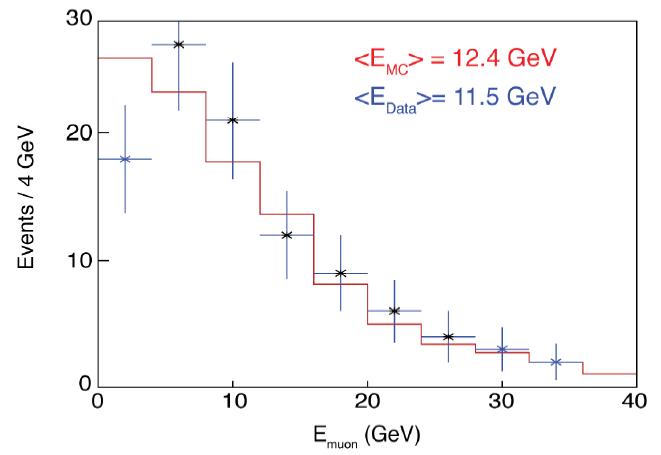
A study by ICARUS re-investigated their neutrino experiments based on the article by Cohen and Glashow, who showed that superluminal neutrinos in standard model physics lose energy through neutral-current weak-interactions, which is somewhat like Cherenkov radiation. Given a neutrino moving faster than light a given distance D through a standard background, one can compute the rate of usually expected energy lost through that radiation. The neutrinos are detected via so called ‘charged-current interactions’, which turn them into muons, 104 of which ICARUS detected.

The saga of the superluminal neutrinos took a dramatic turn today, with the publication of a very simple yet definitive study by ICARUS, another neutrino experiment at the Gran Sasso Laboratories, who has looked at the neutrinos shot from CERN since 2010.
The sixth Snarky Puzzle Answers leads off with the story of a minor controversy.

[Click or skip this video reading on YouTube.] 
Two related Snarky Puzzles
September 20, "Deriving the Maxwell Source Equations Using Quaternions (2/5)"
On October 8th, Octopus Day, I wrote about the incredibly strange Seven-arm Octopus, Haliphron atlanticus. I invoked its tremendous size, irregular arms, habitat flexibility, and peculiarly small body as proof positive of its weirdness.

But I didn't provide very satisfying pictures. 

Today I am here to fill that gap with a couple of beautiful photographs taken by Nan Hauser, director of the Cook Islands Whale Research Project. 
What does the future of science look like? 
About a year ago, I was asked this same question. My response was: Transdisciplinary collaboration. Researchers from a variety of domains—biology, philosophy, psychology, neuroscience, economics, law—all coming together, using inputs from each specialized area to generate the best comprehensive solutions to society's more persistent problems. Indeed, it appears as if I was on the right track, as more and more academic research departments, as well as industries, are seeing the value in this type of partnership. 
Networking and prompt sharing of knowledge are aspects commonly associated with the development of the Internet but intense intellectual exchange and joint work on projects over large distances happened as early as Habsburg times.

The manuscripts of Court Librarian Peter Lambeck, head of Vienna´s Hofbibliothek (Imperial Library), show he was an expert in content management and social networking. The evaluation of his life and work now traces Austria´s role in the "Republic of Letters" - the combined expertise of Europe´s intellectual elite - as early as the 17th century.
How can you test for disaster without freaking out all your co-workers?  Assume the best way to test for a disaster is to simulate it.  Now factor in that a typical co-worker, if they overhead that a chlorine tanker overturned in DC or that terrorists are storming the building, will likely freak out.  Is there a safe way to simulate an emergency?

Due to difficult economics and an aging population that needs social services, Finland is finding itself desperate for workers, but jobs cannot simply be created by giant corporations anymore and the only way to sustain the welfare state seems to be through new ventures and entrepreneurship.  Except government restrictions and regulations that discourage giant corporations hurt small businesses most, and Finns are conservative when it comes to risk anyway.


