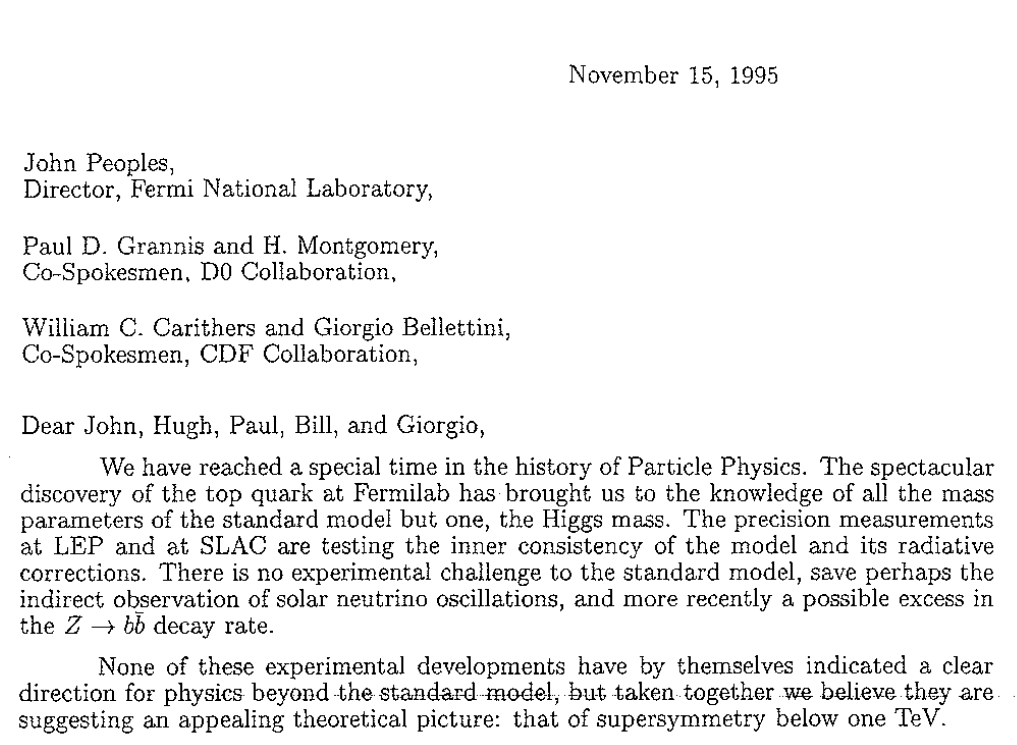



Supersymmetry (SUSY) is a possible extension of the Standard Model (SM), the currently accepted theory of subnuclear physics. SUSY has the potential to "explain away" some of the  problematic features of the SM, by introducing a new symmetry between fermions (the stuff that matter is made of) and bosons (the vectors of the forces that hold matter together). Introduced in the seventies, SUSY was tested with increasingly stringent tests in higher- and higher-energy collisions at particle accelerators, but all searches for its particles have returned empty-handed. In particular, many physicists thought that the turn-on of the Large Hadron Collider (LHC) eight years ago would result in heaps of new discoveries of SUSY particles, which unfortunately weren't. 

With the U.S. Food and Drug Administration rightly cracking down on sales of vaping devices to minors and U.S. Surgeon General Jerome Adams making a recent statement of concern, media are again repeating claims of an epidemic of vaping among children.

Our job at The Conversation is to work with scholars to publish analysis that helps readers make sense of the world. And if we demolish a few popularly held – but erroneous or misplaced – ideas and assumptions in the process, that makes me especially happy.

Hence my list, here, of stories from 2018 that use facts to interrogate popular wisdom – and the ideas they proved wrong:

Few Christmas carols evoke the season of peace and goodwill as readily as Silent Night. Two popular stories contribute to its appeal: one concerning the circumstances of its composition in Oberndorf, near Salzburg in Austria, and the other its role in the Christmas Truce of 1914 when the opposing forces walked out of their trenches to greet their enemies and share food and drink.

But its lyrical and musical content are also important factors in understanding its enduring popularity, and Christmas Eve 2018 marks the 200th anniversary of its performance.

As the West becomes more and more secular, and the discoveries of evolutionary biology and cosmology shrink the boundaries of faith, the claims that science and religion are compatible grow louder. If you’re a believer who doesn’t want to seem anti-science, what can you do? You must argue that your faith – or any faith – is perfectly compatible with science.

Let’s be honest – environment news isn’t always the jolliest, and 2018 was no exception. From climate change, to recycling, to energy policy, at times it has felt like we’ve been lurching from one crisis to the next.

So here are ten upbeat environmental stories from this year that prove it’s not all doom and gloom.

Researchers have studied the effectiveness of new antimicrobial systems based on the use of essential oils extracted from plants such as thyme or cinnamon to improve the preservation of foods and found them suitable - with no smell or taste.

As the developed world becomes wealthier, people are more demanding about the processes used in the foods they eat, even if it means contradictions. Some distrust the science that goes into preservation, like additives. while insisting they are concerned about rampant food waste - which is most often spoilage.

Wind turbines are a leading source of green energy which could supply 12% of the world’s energy by 2020. But their use is often criticised for its impact on wildlife, particularly birds. Larger birds can collide with turbines and some have even learned to avoid flying near them.

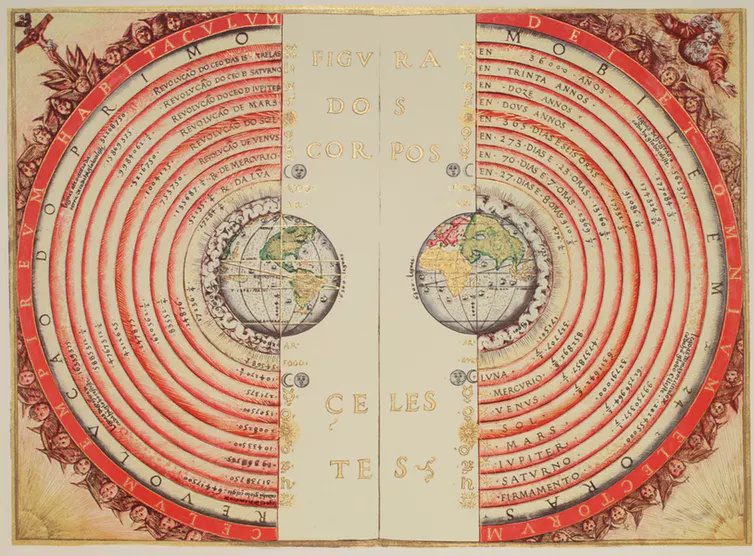
Half a century of Christmases ago, the NASA space mission Apollo 8 became the first manned craft to leave low Earth orbit, atop the unprecedentedly powerful Saturn V rocket, and head out to circumnavigate another celestial body, making 11 orbits of the moon before its return. The mission is often cast in a supporting role – a sort of warm up for the first moon landing. Yet for me, the voyage of Borman, Lovell and Anders six months before Neil Armstrong’s “small step for a man” will always be the great leap for humankind.

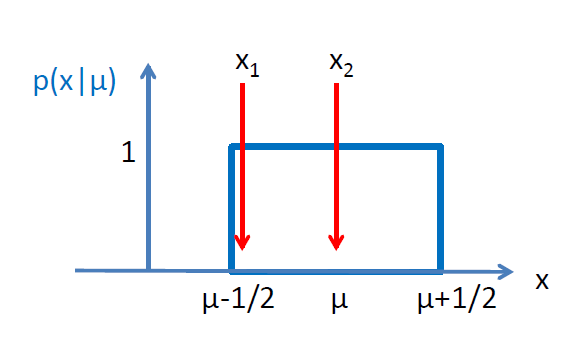
I don't remember who said it, but there's a quote I like a lot: "If you torture them long enough, the data will confess to anything". What the author meant is of course that the manipulation of experimental data and the a posteriori use of hand-picked methods, approximations, and other ad-hoc choices allows you to demonstrate anything with them, from one hypothesis to the opposite one. Statistics, in other words, is a subtle science, which must be handled with care. It is a powerful tool in the hands of people with an agenda.


