







Bamboo can also be a tasty snack. Credit: Chris Ison/PA

By Dirk Hebel, Swiss Federal Institute of Technology Zurich

Bamboo, a common grass which can be harder to pull apart than steel, has the potential to revolutionize building construction throughout the world. But that’s not all. As a raw material found predominantly in the developing world, without a pre-existing industrial infrastructure built to skew things towards the rich world, bamboo has the potential to completely shift international economic relations.

It's the home stretch of the professional baseball season and that means players are more likely to be tired or sustain an injury. New research suggests that a stronger core might help.

In the study, 347 pitchers were assessed for lumbopelvic control during spring training. Pitchers with more tilt in their pelvis as they raised a leg to step up were up to three times more likely to miss at least 30 days – cumulative, not consecutive – during the season than were pitchers who showed minimal tilt in their pelvis.  They found that professional baseball pitchers with poor core stability are more likely to miss 30 or more days in a single season because of injury than are pitchers who have good control of muscles in their lower back and pelvis. 

Human breast milk is nutrition for infants but it also contains a large number of bacterial species, including some opportunistic pathogens of humans. 


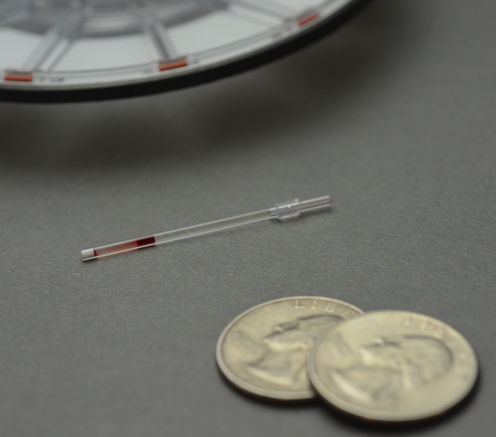
A simple solution to a persistent problem. Credit: Ashok A. Kumar

By Ashok A. Kumar, Harvard University

Every year, 300,000 children are born with sickle-cell disease, primarily in Africa and India.

It is a genetic disorder that causes some blood cells to become abnormally shaped. The result is that those who suffer from it have a shorter lifespan.

 Reperfusion injury prevention isn't possible just yet. The administration of an experimental agent known as TRO40303 to patients who have had a heart attack, with the hope of preventing tissue damage when impaired blood flow is corrected (reperfusion), was disappointingly ineffective, according to results of a European study of patients with acute ST-elevation myocardial infarction (STEMI) presented today at ESC Congress 2014 and published in the European Heart Journal.

Why would anyone bake bread and then turn around and toast it?

I lived in a Pennsylvania house heated by wood. The idea of using our manual labor, in the form of wood, to toast bread was silly - but we owned an electric toaster. Somehow, being removed from the direct labor equation made toasting more acceptable, though our ancestors thought it a pastime for the idle rich.

Given the recent events in Ferguson, Missouri and the highly charged claims of racism, it is no surprise that a Washington State University study of deadly force found that there is bias when it comes to skin color and being willing to pull a gun trigger on someone.

What is a surprise is that whites and Hispanic were more likely to be shot than black people.

A strain of E. coli that is a common cause of outbreaks of food poisoning in the United States has had its genome sequenced. E. coli strain EDL933 was first isolated in the 1980s but gained national attention in 1993 when it was linked to an outbreak of food poisoning from Jack-in-the-Box restaurants in the western United States.


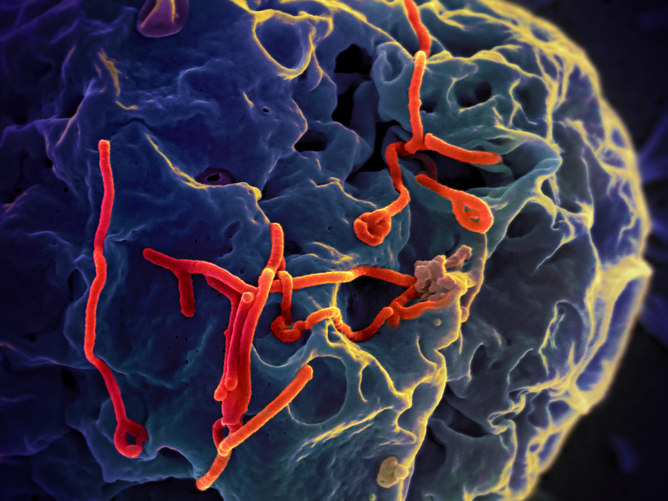
Scanning electron micrograph of Ebola virus budding from the surface of a Vero cell (African green monkey kidney epithelial cell line. Credit:NIAID

By Rob Brooks


My social media accounts today are cluttered with stories about “mutating” Ebola viruses. The usually excellent ScienceAlert, for example, rather breathlessly informs us “The Ebola virus is mutating faster in humans than in animal hosts.”

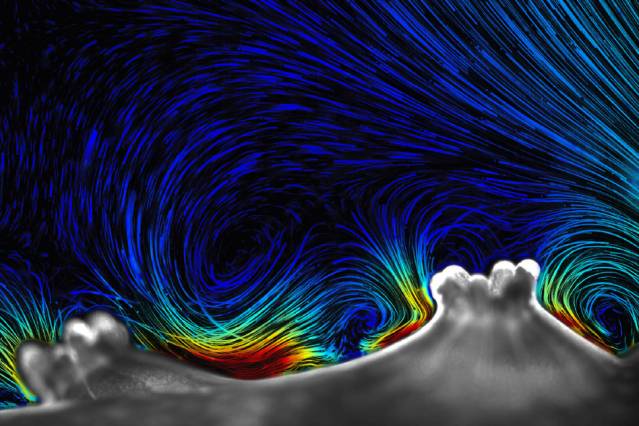
Corals, whose calcium-carbonate skeletons form the foundation of coral reefs, are passive organisms that rely entirely on ocean currents to deliver dissolved substances, such as nutrients and oxygen.

Or so it seemed. Scientists at MIT and the Weizmann Institute of Science (WIS) in Israel have found that they are far from passive, engineering their environment to sweep water into turbulent patterns that greatly enhance their ability to exchange nutrients and dissolved gases with their environment.

